Charles P Darby Children's Research Institute, Medical University of South Carolina, Charleston, SC 29425, USA.
Oncogene. 2013 Jan 3;32(1):97-105. doi: 10.1038/onc.2012.24. Epub 2012 Feb 13.
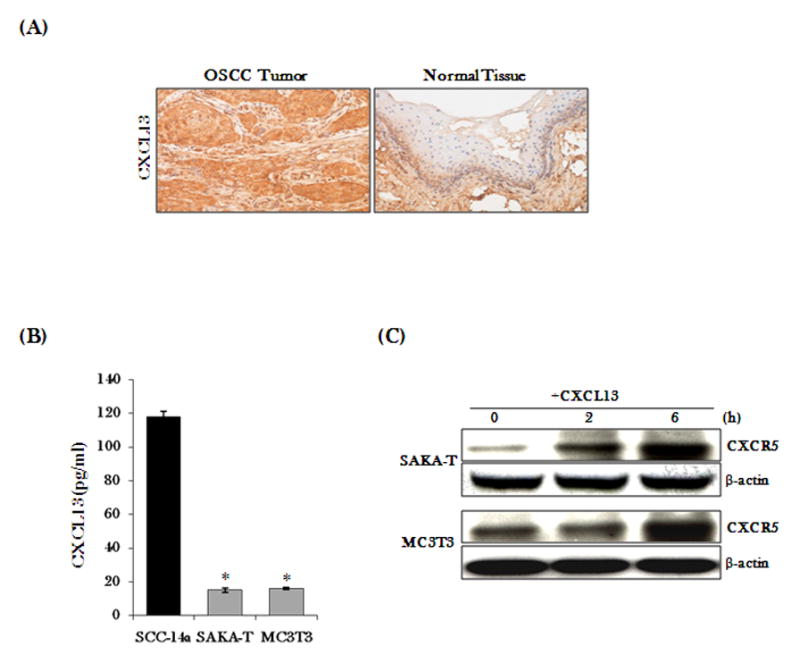
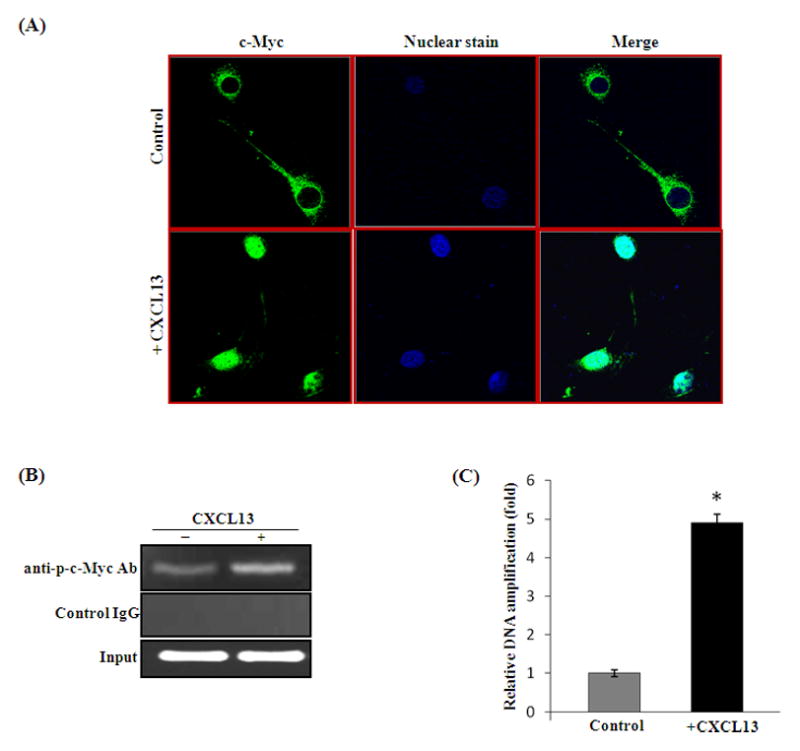
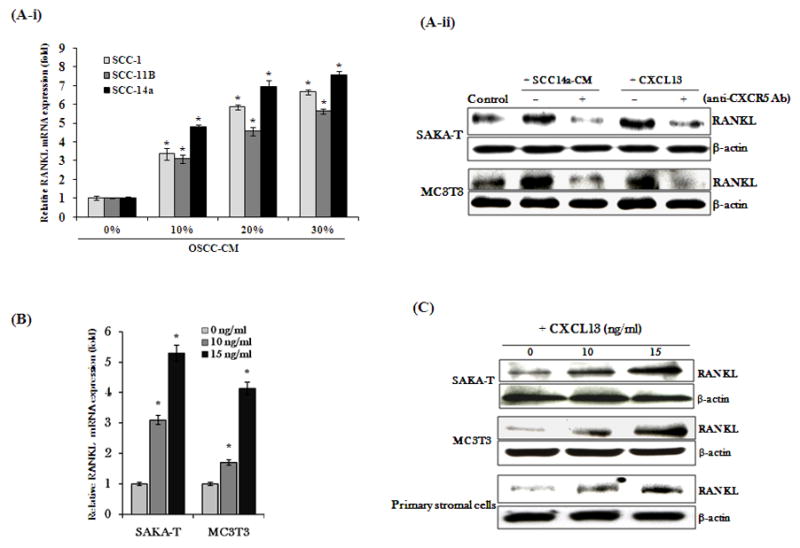
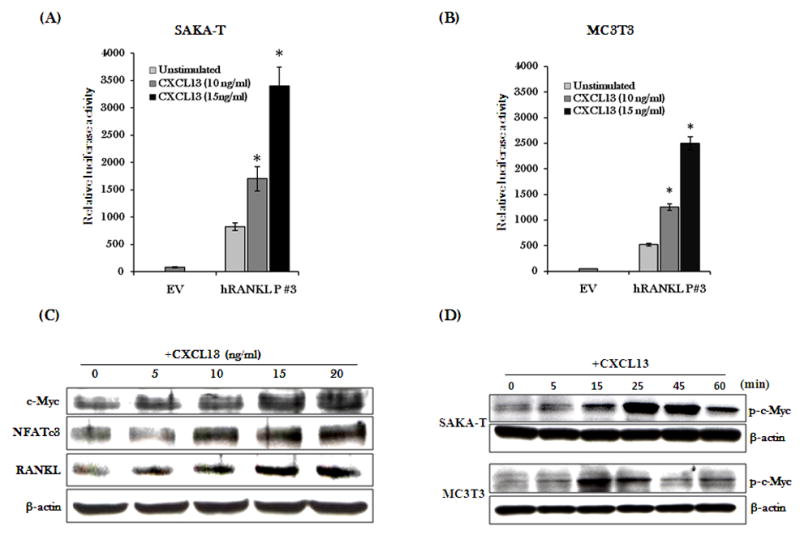
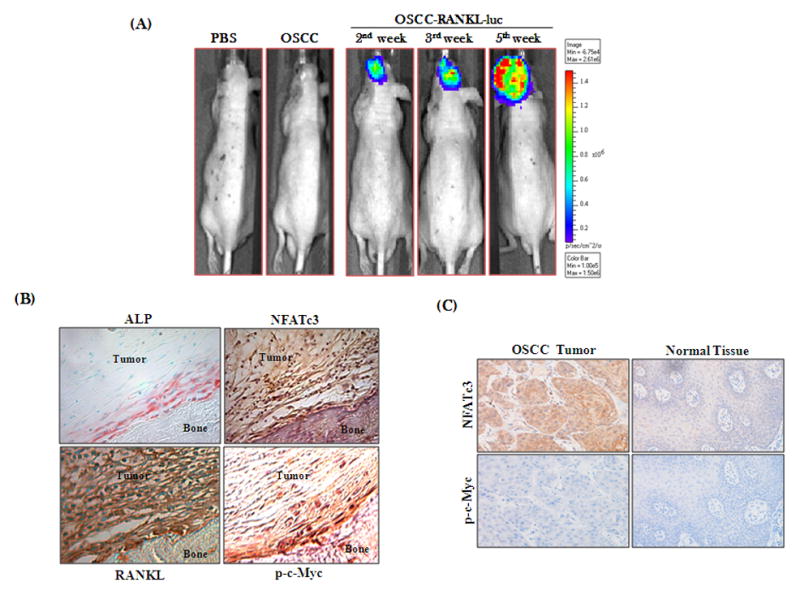
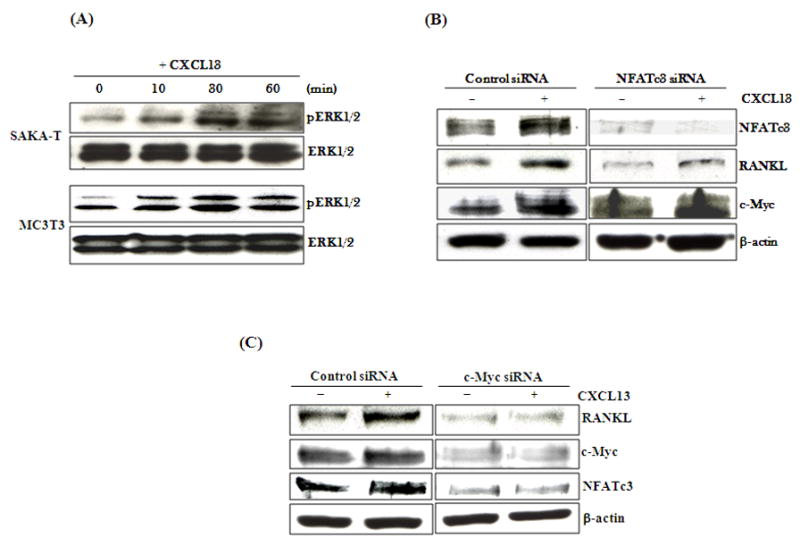
CXC chemokine ligand-13 (CXCL13) has been implicated in oral squamous cell carcinoma (OSCC) tumor progression and osteolysis. The tumor necrosis factor family member RANKL (receptor activator of NF-κB ligand), a critical bone resorbing osteoclastogenic factor, has an important role in cancer invasion of bone/osteolysis. Here, we show high-level expression of CXCL13 in primary human OSCC tumor specimens; however, human bone marrow-derived stromal (SAKA-T) and murine preosteoblast (MC3T3-E1) cells produce at very low level. Recombinant CXCL13 (0-15 ng/ml) dose dependently induced CXCR5 expression in SAKA-T and MC3T3-E1 cells. Conditioned media obtained from OSCC cell lines increased the RANKL expression and an antibody against the CXCL13 specific receptor, CXCR5 markedly decreased RANKL expression in these cells. Furthermore, CXCL13 increased hRANKL-Luc promoter activity. Superarray screening identified c-Myc and NFATc3 transcription factors upregulated in CXCL13-stimulated SAKA-T cells. Immunohistochemical analysis of OSCC tumors that developed in athymic mice demonstrated RANKL and NFATc3 expression in tumor and osteoblast cells, however, showed p-c-Myc expression specific to osteoblastic cells at the tumor-bone interface. We further identified NFATc3 expression, but not c-Myc activation in primary human OSCC tumor specimens compared with adjacent normal tissue. Also, CXCL13 significantly increased p-ERK1/2 in SAKA-T and MC3T3-E1 cells. siRNA suppression of c-Myc expression markedly decreased CXCL13-induced RANKL and NFATc3 expression in preosteoblast cells. Chromatin-immuno precipitation assay confirmed p-c-Myc binding to the hRANKL promoter region. In summary, c-Myc activation through CXCL13-CXCR5 signaling axis stimulates RANKL expression in stromal/preosteoblast cells. Thus, our results implicate CXCL13 as a potential therapeutic target to prevent OSCC invasion of bone/osteolysis.
CXC 趋化因子配体 13(CXCL13)已被牵涉到口腔鳞状细胞癌(OSCC)肿瘤进展和溶骨性病变中。肿瘤坏死因子家族成员 RANKL(核因子-κB 配体受体激活剂),一种关键的破骨细胞生成的骨吸收因子,在癌症侵袭骨骼/溶骨性病变中起着重要作用。在这里,我们显示 CXCL13 在原发性人类 OSCC 肿瘤标本中高表达;然而,人类骨髓基质(SAKA-T)和鼠前成骨细胞(MC3T3-E1)细胞则低水平表达。重组 CXCL13(0-15ng/ml)剂量依赖性地诱导 SAKA-T 和 MC3T3-E1 细胞中 CXCR5 的表达。从 OSCC 细胞系获得的条件培养基增加了 RANKL 的表达,而针对 CXCL13 特异性受体 CXCR5 的抗体则显著降低了这些细胞中的 RANKL 表达。此外,CXCL13 增加了 hRANKL-Luc 启动子活性。Superarray 筛选鉴定出在 CXCL13 刺激的 SAKA-T 细胞中上调的 c-Myc 和 NFATc3 转录因子。在裸鼠中形成的 OSCC 肿瘤的免疫组织化学分析显示,肿瘤和成骨细胞中表达 RANKL 和 NFATc3,但在肿瘤-骨界面处仅在成骨细胞中显示 p-c-Myc 表达。我们进一步鉴定出与相邻正常组织相比,在原发性人类 OSCC 肿瘤标本中表达 NFATc3,但未激活 c-Myc。此外,CXCL13 显著增加了 SAKA-T 和 MC3T3-E1 细胞中 p-ERK1/2 的表达。siRNA 抑制 c-Myc 表达显著降低了前成骨细胞中 CXCL13 诱导的 RANKL 和 NFATc3 表达。染色质免疫沉淀测定证实了 p-c-Myc 结合到 hRANKL 启动子区域。总之,通过 CXCL13-CXCR5 信号轴激活 c-Myc 会刺激基质/前成骨细胞中 RANKL 的表达。因此,我们的结果表明 CXCL13 是预防 OSCC 侵袭骨骼/溶骨性病变的潜在治疗靶点。