Katagiri Hiroyuki, Pallotto Marta, Nissant Antoine, Murray Kerren, Sassoè-Pognetto Marco, Lledo Pierre-Marie
Laboratory for Perception and Memory, Institut Pasteur, Paris, France.
Neural Syst Circuits. 2011 Feb 1;1(1):6. doi: 10.1186/2042-1001-1-6.
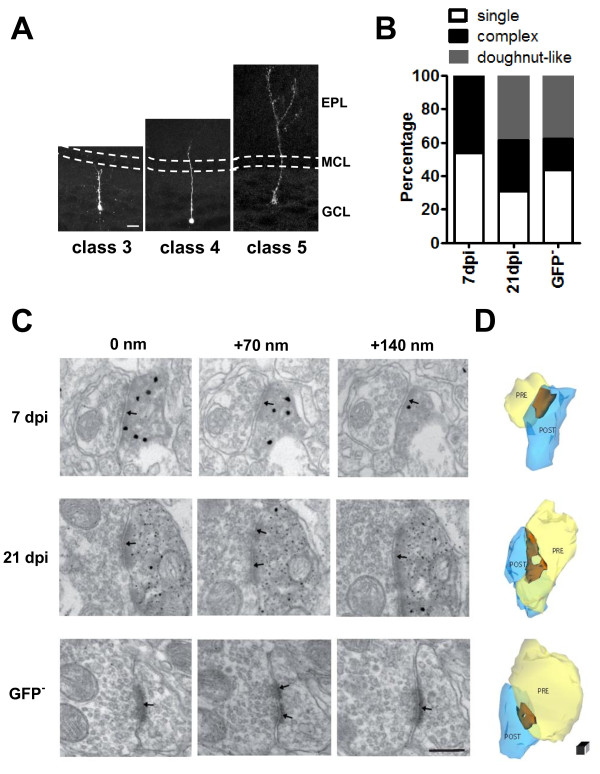
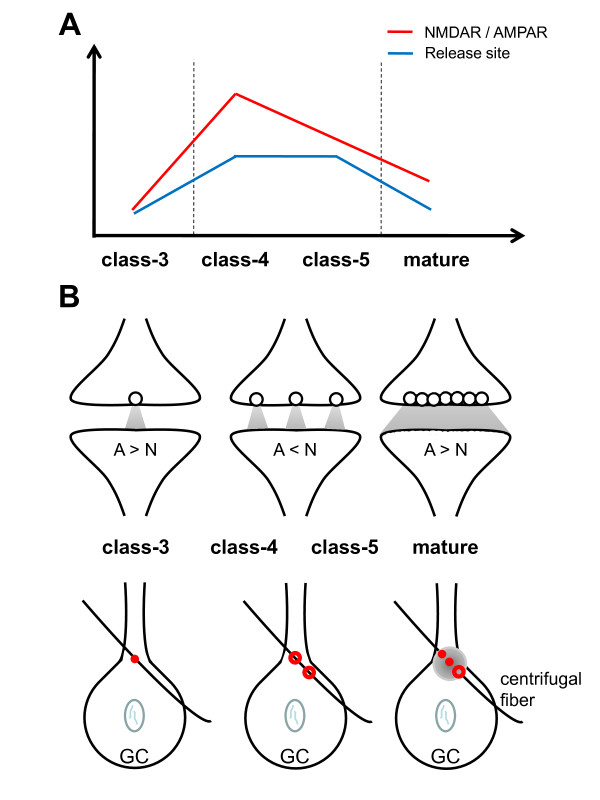
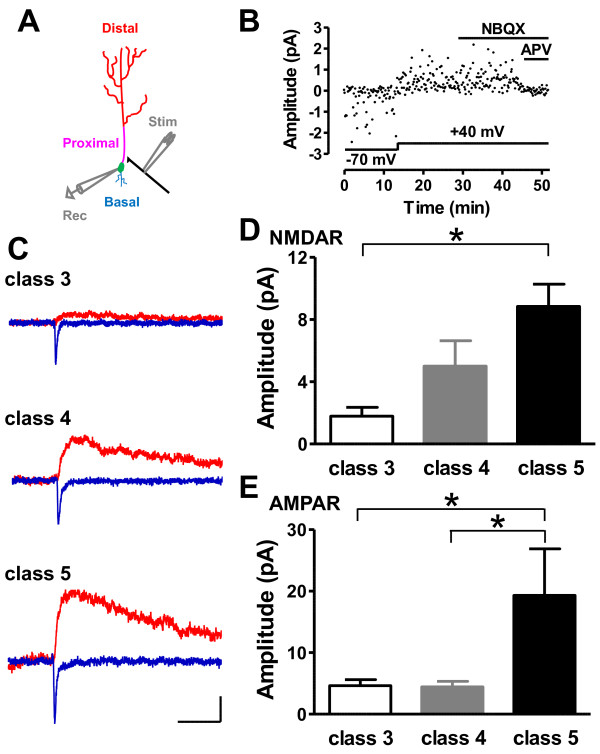
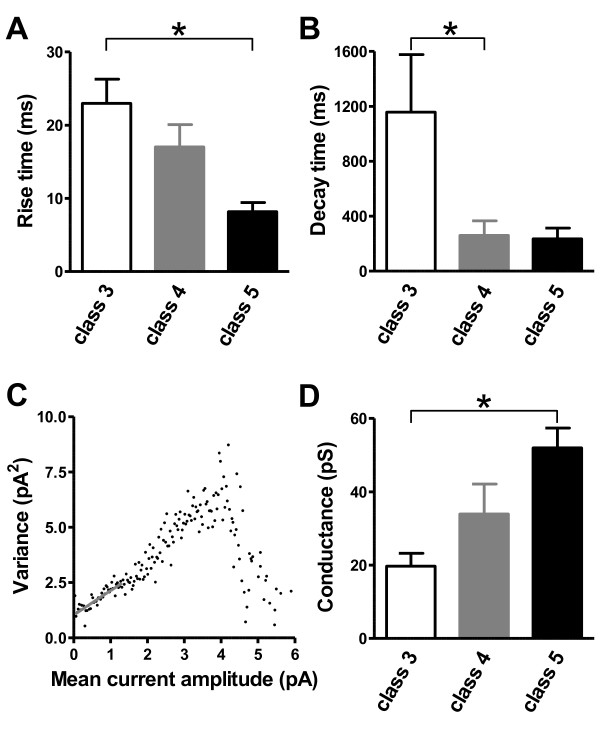
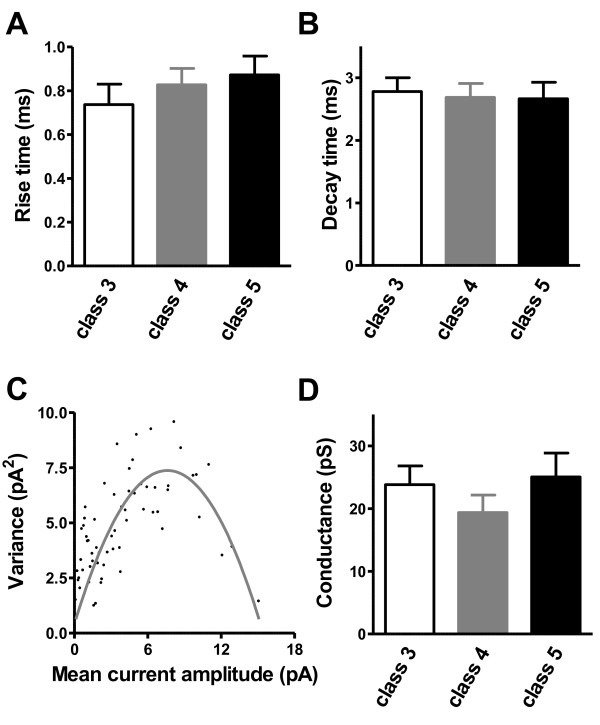
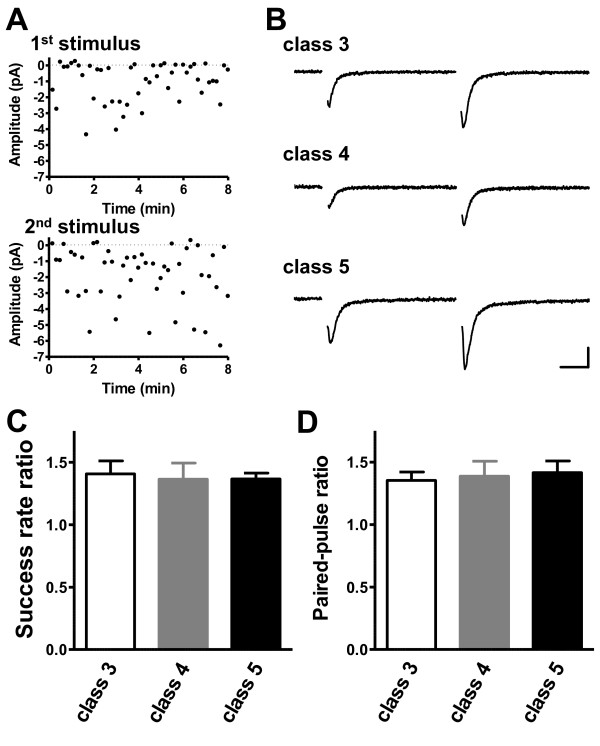
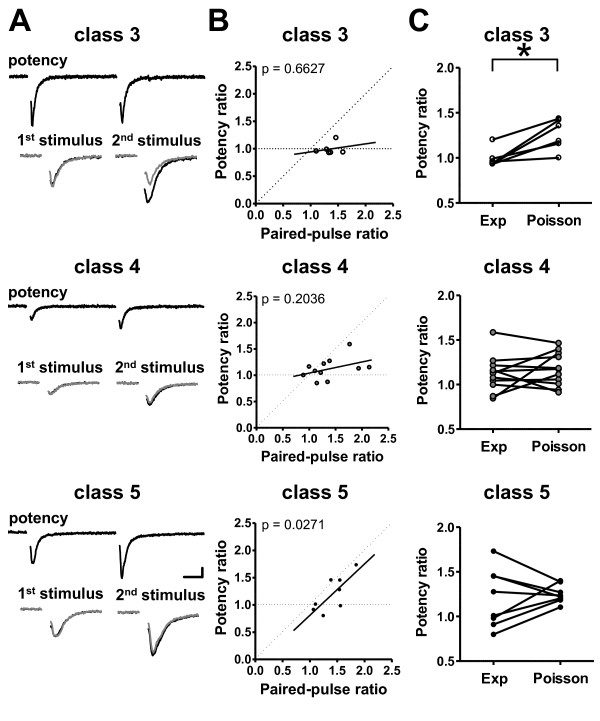
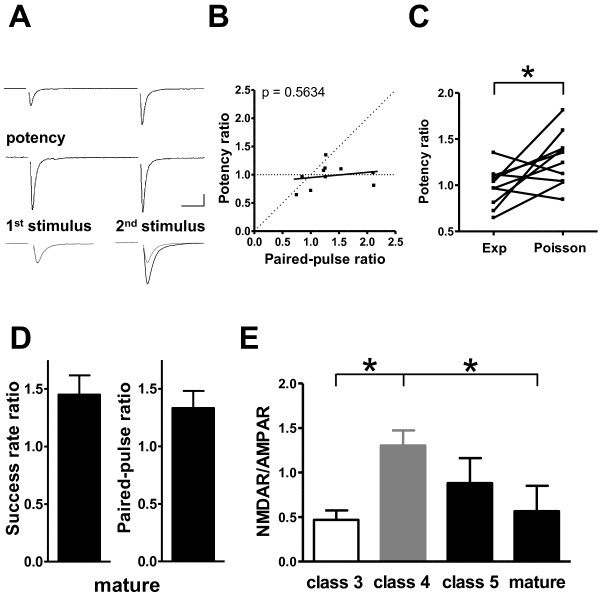
The olfactory bulb (OB) receives and integrates newborn interneurons throughout life. This process is important for the proper functioning of the OB circuit and consequently, for the sense of smell. Although we know how these new interneurons are produced, the way in which they integrate into the pre-existing ongoing circuits remains poorly documented. Bearing in mind that glutamatergic inputs onto local OB interneurons are crucial for adjusting the level of bulbar inhibition, it is important to characterize when and how these inputs from excitatory synapses develop on newborn OB interneurons. We studied early synaptic events that lead to the formation and maturation of the first glutamatergic synapses on adult-born granule cells (GCs), the most abundant subtype of OB interneuron. Patch-clamp recordings and electron microscopy (EM) analysis were performed on adult-born interneurons shortly after their arrival in the adult OB circuits. We found that both the ratio of N-methyl-D-aspartate receptor (NMDAR) to α-amino-3-hydroxy-5-methyl-4-isoxazolepropionic acid receptor (AMPAR), and the number of functional release sites at proximal inputs reached a maximum during the critical period for the sensory-dependent survival of newborn cells, well before the completion of dendritic arborization. EM analysis showed an accompanying change in postsynaptic density shape during the same period of time. Interestingly, the latter morphological changes disappeared in more mature newly-formed neurons, when the NMDAR to AMPAR ratio had decreased and functional presynaptic terminals expressed only single release sites. Together, these findings show that the first glutamatergic inputs to adult-generated OB interneurons undergo a unique sequence of maturation stages.
嗅球(OB)在整个生命过程中接收并整合新生的中间神经元。这一过程对于OB回路的正常运作至关重要,进而对于嗅觉也很重要。尽管我们知道这些新的中间神经元是如何产生的,但它们如何整合到已有的正在进行的回路中的方式仍鲜有文献记载。考虑到谷氨酸能输入到局部OB中间神经元对于调节球状体抑制水平至关重要,表征这些来自兴奋性突触的输入在新生OB中间神经元上何时以及如何发育就很重要。我们研究了导致成年新生颗粒细胞(GCs)上第一个谷氨酸能突触形成和成熟的早期突触事件,GCs是OB中间神经元中最丰富的亚型。在成年新生中间神经元到达成年OB回路后不久,对其进行了膜片钳记录和电子显微镜(EM)分析。我们发现,在新生细胞依赖感觉的存活关键期内,N-甲基-D-天冬氨酸受体(NMDAR)与α-氨基-3-羟基-5-甲基-4-异恶唑丙酸受体(AMPAR)的比例以及近端输入处功能性释放位点的数量均达到最大值,这远在树突分支完成之前。EM分析显示在同一时间段内突触后致密物形状伴随发生变化。有趣的是,当NMDAR与AMPAR的比例下降且功能性突触前终末仅表达单个释放位点时,在更成熟的新形成神经元中,后者的形态学变化消失了。总之,这些发现表明,对成年产生的OB中间神经元的首批谷氨酸能输入经历了独特的成熟阶段序列。