Department of Chemistry, University of California Irvine, 1102 Natural Sciences II, Irvine, CA 92697-2025, USA.
Dalton Trans. 2012 Apr 21;41(15):4358-64. doi: 10.1039/c2dt12244h. Epub 2012 Feb 15.
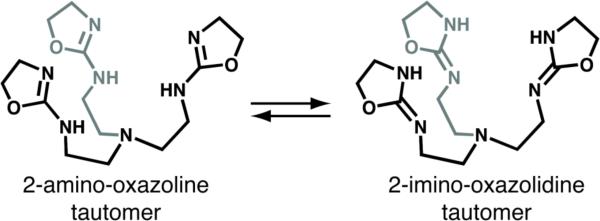
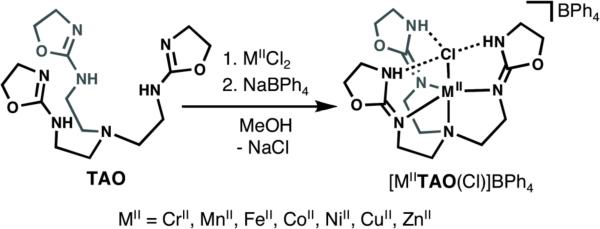
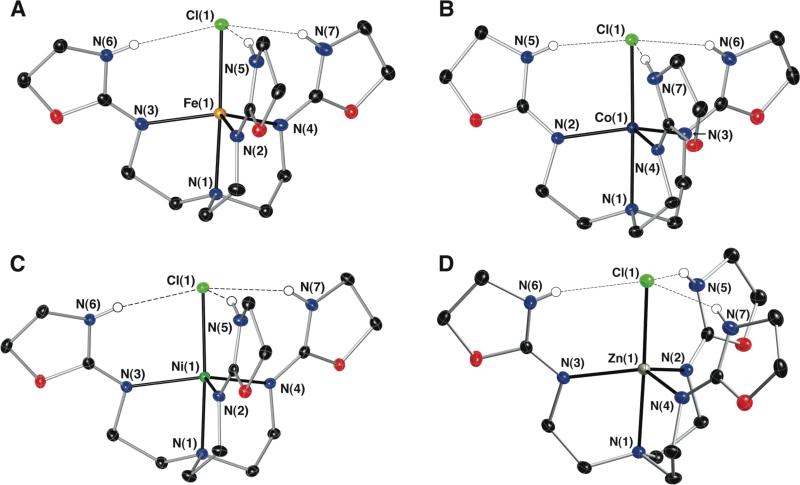
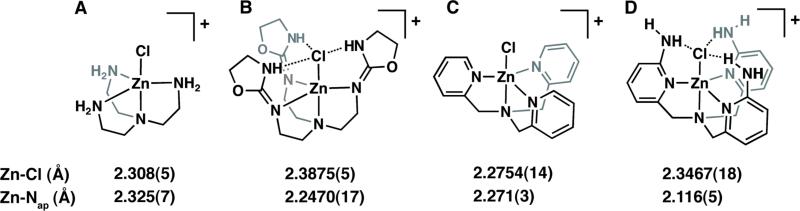
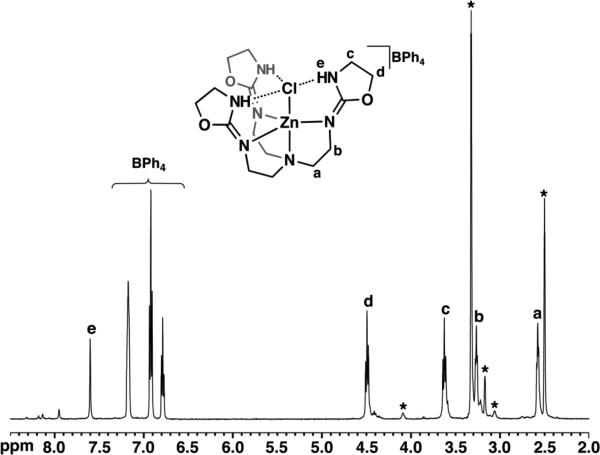
A series of transition metal chloro complexes with the tetradentate tripodal tris(2-amino-oxazoline)amine ligand (TAO) have been synthesized and characterized. X-Ray structural analyses of these compounds demonstrate the formation of the mononuclear complexes M(II)(TAO)(Cl), where M(II) = Cr, Mn, Fe, Co, Ni, Cu and Zn. These complexes exhibit distorted trigonal-bipyramidal geometry, coordinating the metal through an apical tertiary amine, three equatorial imino nitrogen atoms, and an axial chloride anion. All the complexes possess an intramolecular hydrogen-bonding (H-bonding) network within the cavity occupied by the metal-bound chloride ion. The metal-chloride bond distances are atypically long, which is attributed to the effects of the H-bonding network. Nuclear magnetic resonance (NMR) spectroscopy of the Zn complex suggests that the solid-state structures are representative of that observed in solution, and that the H-bonding interactions persist as well. Additionally, density functional theory (DFT) calculations were carried out to probe the electronic structures of the complexes.
一系列具有四齿三脚架三(2-氨基恶唑啉)胺配体(TAO)的过渡金属氯配合物已被合成并进行了表征。这些化合物的 X 射线结构分析表明形成单核配合物[M(II)(TAO)(Cl)](+),其中 M(II)= Cr、Mn、Fe、Co、Ni、Cu 和 Zn。这些配合物具有扭曲的三角双锥几何形状,通过一个顶端叔胺、三个赤道亚氨基氮原子和一个轴向氯离子来配位金属。所有配合物在由金属结合的氯离子占据的空腔内都具有分子内氢键(H 键)网络。金属-氯键的距离异常长,这归因于氢键网络的影响。Zn 配合物的核磁共振(NMR)光谱表明,固态结构代表了在溶液中观察到的结构,并且氢键相互作用也持续存在。此外,还进行了密度泛函理论(DFT)计算以探究配合物的电子结构。