Centre for International Mental Health, Melbourne School of Population Health, University of Melbourne, Australia.
Harv Rev Psychiatry. 2012 Jan-Feb;20(1):37-46. doi: 10.3109/10673229.2012.649090.
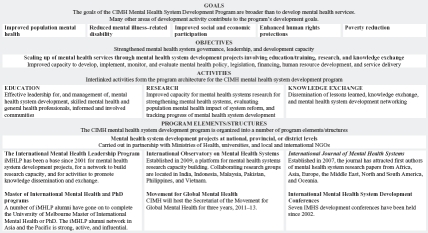
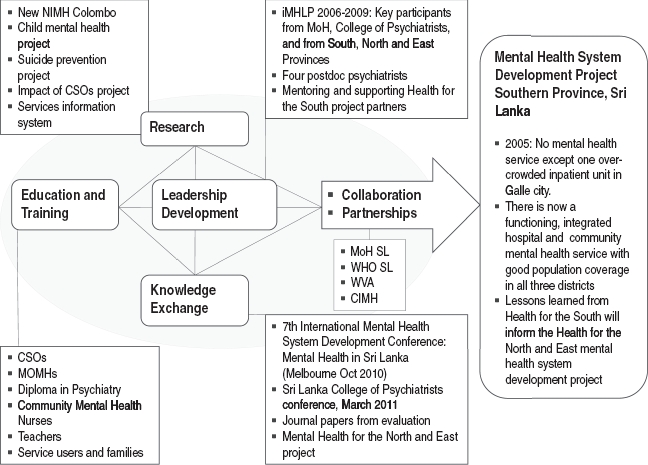
Although mental disorders are a major public health problem, the development of mental health services has been a low priority everywhere, particularly in low- and middle-income countries. Recent years have seen a growing understanding of the importance of population mental health and increased attention to the need to develop mental health systems for responding to population mental health service needs. In countries and regions where mental health services are all but nonexistent, and in postconflict and postdisaster settings, there are many impediments to establishing or scaling up mental health services. It is frequently necessary to act simultaneously on multiple fronts: generating local evidence that will inform decision makers; developing a policy framework; securing investment; determining the most appropriate service model for the context; training and supporting mental health workers; establishing or expanding existing services; putting in place systems for monitoring and evaluation; and strengthening leadership and governance capabilities. This article presents the approach of the Centre for International Mental Health in the Melbourne School of Population Health to mental health system development, and illustrates the way in which the elements of the program are integrated by giving a brief case example from Sri Lanka.
尽管精神障碍是一个主要的公共卫生问题,但精神卫生服务的发展在任何地方都是一个低优先级事项,特别是在中低收入国家。近年来,人们越来越认识到人口精神卫生的重要性,并更加关注需要发展精神卫生系统以满足人口精神卫生服务需求。在精神卫生服务几乎不存在的国家和地区,以及在冲突后和灾后环境中,建立或扩大精神卫生服务存在许多障碍。通常需要同时在多个方面采取行动:生成将为决策者提供信息的本地证据;制定政策框架;确保投资;确定最适合背景的服务模式;培训和支持精神卫生工作者;建立或扩大现有服务;建立监测和评估系统;以及加强领导和治理能力。本文介绍了墨尔本人口健康学院国际精神卫生中心在精神卫生系统发展方面的方法,并通过来自斯里兰卡的简要案例说明说明了该方案各要素的整合方式。