Verma Rajesh, Sharma Pawan, Garg Ravindra Kumar, Atam Veerendra, Singh Maneesh Kumar, Mehrotra Hardeep Singh
Department of Neurology, Chhatrapati Sahuji Maharaj Medical University, Lucknow, Uttar Pradesh, India.
Ann Indian Acad Neurol. 2011 Oct;14(4):272-8. doi: 10.4103/0972-2327.91946.
Dengue, an acute viral disease transmitted by Aedes mosquitoes, is highly endemic in many tropical and subtropical areas of the world. Neurological complications of dengue infection have been observed more frequently in the recent past and some studies highlighted varied neurological complications arising in the course of dengue illness. In this retrospective study, we report various neurological complications observed during the last 2 years in patients of dengue fever.
The patients presenting with neurological complications with positive serology (IgM antibody) for dengue infection were consecutively recruited from the Department of Neurology/Medicine from a tertiary center of Lucknow, India. These patients were subjected to a detailed clinical evaluation, laboratory assessment including blood count, hematocrit, coagulation parameters, biochemical assays, serology for dengue fever, enzyme-linked immunosorbent assay for human immunodeficiency virus and other relevant investigations.
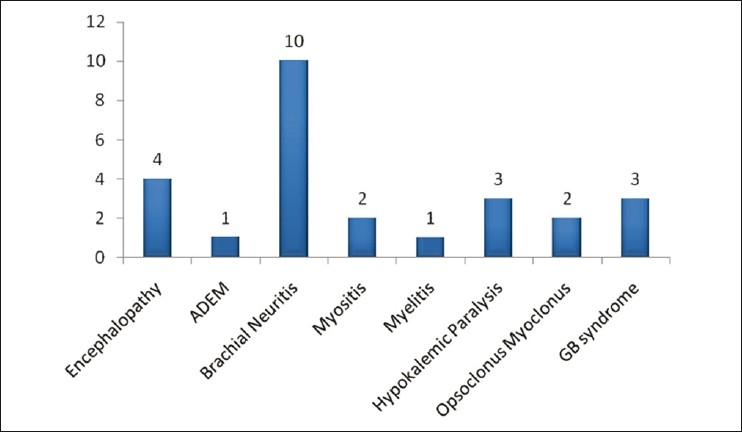
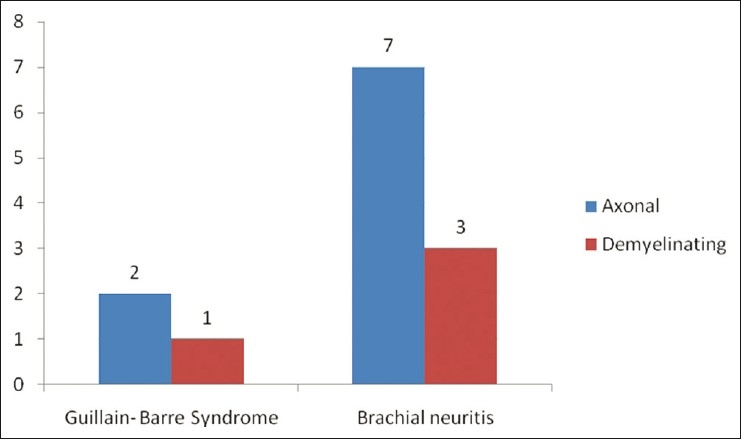
Twenty-six patients with neurological complications associated with confirmed dengue infection were observed during the last 2 years. Eighteen of these patients were male. Of the 26 patients, 10 patients were suffering from brachial neuritis, four patients had encephalopathy, three patients were consistent with the diagnosis of Guillain Barre syndrome, three patients had hypokalemic paralysis associated with dengue fever and two patients had acute viral myositis. Opsoclonus-myoclonus syndrome was diagnosed in two patients, myelitis in one patient and acute disseminated encephalo-myelitis also in one patient.
Dengue fever was associated with widespread neurological complications. Brachial neuritis and opsoclonus-myoclonus syndrome were observed for the first time in this study.
登革热是一种由伊蚊传播的急性病毒性疾病,在世界许多热带和亚热带地区高度流行。近年来,登革热感染的神经并发症观察得更为频繁,一些研究强调了登革热病程中出现的各种神经并发症。在这项回顾性研究中,我们报告了过去两年登革热患者中观察到的各种神经并发症。
从印度勒克瑙一家三级中心的神经内科/内科连续招募血清学(IgM抗体)检测为登革热感染阳性且伴有神经并发症的患者。这些患者接受了详细的临床评估、实验室检查,包括血细胞计数、血细胞比容、凝血参数、生化检测、登革热血清学检测、人类免疫缺陷病毒酶联免疫吸附测定及其他相关检查。
在过去两年中,观察到26例确诊为登革热感染且伴有神经并发症的患者。其中18例为男性。在这26例患者中,10例患有臂丛神经炎,4例患有脑病,3例符合吉兰 - 巴雷综合征诊断,3例患有与登革热相关的低钾性麻痹,2例患有急性病毒性肌炎。2例患者被诊断为眼阵挛 - 肌阵挛综合征,1例患有脊髓炎,1例患有急性播散性脑脊髓炎。
登革热与广泛的神经并发症有关。本研究首次观察到臂丛神经炎和眼阵挛 - 肌阵挛综合征。