Research Institution of Methane and Safety Monitoring Technology, China University of Mining and Technology, China.
Sensors (Basel). 2011;11(1):19-31. doi: 10.3390/s110100019. Epub 2010 Dec 23.
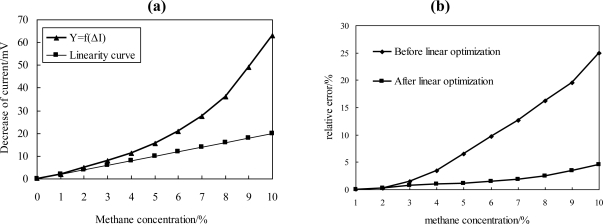
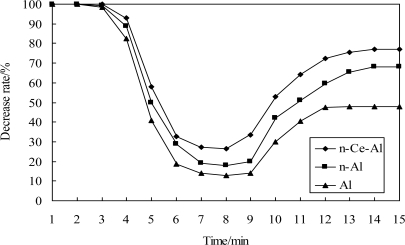
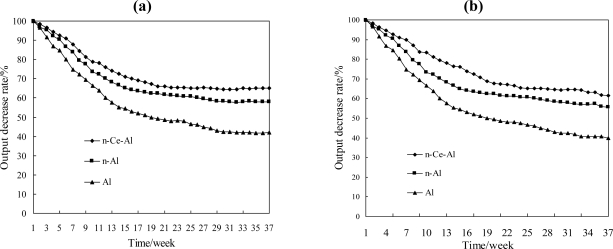
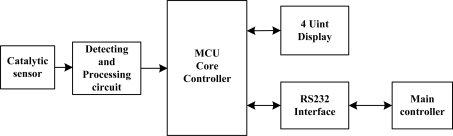
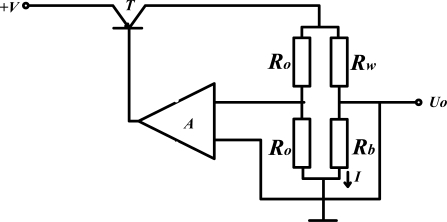
Conventional methane gas sensors based on catalytic combustion have the drawbacks of high working temperature, low thermal stability and small measurement range. To improve their performance, cerium, which possesses high oxygen storage and release ability, was introduced via nanotechnology to prepare Ce-contained nanostructure elements. Three kinds of elements with different carriers: Al(2)O(3), n-Al(2)O(3) and n-Ce-Al(2)O(3) were prepared and separately fabricated (Pt-Pd/Al, Pt-Pd/n-Al, Pt-Pd/n-Ce-Al). The performances of Wheatstone Bridges with three different catalytic elements were tested and compared. The results indicated that the cerium-containing element exhibited better performance than other elements regarding activity, anti-sulfur ability and thermal stability. Moreover, a constant temperature circuit was also applied in this system. The measurement range was extended from 4% to 10% by automatically decreasing the working current in a reasonable range. The maximum error for 0%-10% CH(4) was controlled below 5%, which fully meets the measurement requirements.
基于催化燃烧的传统甲烷气体传感器存在工作温度高、热稳定性低和测量范围小等缺点。为了提高其性能,采用纳米技术引入具有高储放氧能力的铈,制备了含铈的纳米结构元素。制备了三种具有不同载体的元素:Al2O3、n-Al2O3 和 n-Ce-Al2O3,并分别制备了(Pt-Pd/Al、Pt-Pd/n-Al、Pt-Pd/n-Ce-Al)。测试并比较了具有三种不同催化元素的惠斯通电桥的性能。结果表明,与其他元素相比,含铈元素在活性、抗硫能力和热稳定性方面表现出更好的性能。此外,该系统还应用了恒温电路。通过在合理范围内自动降低工作电流,将测量范围从 4%扩展到 10%。0%-10%CH4 的最大误差控制在 5%以下,完全满足测量要求。