Mackey Katherine R M, Mioni Cécile E, Ryan John P, Paytan Adina
Marine Chemistry and Geochemistry, Woods Hole Oceanographic Institution Woods Hole, MA, USA.
Front Microbiol. 2012 Feb 7;3:33. doi: 10.3389/fmicb.2012.00033. eCollection 2012.
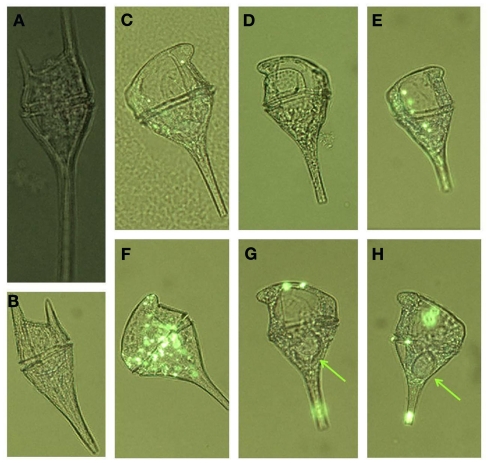
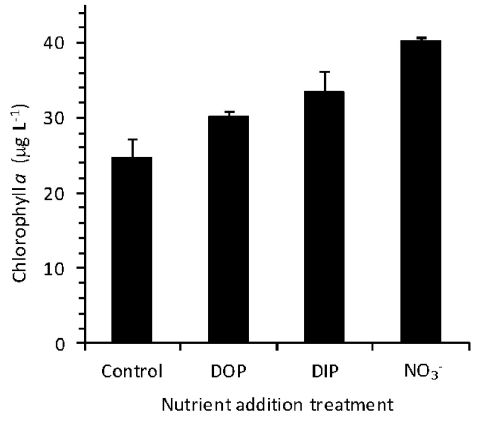
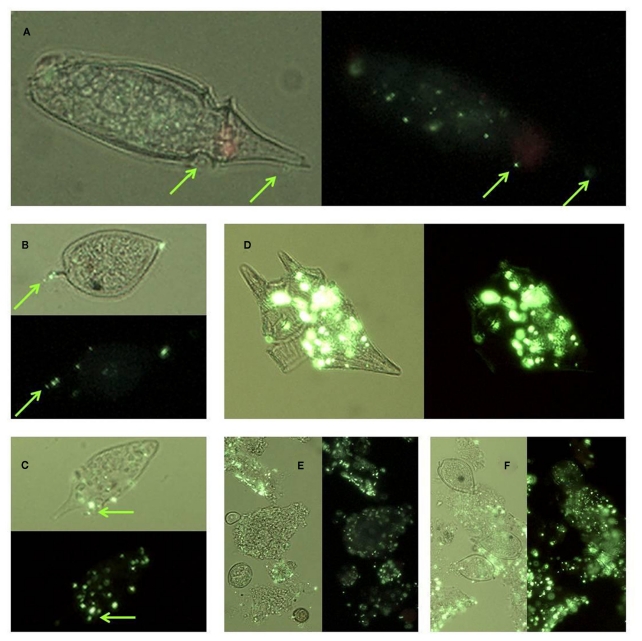
This study explores the cycling of phosphorus (P) in the euphotic zone following upwelling in northeastern Monterey Bay (the Red Tide Incubator region) of coastal California, with particular emphasis on how bacteria and phytoplankton that form harmful algal blooms mediate and respond to changes in P availability. In situ measurements of nutrient concentrations, phytoplankton community composition, and cell-specific alkaline phosphatase (AP) activity (determined via enzyme-labeled fluorescence assay) were measured during three cruises. Upwelling led to a 10-fold increase in dissolved inorganic (DIP) in surface waters, reaching ∼0.5 μmol L(-1). This DIP was drawn down rapidly as upwelling relaxed over a period of 1 week. Ratios of nitrate to DIP drawdown (∼5:1, calculated as the change in nitrate divided by the change in DIP) were lower than the Redfield ratio of 16:1, suggesting that luxury P uptake was occurring as phytoplankton bloomed. Dissolved organic (DOP) remained relatively constant (∼0.3 μmol L(-1)) before and immediately following upwelling, but doubled as upwelling relaxed, likely due to phytoplankton excretion and release during grazing. This transition from a relatively high DIP:DOP ratio to lower DIP:DOP ratio was accompanied by a decline in the abundance of diatoms, which had low AP activity, toward localized, spatially heterogeneous blooms of dinoflagellates in the genera Prorocentrum, Ceratium, Dinophysis, Alexandrium, and Scrippsiella that showed high AP activity regardless of ambient DIP levels. A nutrient addition incubation experiment showed that phytoplankton growth was primarily limited by nitrate, followed by DIP and DOP, suggesting that P regulates phytoplankton physiology and competition, but is not a limiting nutrient in this region. AP activity was observed in bacteria associated with lysed cell debris and aggregates of particulate organic material, where it may serve to facilitate P regeneration, as well as affixed to the surfaces of intact phytoplankton cells, possibly indicative of close, beneficial phytoplankton-bacteria interactions.
本研究探讨了加利福尼亚州沿海蒙特雷湾东北部(赤潮孵化区)上升流后真光层中磷(P)的循环,特别强调形成有害藻华的细菌和浮游植物如何介导和响应磷有效性的变化。在三次巡航期间,对营养物浓度、浮游植物群落组成和细胞特异性碱性磷酸酶(AP)活性(通过酶标记荧光测定法测定)进行了现场测量。上升流导致表层水体中溶解无机磷(DIP)增加了10倍,达到约0.5 μmol L⁻¹。随着上升流在1周内减弱,这种DIP迅速下降。硝酸盐与DIP下降的比率(约5:1,计算为硝酸盐变化量除以DIP变化量)低于雷德菲尔德比率16:1,这表明浮游植物大量繁殖时发生了奢侈性磷吸收。上升流之前和之后,溶解有机磷(DOP)保持相对恒定(约0.3 μmol L⁻¹),但随着上升流减弱而增加了一倍,这可能是由于浮游植物在摄食过程中的排泄和释放。从相对较高的DIP:DOP比率到较低的DIP:DOP比率的这种转变,伴随着硅藻丰度的下降,硅藻的AP活性较低,而转向了原甲藻属、角藻属、鳍藻属、亚历山大藻属和斯克里普藻属等具有高AP活性的甲藻的局部、空间异质性藻华,无论环境DIP水平如何。一项营养添加培养实验表明,浮游植物生长主要受硝酸盐限制,其次是DIP和DOP,这表明磷调节浮游植物的生理和竞争,但在该区域不是限制营养物。在与裂解细胞碎片和颗粒有机物质聚集体相关的细菌中观察到了AP活性,在那里它可能有助于促进磷的再生,并且也附着在完整浮游植物细胞的表面,这可能表明浮游植物与细菌之间存在密切的有益相互作用。