Laboratório de Biotecnologia, Centro de Citricultura Sylvio Moreira, Cordeirópolis-São Paulo, Brazil.
PLoS One. 2012;7(2):e31263. doi: 10.1371/journal.pone.0031263. Epub 2012 Feb 9.
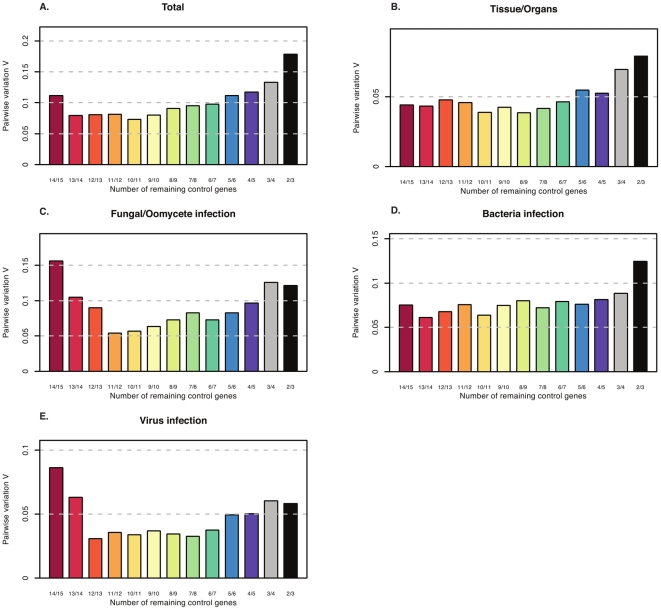
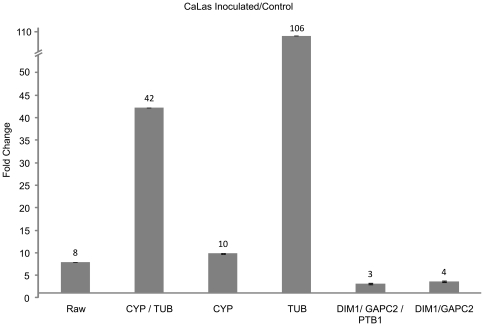
Real-time reverse transcription PCR (RT-qPCR) has emerged as an accurate and widely used technique for expression profiling of selected genes. However, obtaining reliable measurements depends on the selection of appropriate reference genes for gene expression normalization. The aim of this work was to assess the expression stability of 15 candidate genes to determine which set of reference genes is best suited for transcript normalization in citrus in different tissues and organs and leaves challenged with five pathogens (Alternaria alternata, Phytophthora parasitica, Xylella fastidiosa and Candidatus Liberibacter asiaticus). We tested traditional genes used for transcript normalization in citrus and orthologs of Arabidopsis thaliana genes described as superior reference genes based on transcriptome data. geNorm and NormFinder algorithms were used to find the best reference genes to normalize all samples and conditions tested. Additionally, each biotic stress was individually analyzed by geNorm. In general, FBOX (encoding a member of the F-box family) and GAPC2 (GAPDH) was the most stable candidate gene set assessed under the different conditions and subsets tested, while CYP (cyclophilin), TUB (tubulin) and CtP (cathepsin) were the least stably expressed genes found. Validation of the best suitable reference genes for normalizing the expression level of the WRKY70 transcription factor in leaves infected with Candidatus Liberibacter asiaticus showed that arbitrary use of reference genes without previous testing could lead to misinterpretation of data. Our results revealed FBOX, SAND (a SAND family protein), GAPC2 and UPL7 (ubiquitin protein ligase 7) to be superior reference genes, and we recommend their use in studies of gene expression in citrus species and relatives. This work constitutes the first systematic analysis for the selection of superior reference genes for transcript normalization in different citrus organs and under biotic stress.
实时逆转录聚合酶链反应(RT-qPCR)已成为一种准确且广泛使用的技术,可用于对选定基因的表达谱进行分析。然而,要获得可靠的测量结果,取决于选择合适的基因作为表达归一化的参考基因。本研究旨在评估 15 个候选基因的表达稳定性,以确定在柑橘不同组织和器官以及受五种病原体(Alternaria alternata、Phytophthora parasitica、Xylella fastidiosa 和 Candidatus Liberibacter asiaticus)挑战的叶片中,哪一组参考基因最适合转录归一化。我们测试了柑橘中用于转录归一化的传统基因和基于转录组数据被描述为优异参考基因的拟南芥基因的同源基因。使用 geNorm 和 NormFinder 算法来确定最佳参考基因,以归一化所有测试的样本和条件。此外,还通过 geNorm 分别分析每种生物胁迫。一般来说,在不同条件和测试子集中,FBOX(编码 F-box 家族成员)和 GAPC2(GAPDH)是最稳定的候选基因集,而 CYP(细胞色素 P450)、TUB(微管蛋白)和 CtP(组织蛋白酶)是发现的表达最不稳定的基因。验证 WRKY70 转录因子在感染 Candidatus Liberibacter asiaticus 的叶片中表达水平归一化的最佳适用参考基因表明,未经先前测试随意使用参考基因可能导致数据的错误解释。我们的结果表明,FBOX、SAND(SAND 家族蛋白)、GAPC2 和 UPL7(泛素蛋白连接酶 7)是优异的参考基因,我们建议在柑橘属和相关物种的基因表达研究中使用这些基因。这项工作首次对不同柑橘器官和生物胁迫下转录归一化的优异参考基因进行了系统分析。