Department of Pathology and Molecular Medicine, Faculty of Health Sciences, McMaster University, Hamilton, ON, Canada.
Br J Nutr. 2012 Aug;108(3):418-23. doi: 10.1017/S000711451200013X. Epub 2012 Feb 21.
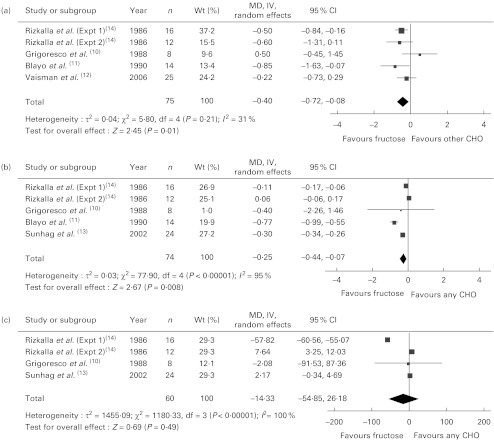
Contrary to concerns that fructose may have adverse metabolic effects, there is evidence that small, 'catalytic' doses ( ≤ 10 g/meal) of fructose decrease the glycaemic response to high-glycaemic index meals in human subjects. To assess the longer-term effects of 'catalytic' doses of fructose, we undertook a meta-analysis of controlled feeding trials. We searched MEDLINE, EMBASE, CINAHL and the Cochrane Library. Analyses included all controlled feeding trials ≥ 7 d featuring 'catalytic' fructose doses ( ≤ 36 g/d) in isoenergetic exchange for other carbohydrates. Data were pooled by the generic inverse variance method using random-effects models and expressed as mean differences (MD) with 95 % CI. Heterogeneity was assessed by the Q statistic and quantified by I 2. The Heyland Methodological Quality Score assessed study quality. A total of six feeding trials (n 118) met the eligibility criteria. 'Catalytic' doses of fructose significantly reduced HbA1c (MD - 0·40, 95 % CI - 0·72, - 0·08) and fasting glucose (MD - 0·25, 95 % CI - 0·44, - 0·07). This benefit was seen in the absence of adverse effects on fasting insulin, body weight, TAG or uric acid. Subgroup and sensitivity analyses showed evidence of effect modification under certain conditions. The small number of trials and their relatively short duration limit the strength of the conclusions. In conclusion, this small meta-analysis shows that 'catalytic' fructose doses ( ≤ 36 g/d) may improve glycaemic control without adverse effects on body weight, TAG, insulin and uric acid. There is a need for larger, longer ( ≥ 6 months) trials using 'catalytic' fructose to confirm these results.
与果糖可能产生不良代谢作用的担忧相反,有证据表明,小剂量的“催化剂量”(每餐≤10 克)果糖可降低人体对高血糖指数膳食的血糖反应。为了评估“催化剂量”果糖的长期作用,我们对对照喂养试验进行了荟萃分析。我们检索了 MEDLINE、EMBASE、CINAHL 和 Cochrane 图书馆。分析包括所有≥7 天的对照喂养试验,这些试验以等能量交换的方式用“催化剂量”果糖(≤36 克/天)替代其他碳水化合物。数据通过通用倒数方差法进行汇总,采用随机效应模型,并以均数差值(MD)和 95%置信区间(CI)表示。采用 Q 统计量评估异质性,并以 I 2 表示。Heyland 方法学质量评分评估研究质量。共有 6 项喂养试验(n=118)符合入选标准。果糖的“催化剂量”显著降低了糖化血红蛋白(MD -0.40,95%CI -0.72,-0.08)和空腹血糖(MD -0.25,95%CI -0.44,-0.07)。在不影响空腹胰岛素、体重、TAG 或尿酸的情况下,观察到了这种益处。亚组和敏感性分析显示,在某些条件下存在效应修饰的证据。试验数量少且持续时间相对较短,限制了结论的强度。总之,这项小型荟萃分析表明,“催化剂量”果糖(≤36 克/天)可能改善血糖控制,而不会对体重、TAG、胰岛素和尿酸产生不良影响。需要更大、更长(≥6 个月)的试验来验证这些结果。