Department of Ecophysiology and Aquaculture, Leibniz-Institute of Freshwater Ecology and Inland Fisheries, Berlin, Germany.
PLoS One. 2012;7(2):e32097. doi: 10.1371/journal.pone.0032097. Epub 2012 Feb 15.
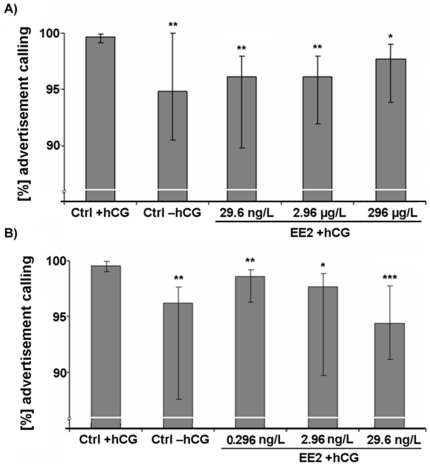
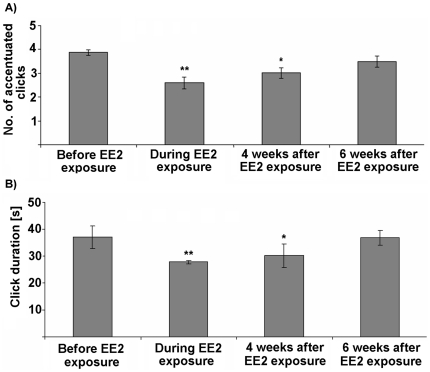
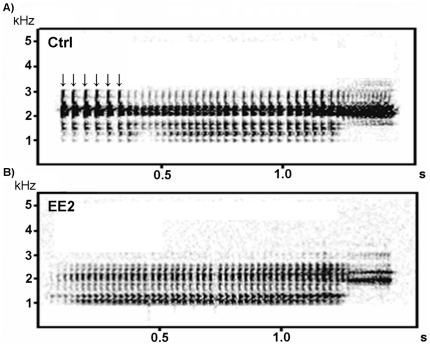
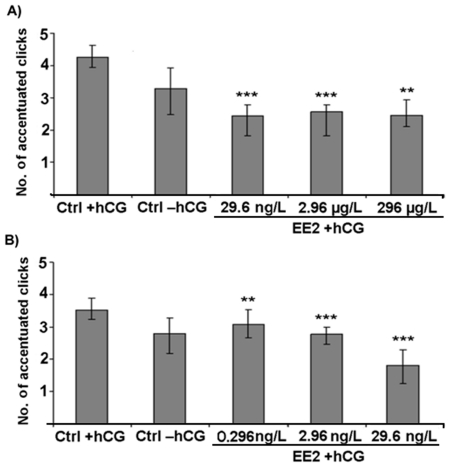
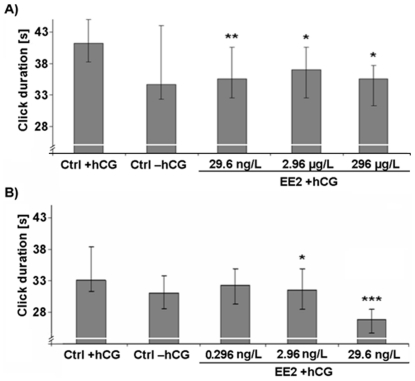
The main component of classical contraceptives, 17α-ethinylestradiol (EE2), has high estrogenic activity even at environmentally relevant concentrations. Although estrogenic endocrine disrupting compounds are assumed to contribute to the worldwide decline of amphibian populations by adverse effects on sexual differentiation, evidence for EE2 affecting amphibian mating behaviour is lacking. In this study, we demonstrate that EE2 exposure at five different concentrations (0.296 ng/L, 2.96 ng/L, 29.64 ng/L, 2.96 µg/L and 296.4 µg/L) can disrupt the mating behavior of adult male Xenopus laevis. EE2 exposure at all concentrations lowered male sexual arousal, indicated by decreased proportions of advertisement calls and increased proportions of the call type rasping, which characterizes a sexually unaroused state of a male. Additionally, EE2 at all tested concentrations affected temporal and spectral parameters of the advertisement calls, respectively. The classical and highly sensitive biomarker vitellogenin, on the other hand, was only induced at concentrations equal or higher than 2.96 µg/L. If kept under control conditions after a 96 h EE2 exposure (2.96 µg/L), alterations of male advertisement calls vanish gradually within 6 weeks and result in a lower sexual attractiveness of EE2 exposed males toward females as demonstrated by female choice experiments. These findings indicate that exposure to environmentally relevant EE2 concentrations can directly disrupt male mate calling behavior of X. laevis and can indirectly affect the mating behavior of females. The results suggest the possibility that EE2 exposure could reduce the reproductive success of EE2 exposed animals and these effects might contribute to the global problem of amphibian decline.
经典避孕药的主要成分 17α-乙炔基雌二醇(EE2)即使在环境相关浓度下也具有很高的雌激素活性。尽管雌激素内分泌干扰化合物被认为通过对性分化的不利影响导致了全世界两栖动物数量的下降,但缺乏 EE2 影响两栖动物交配行为的证据。在这项研究中,我们证明了 EE2 在五个不同浓度(0.296ng/L、2.96ng/L、29.64ng/L、2.96μg/L 和 296.4μg/L)下暴露会破坏成年雄性非洲爪蟾(Xenopus laevis)的交配行为。EE2 在所有浓度下都降低了雄性的性唤起,表现为广告叫声的比例降低, rasping 叫声的比例增加,rasping 叫声特征是雄性处于未唤起的性状态。此外,EE2 在所有测试浓度下分别影响了广告叫声的时间和光谱参数。另一方面,经典且高度敏感的生物标志物卵黄蛋白原仅在浓度等于或高于 2.96μg/L 时才被诱导。如果在 96 小时 EE2 暴露(2.96μg/L)后保持对照条件,雄性广告叫声的变化会在 6 周内逐渐消失,并导致 EE2 暴露雄性对雌性的性吸引力降低,如雌性选择实验所示。这些发现表明,暴露于环境相关的 EE2 浓度可能会直接破坏非洲爪蟾的雄性求偶叫声行为,并可能间接影响雌性的交配行为。研究结果表明,EE2 暴露可能会降低 EE2 暴露动物的繁殖成功率,这些影响可能是导致全球两栖动物数量下降的原因之一。