Dipartimento di Entomologia e Zoologia Agraria "Filippo Silvestri", Universita' degli Studi di Napoli "Federico II", Via Universita' n.100, 80055 Portici, Napoli, Italy.
College of Plant Protection, Yunnan Agricultural University, Yunnan 650201, China.
Viruses. 2011 Dec;3(12):2425-2441. doi: 10.3390/v3122425. Epub 2011 Dec 14.
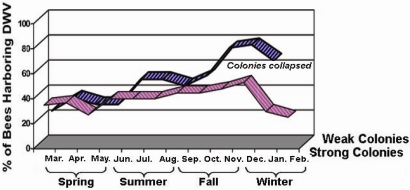
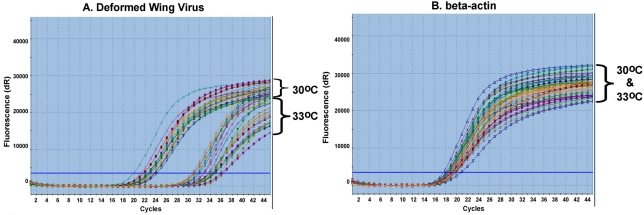
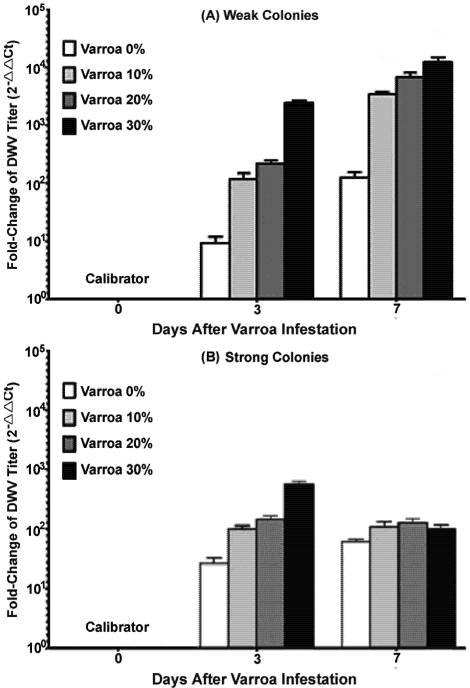
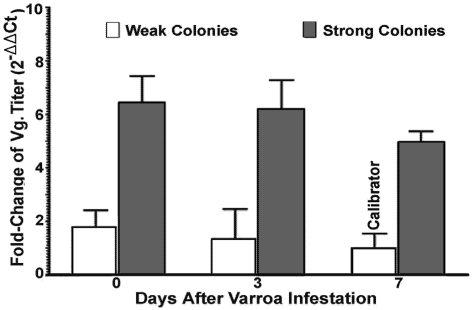
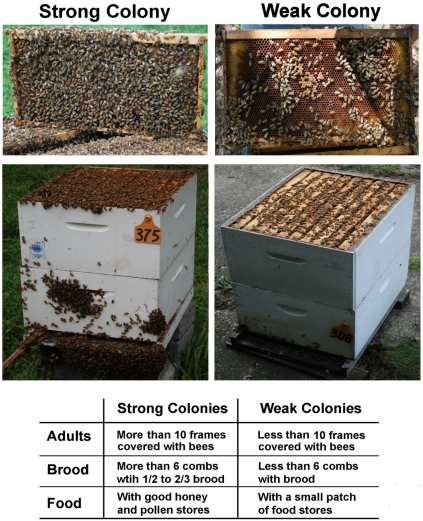
The dynamics of viruses are critical to our understanding of disease pathogenesis. Using honey bee Deformed wing virus (DWV) as a model, we conducted field and laboratory studies to investigate the roles of abiotic and biotic stress factors as well as host health conditions in dynamics of virus replication in honey bees. The results showed that temperature decline could lead to not only significant decrease in the rate for pupae to emerge as adult bees, but also an increased severity of the virus infection in emerged bees, partly explaining the high levels of winter losses of managed honey bees, Apis mellifera, around the world. By experimentally exposing adult bees with variable levels of parasitic mite Varroa destructor, we showed that the severity of DWV infection was positively correlated with the density and time period of Varroa mite infestation, confirming the role of Varroa mites in virus transmission and activation in honey bees. Further, we showed that host conditions have a significant impact on the outcome of DWV infection as bees that originate from strong colonies resist DWV infection and replication significantly better than bee originating from weak colonies. The information obtained from this study has important implications for enhancing our understanding of host‑pathogen interactions and can be used to develop effective disease control strategies for honey bees.
病毒的动态变化对于我们理解疾病发病机制至关重要。本研究以蜜蜂麻痹病毒(DWV)为模型,通过野外和实验室研究,调查了非生物和生物胁迫因素以及宿主健康状况对蜜蜂体内病毒复制动态的作用。结果表明,温度下降不仅会显著降低蛹发育为成蜂的速度,还会增加成蜂病毒感染的严重程度,这部分解释了世界各地管理的蜜蜂(Apis mellifera)在冬季大量死亡的原因。通过实验性地使成年蜜蜂暴露于不同密度和时间的寄生螨 Varroa destructor 下,我们发现 DWV 感染的严重程度与 Varroa 螨虫的密度和时间呈正相关,证实了 Varroa 螨虫在蜜蜂体内传播和激活病毒的作用。此外,我们还表明,宿主状况对 DWV 感染的结果有重大影响,因为来自强群的蜜蜂比来自弱群的蜜蜂抵抗 DWV 感染和复制的能力要强得多。本研究获得的信息对于深入了解宿主-病原体相互作用具有重要意义,并可用于开发针对蜜蜂的有效疾病控制策略。