Department of Medicine, Channing Laboratory, Brigham and Women's Hospital, Harvard Medical School, Boston MA, USA.
Sci Rep. 2011;1:58. doi: 10.1038/srep00058. Epub 2011 Aug 8.
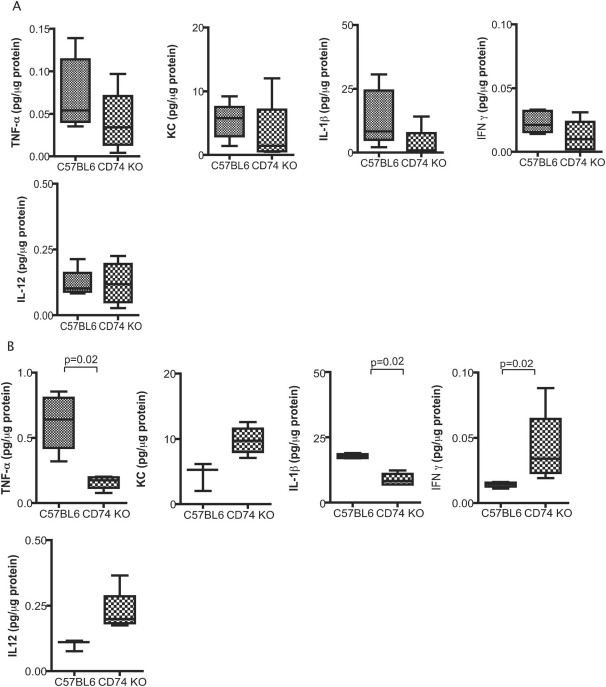
Eye trauma and contact lens wear are the main factors that predispose to the development of infectious keratitis. The existing therapies fail to control the inflammation-driven tissue damage that occurs during Pseudomonas aeruginosa infection. Antibiotic treatment reduces bacterial burdens, but better interventions are needed to alleviate tissue damage resulting from local inflammation. We have previously documented that inhibition of macrophage migration inhibitory factor (MIF) reduces the bacterial levels and the inflammatory damage during keratitis. Here, we report that mice deficient for CD74, the putative MIF receptor, developed milder Pseudomonas aeruginosa-induced disease, characterized by decreased proinflammatory mediators and reduced bacterial presence in the cornea. However, topical inhibition of MIF using antibodies applied to the cornea further promoted recovery from disease, suggesting that in addition to MIF-dependent signaling events, MIF-triggered CD74-independent signaling pathways regulate sensitization to P. aeruginosa-induced infection.
眼创伤和隐形眼镜的佩戴是导致感染性角膜炎的主要因素。现有的治疗方法无法控制铜绿假单胞菌感染时发生的炎症驱动的组织损伤。抗生素治疗可以降低细菌负荷,但需要更好的干预措施来减轻局部炎症引起的组织损伤。我们之前的研究已经证明,抑制巨噬细胞移动抑制因子(MIF)可以减少角膜炎中的细菌数量和炎症损伤。在这里,我们报告说,缺乏 CD74(假定的 MIF 受体)的小鼠发生了较轻的铜绿假单胞菌诱导的疾病,其特征是促炎介质减少,角膜中的细菌数量减少。然而,通过在角膜上应用抗体来局部抑制 MIF 进一步促进了疾病的恢复,这表明除了依赖 MIF 的信号事件外,MIF 触发的 CD74 非依赖性信号通路也调节了对铜绿假单胞菌诱导感染的敏感性。