Immunogenetics Laboratory, University of Turku, Turku, Finland.
Diabetes. 2012 Apr;61(4):963-6. doi: 10.2337/db11-0386. Epub 2012 Feb 22.
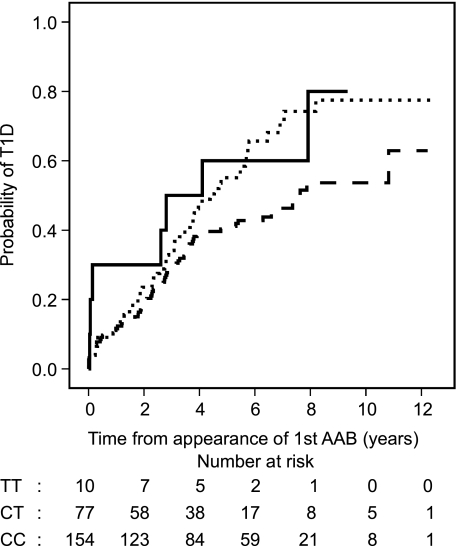
We set out to analyze the role of two major non-HLA gene polymorphisms associated with type 1 diabetes (T1D), PTPN22 1858C/T and insulin gene INS-23 A/T in progression to clinical T1D after the appearance of β-cell autoimmunity. The study population comprised 249 children with HLA-associated T1D susceptibility. All subjects were persistently positive for at least one of the T1D-associated biochemically defined autoantibodies (insulin autoantibody, GAD antibody, or IA-2 antibody), and 136 subjects presented with T1D over a median follow-up of 4.3 years (range 0.0-12.5) after the appearance of the first autoantibody. The PTPN22 1858T allele was strongly associated with progression to T1D after the appearance of the first biochemically defined β-cell autoantibody (hazard ratio 1.68 [95% CI 1.09-2.60], P = 0.02 Cox regression analysis, multivariate test), and the effect remained similar when analyzed after the appearance of the second autoantibody (P = 0.013), whereas INS-23 HphI AA genotype was not associated with progression to clinical diabetes after the appearance of the first or second autoantibody (P = 0.38 and P = 0.88, respectively). The effect of the INS risk genotype seems to be limited to the induction and early phases of β-cell autoimmunity, but the PTPN22 1858T allele instead affects the initiation and late progression phase of diabetes-associated autoimmunity.
我们旨在分析与 1 型糖尿病(T1D)相关的两个主要非 HLA 基因多态性(PTPN22 1858C/T 和胰岛素基因 INS-23 A/T)在出现β细胞自身免疫后向临床 T1D 进展的作用。研究人群包括 249 名具有 HLA 相关 T1D 易感性的儿童。所有受试者均至少持续存在一种与 T1D 相关的生化定义自身抗体(胰岛素自身抗体、GAD 抗体或 IA-2 抗体)阳性,136 名受试者在出现首个自身抗体后中位随访 4.3 年(范围 0.0-12.5)后出现 T1D。PTPN22 1858T 等位基因与出现首个生化定义的β细胞自身抗体后进展为 T1D 密切相关(危险比 1.68 [95%CI 1.09-2.60],P=0.02 Cox 回归分析,多变量检验),并且在出现第二个自身抗体后分析时,效果仍然相似(P=0.013),而 INS-23 HphI AA 基因型与出现首个或第二个自身抗体后进展为临床糖尿病无关(P=0.38 和 P=0.88,分别)。INS 风险基因型的作用似乎仅限于β细胞自身免疫的诱导和早期阶段,但 PTPN22 1858T 等位基因影响糖尿病相关自身免疫的启动和晚期进展阶段。