School of Biosciences, The University of Birmingham, Edgbaston, Birmingham, United Kingdom.
PLoS One. 2012;7(2):e30587. doi: 10.1371/journal.pone.0030587. Epub 2012 Feb 16.
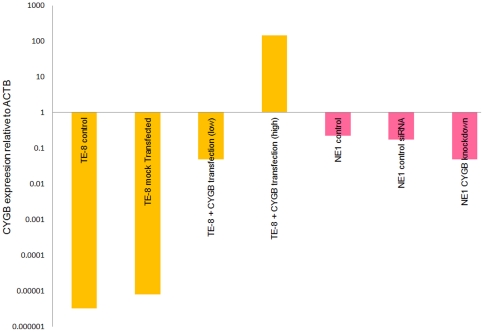
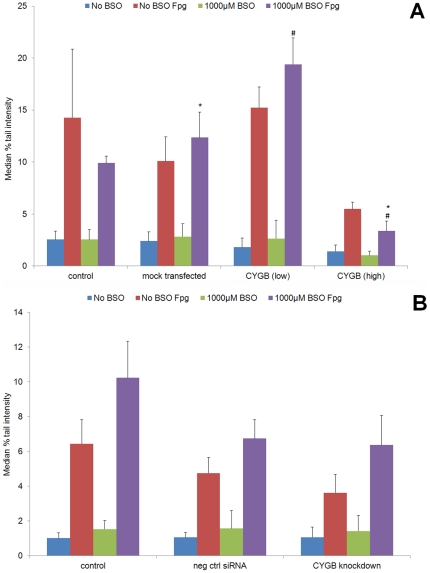
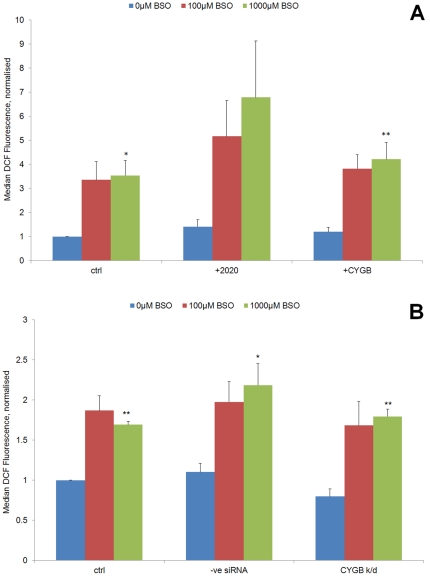
Cytoglobin is an intracellular globin of unknown function that is expressed mostly in cells of a myofibroblast lineage. Possible functions of cytoglobin include buffering of intracellular oxygen and detoxification of reactive oxygen species. Previous work in our laboratory has demonstrated that cytoglobin affords protection from oxidant-induced DNA damage when over expressed in vitro, but the importance of this in more physiologically relevant models of disease is unknown. Cytoglobin is a candidate for the tylosis with oesophageal cancer gene, and its expression is strongly down-regulated in non-cancerous oesophageal biopsies from patients with TOC compared with normal biopsies. Therefore, oesophageal cells provide an ideal experimental model to test our hypothesis that downregulation of cytoglobin expression sensitises cells to the damaging effects of reactive oxygen species, particularly oxidative DNA damage, and that this could potentially contribute to the TOC phenotype. In the current study, we tested this hypothesis by manipulating cytoglobin expression in both normal and oesophageal cancer cell lines, which have normal physiological and no expression of cytoglobin respectively. Our results show that, in agreement with previous findings, over expression of cytoglobin in cancer cell lines afforded protection from chemically-induced oxidative stress but this was only observed at non-physiological concentrations of cytoglobin. In addition, down regulation of cytoglobin in normal oesophageal cells had no effect on their sensitivity to oxidative stress as assessed by a number of end points. We therefore conclude that normal physiological concentrations of cytoglobin do not offer cytoprotection from reactive oxygen species, at least in the current experimental model.
细胞血红素蛋白是一种功能未知的细胞内球蛋白,主要在成肌纤维细胞谱系的细胞中表达。细胞血红素蛋白的可能功能包括缓冲细胞内的氧和清除活性氧物质。我们实验室之前的工作表明,细胞血红素蛋白在体外过表达时可提供对氧化剂诱导的 DNA 损伤的保护,但在更具生理相关性的疾病模型中,其重要性尚不清楚。细胞血红素蛋白是贲门癌伴食管裂孔疝基因的候选基因,与正常活检相比,TOC 患者的非癌性食管活检中其表达强烈下调。因此,食管细胞提供了一个理想的实验模型,以检验我们的假设,即细胞血红素蛋白表达下调使细胞对活性氧物质的破坏性影响(特别是氧化 DNA 损伤)敏感,并且这可能有助于 TOC 表型。在当前的研究中,我们通过在正常和食管癌细胞系中操纵细胞血红素蛋白的表达来检验这一假设,这两种细胞系分别具有正常的生理功能和细胞血红素蛋白的表达。我们的结果表明,与之前的发现一致,在癌细胞系中过表达细胞血红素蛋白可提供对化学诱导的氧化应激的保护,但仅在非生理浓度的细胞血红素蛋白下观察到这种保护。此外,下调正常食管细胞中的细胞血红素蛋白对其对氧化应激的敏感性没有影响,这可以通过多种终点来评估。因此,我们得出结论,正常生理浓度的细胞血红素蛋白不能提供对活性氧物质的细胞保护,至少在当前的实验模型中是这样。