Department of Experimental Pharmacology, Chair of Pharmacology, Jagiellonian University Medical College, Krakow, Poland.
Naunyn Schmiedebergs Arch Pharmacol. 2012 Jun;385(6):641-50. doi: 10.1007/s00210-012-0732-4. Epub 2012 Feb 25.
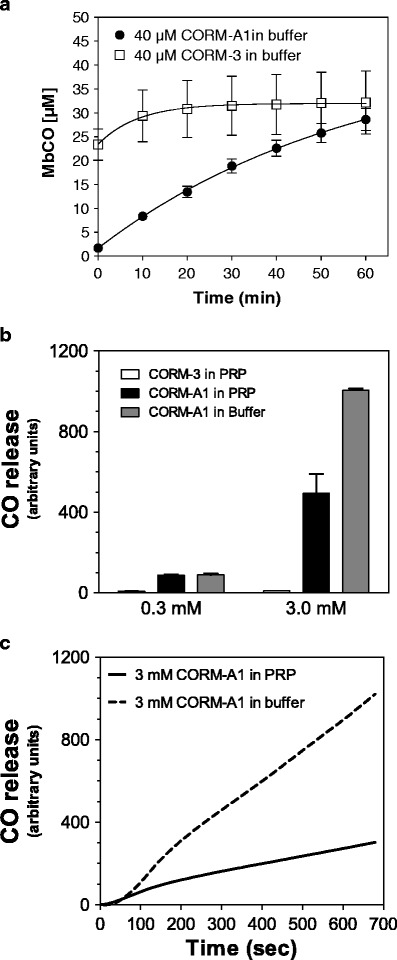
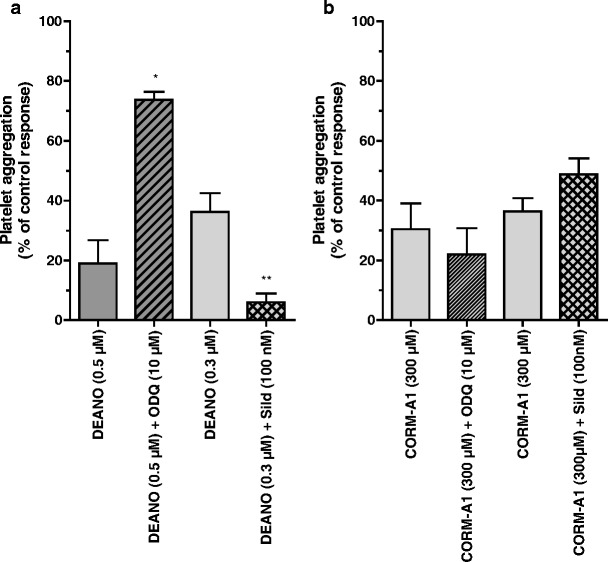
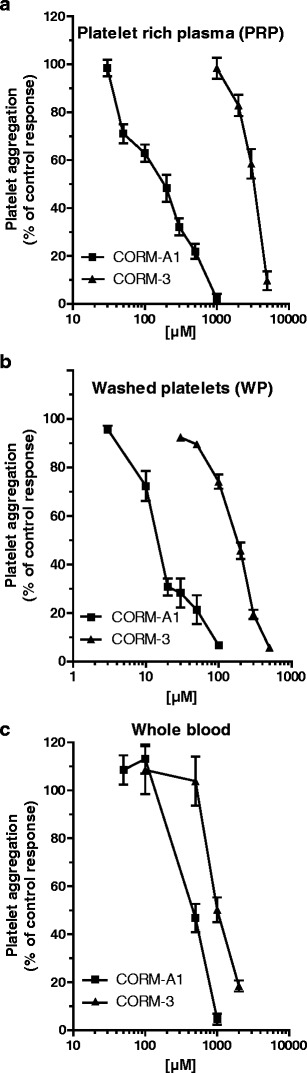
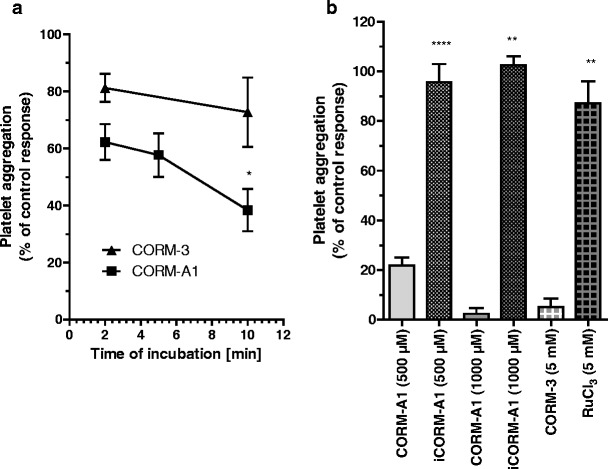
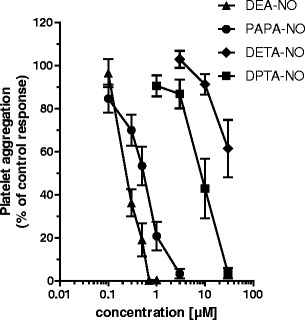
Carbon monoxide (CO) and CO-releasing molecules (CO-RMs) inhibit platelet aggregation in vitro. Herein, we compare the anti-platelet action of CORM-3, which releases CO rapidly (t (½) 1 min), and CORM-A1, which slowly releases CO (t(½) = 21 min). The anti-platelet effects of NO donors with various kinetics of NO release were studied for comparison. The effects of CO-RMs and NO donors were analyzed in washed human platelets (WP), platelets rich plasma (PRP), or whole blood (WB) using aggregometry technique. CORM-3 and CORM-A1 inhibited platelet aggregation in human PRP, WP, or WB, in a concentration-dependent manner. In all three preparations, CORM-A1 was more potent than CORM-3. Inhibition of platelets aggregation by CORM-A1 was not significantly affected by a guanylate cyclase inhibitor (ODQ) and a phosphodiesterase-5 inhibitor, sildenafil. In contrast, inhibition of platelet aggregation by NO donors was more potent with a fast NO releaser (DEA-NO, t (½) = 2 min) than slow NO releasers such as PAPA-NO (t (½) = 15 min) or other slow NO donors. Predictably, the anti-platelet effect of DEA-NO and other NO donors was reversed by ODQ while potentiated by sildenafil. In contrast to NO donors which inhibit platelets proportionally to the kinetics of NO released via activation of soluble guanylate cyclase (sGC), the slow CO-releaser CORM-A1 is a superior anti-platelet agent as compared to CORM-3 which releases CO instantly. The anti-platelet action of CO-RMs does not involve sGC activation. Importantly, CORM-A1 or its derivatives representing the class of slow CO releasers display promising pharmacological profile as anti-platelet agents.
一氧化碳(CO)和 CO 释放分子(CO-RMs)可在体外抑制血小板聚集。在此,我们比较了 CO 快速释放的 CORM-3(t (½) 1 分钟)和 CO 缓慢释放的 CORM-A1(t(½) = 21 分钟)的抗血小板作用。比较了具有不同 NO 释放动力学的 NO 供体的抗血小板作用。使用聚集测定法在洗涤的人血小板(WP)、富含血小板的血浆(PRP)或全血(WB)中分析 CO-RMs 和 NO 供体的作用。CORM-3 和 CORM-A1 以浓度依赖性方式抑制人 PRP、WP 或 WB 中的血小板聚集。在所有三种制剂中,CORM-A1 比 CORM-3 更有效。CORM-A1 对血小板聚集的抑制作用不受鸟苷酸环化酶抑制剂(ODQ)和磷酸二酯酶-5 抑制剂西地那非的显著影响。相比之下,快速 NO 释放体(DEA-NO,t (½) = 2 分钟)比慢速 NO 释放体(如 PAPA-NO,t (½) = 15 分钟)或其他慢速 NO 供体对血小板聚集的抑制作用更强。可以预见的是,DEA-NO 和其他 NO 供体的抗血小板作用被 ODQ 逆转,而被西地那非增强。与通过激活可溶性鸟苷酸环化酶(sGC)按 NO 释放动力学比例抑制血小板的 NO 供体不同,缓慢 CO 释放体 CORM-A1 作为抗血小板剂优于即刻释放 CO 的 CORM-3。CO-RMs 的抗血小板作用不涉及 sGC 激活。重要的是,CO-RMs(如 CORM-A1)或其代表缓慢 CO 释放体的衍生物作为抗血小板剂具有有前景的药理学特性。