Faculty of Medicine, Departments of Psychiatry and Neuroscience, Université Laval, Québec QC, Canada.
Front Mol Neurosci. 2012 Feb 20;5:14. doi: 10.3389/fnmol.2012.00014. eCollection 2012 Jan 27.
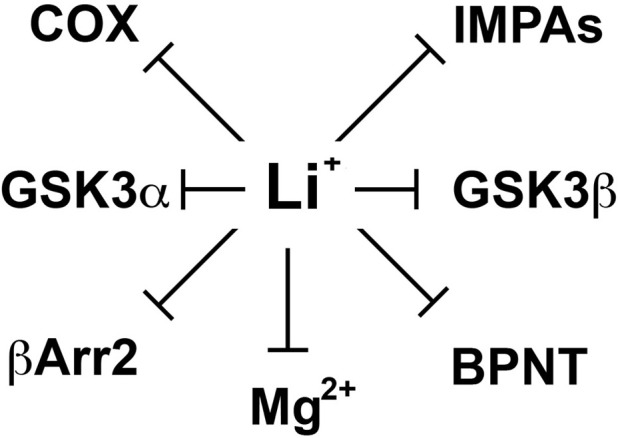
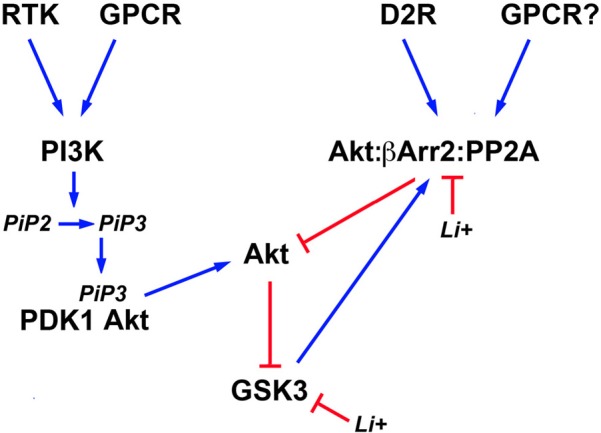
For more than 60 years, the mood stabilizer lithium has been used alone or in combination for the treatment of bipolar disorder, schizophrenia, depression, and other mental illnesses. Despite this long history, the molecular mechanisms trough which lithium regulates behavior are still poorly understood. Among several targets, lithium has been shown to directly inhibit glycogen synthase kinase 3 alpha and beta (GSK3α and GSK3β). However in vivo, lithium also inhibits GSK3 by regulating other mechanisms like the formation of a signaling complex comprised of beta-arrestin 2 (βArr2) and Akt. Here, we provide an overview of in vivo evidence supporting a role for inhibition of GSK3 in some behavioral effects of lithium. We also explore how regulation of GSK3 by lithium within a signaling network involving several molecular targets and cell surface receptors [e.g., G protein coupled receptors (GPCRs) and receptor tyrosine kinases (RTKs)] may provide cues to its relative pharmacological selectivity and its effects on disease mechanisms. A better understanding of these intricate actions of lithium at a systems level may allow the rational development of better mood stabilizer drugs with enhanced selectivity, efficacy, and lesser side effects.
六十多年来,心境稳定剂锂一直被单独或联合用于治疗双相情感障碍、精神分裂症、抑郁症和其他精神疾病。尽管历史悠久,但锂调节行为的分子机制仍知之甚少。在几个靶点中,锂已被证明可直接抑制糖原合酶激酶 3α和β(GSK3α 和 GSK3β)。然而,在体内,锂还通过调节其他机制,如由β-arrestin 2(βArr2)和 Akt 组成的信号复合物的形成,来抑制 GSK3。在这里,我们提供了支持抑制 GSK3 在锂的一些行为效应中的作用的体内证据概述。我们还探讨了锂如何在涉及多个分子靶点和细胞表面受体(如 G 蛋白偶联受体(GPCR)和受体酪氨酸激酶(RTK))的信号网络内调节 GSK3,这可能为其相对药理学选择性及其对疾病机制的影响提供线索。更好地了解锂在系统水平上的这些复杂作用,可能有助于合理开发具有增强选择性、疗效和较少副作用的更好的心境稳定剂药物。