Model Animal Research Center, MOE Key Laboratory of Model Animal for Disease Study, Nanjing University, Nanjing, China.
PLoS One. 2012;7(2):e30865. doi: 10.1371/journal.pone.0030865. Epub 2012 Feb 17.
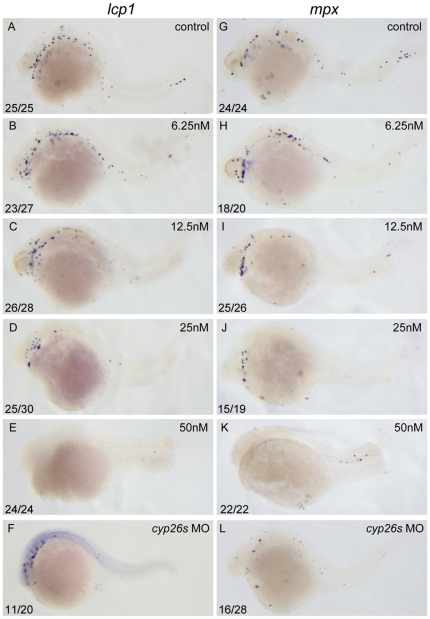
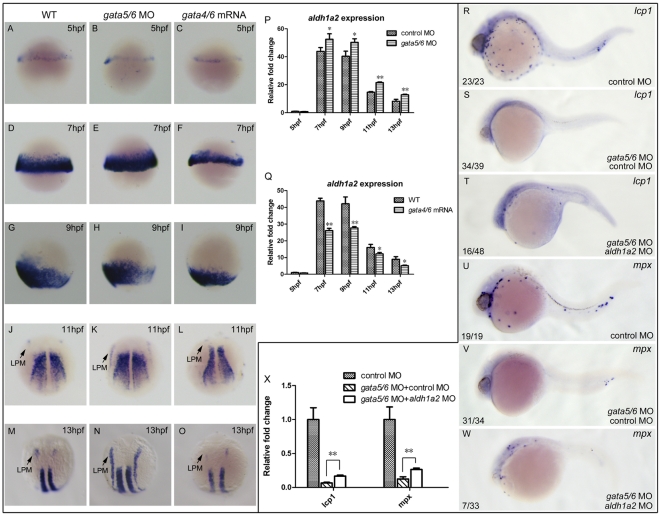
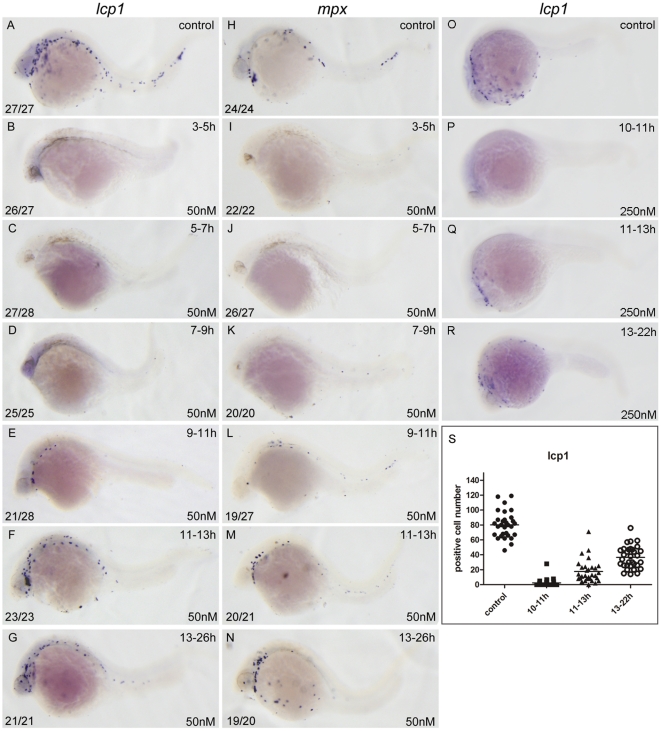
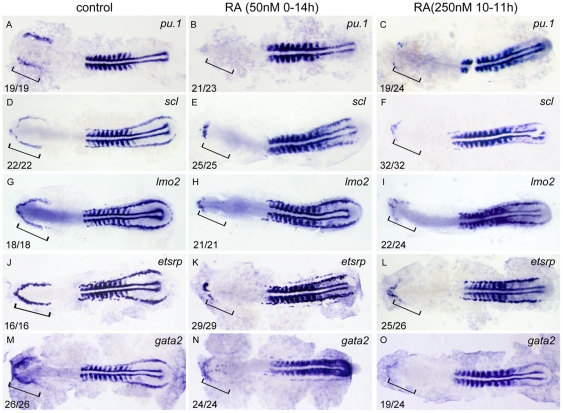
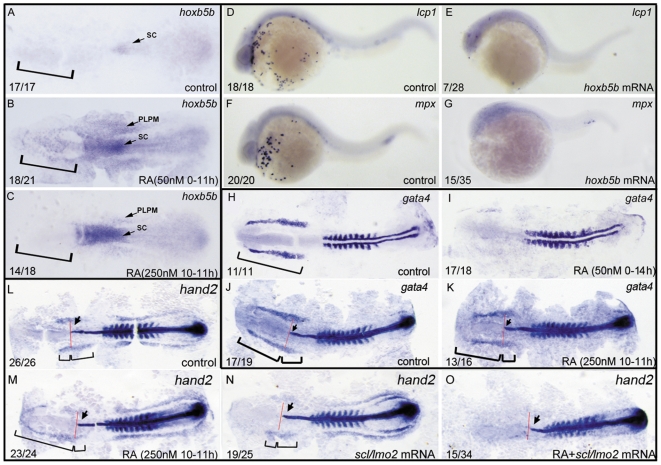
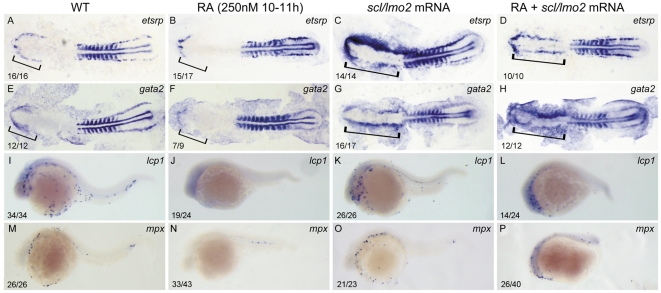
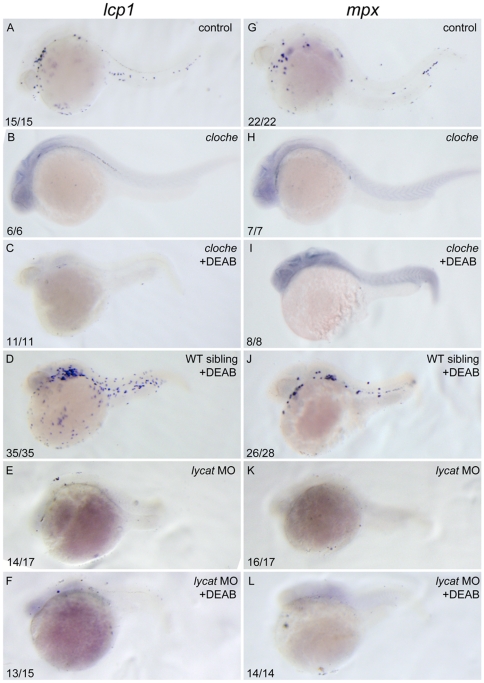
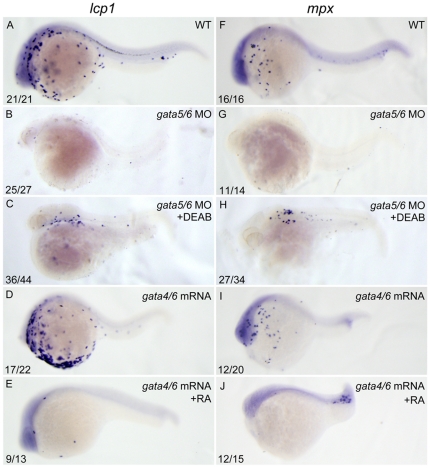
Retinoic acid (RA) is known to regulate definitive myelopoiesis but its role in vertebrate primitive myelopoiesis remains unclear. Here we report that zebrafish primitive myelopoiesis is restricted by RA in a dose dependent manner mainly before 11 hpf (hours post fertilization) when anterior hemangioblasts are initiated to form. RA treatment significantly reduces expressions of anterior hemangioblast markers scl, lmo2, gata2 and etsrp in the rostral end of ALPM (anterior lateral plate mesoderm) of the embryos. The result indicates that RA restricts primitive myelopoiesis by suppressing formation of anterior hemangioblasts. Analyses of ALPM formation suggest that the defective primitive myelopoiesis resulting from RA treatment before late gastrulation may be secondary to global loss of cells for ALPM fate whereas the developmental defect resulting from RA treatment during 10-11 hpf should be due to ALPM patterning shift. Overexpressions of scl and lmo2 partially rescue the block of primitive myelopoiesis in the embryos treated with 250 nM RA during 10-11 hpf, suggesting RA acts upstream of scl to control primitive myelopoiesis. However, the RA treatment blocks the increased primitive myelopoiesis caused by overexpressing gata4/6 whereas the abolished primitive myelopoiesis in gata4/5/6 depleted embryos is well rescued by 4-diethylamino-benzaldehyde, a retinal dehydrogenase inhibitor, or partially rescued by knocking down aldh1a2, the major retinal dehydrogenase gene that is responsible for RA synthesis during early development. Consistently, overexpressing gata4/6 inhibits aldh1a2 expression whereas depleting gata4/5/6 increases aldh1a2 expression. The results reveal that RA signaling acts downstream of gata4/5/6 to control primitive myelopoiesis. But, 4-diethylamino-benzaldehyde fails to rescue the defective primitive myelopoiesis in either cloche embryos or lycat morphants. Taken together, our results demonstrate that RA signaling restricts zebrafish primitive myelopoiesis through acting downstream of gata4/5/6, upstream of, or parallel to, cloche, and upstream of scl.
视黄酸(RA)已知可调节定型髓系发生,但它在脊椎动物原始髓系发生中的作用尚不清楚。在这里,我们报告说,斑马鱼原始髓系发生受到 RA 的限制,主要在受精后 11 小时(hpf)之前,即前血管球祖细胞开始形成时,RA 以剂量依赖的方式起作用。RA 处理显著降低了胚胎前侧板中胚层(ALPM)的头端的前血管球祖细胞标志物 scl、lmo2、gata2 和 etsrp 的表达。结果表明,RA 通过抑制前血管球祖细胞的形成来限制原始髓系发生。对 ALPM 形成的分析表明,由于晚原肠胚期 RA 处理导致的原始髓系发生缺陷可能是由于 ALPM 命运的细胞整体缺失所致,而 10-11 hpf 期间 RA 处理导致的发育缺陷应归因于 ALPM 模式转移。在 10-11 hpf 期间用 250 nM RA 处理的胚胎中,scl 和 lmo2 的过表达部分挽救了原始髓系发生的阻断,表明 RA 在前 scl 起作用以控制原始髓系发生。然而,RA 处理阻断了 gata4/6 过表达引起的原始髓系发生增加,而在 gata4/5/6 耗尽的胚胎中被废除的原始髓系发生则被视网膜脱氢酶抑制剂 4-二乙氨基苯甲醛或通过敲低负责早期发育中 RA 合成的主要视网膜脱氢酶基因 aldh1a2 部分挽救。一致地,gata4/6 的过表达抑制 aldh1a2 的表达,而 gata4/5/6 的耗尽增加 aldh1a2 的表达。结果表明,RA 信号通过作用于 gata4/5/6 的下游来控制原始髓系发生。但是,4-二乙氨基苯甲醛未能挽救 cloche 胚胎或 lycat 嵌合体中的原始髓系发生缺陷。总之,我们的结果表明,RA 信号通过作用于 gata4/5/6 的下游、cloche 的上游或平行、scl 的上游来限制斑马鱼原始髓系发生。