Computational Biology Laboratory, Centro de Modelamiento Matematico, Facultad de Ciencias Fisicas y Matematicas, Universidad de Chile, Santiago, Chile.
BMC Genomics. 2011 Dec 22;12 Suppl 4(Suppl 4):S8. doi: 10.1186/1471-2164-12-S4-S8.
Aquaporins are a large family of transmembrane channel proteins that are present throughout all domains of life and are implicated in human disorders. These channels, allow the passive but selective movement of water and other small neutral solutes across cell membranes. Aquaporins have been classified into two sub-families: i) strict aquaporins that only allow the passage of water and ii) the less selective aquaglyceroporins that transport water and other neutral solutes, such as glycerol, CO2 or urea. Recently, the identification and characterization of a number of archaeal and bacterial aquaporins suggested the existence of a third sub-family; one that is neither a strict aquaporin nor an aquaglyceroporin. The function and phylogeny of this third family is still a matter of debate.
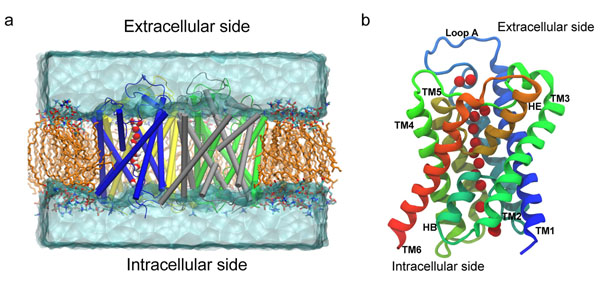
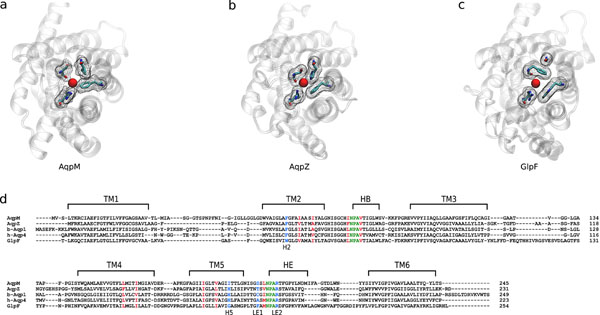
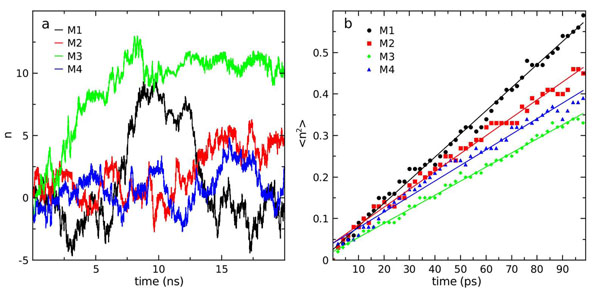
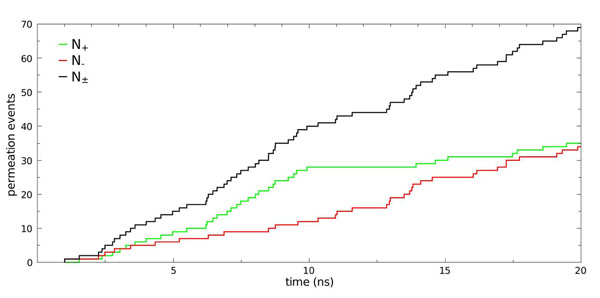
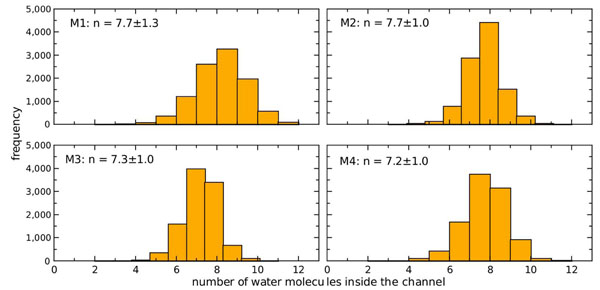
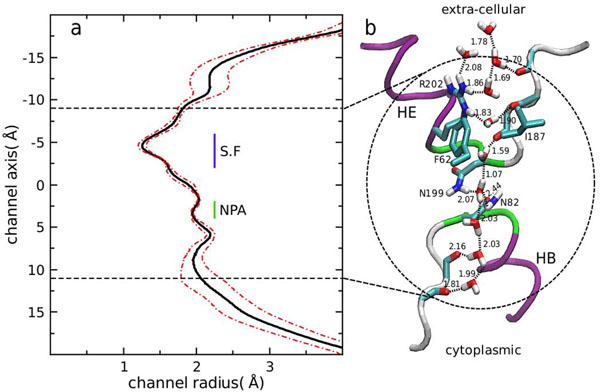
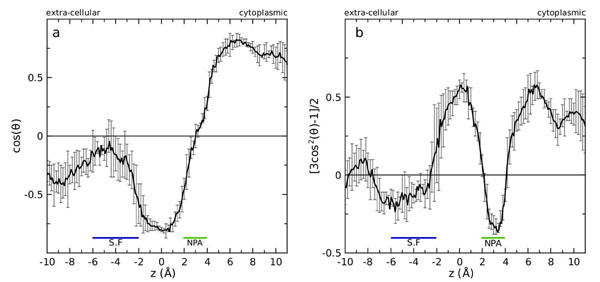
Twenty nanosecond molecular dynamics (MD) simulation of a fully hydrated tetramer of AqpM embedded in a lipid bilayer permitted predictions to be made of key biophysical parameters including: single channel osmotic permeability constant (pf), single channel diffusive permeability constant (pd), channel radius, potential water occupancy of the channel and water orientation inside the pore. These properties were compared with those of well characterized representatives of the two main aquaporin sub-families. Results show that changes in the amino acid composition of the aromatic/arginine region affect the size and polarity of the selectivity filter (SF) and could help explain the difference in water permeability between aquaporins. In addition, MD simulation results suggest that AqpM combines characteristics of strict aquaporins, such as the narrow SF and channel radius, with those of aquaglyceroporins, such as a more hydrophobic and less polar SF.
MD simulations of AqpM extend previous evidence that this archaeal aquaporin exhibits hybrid features intermediate between the two known aquaporin sub-families, supporting the idea that it may constitute a member of a novel class of aquaporins.
水通道蛋白是一个大型的跨膜通道蛋白家族,存在于所有生命领域,并与人类疾病有关。这些通道允许水和其他小的中性溶质被动但选择性地穿过细胞膜。水通道蛋白已被分为两个亚家族:i)严格的水通道蛋白,只允许水通过;ii)不太选择性的水甘油通道蛋白,可运输水和其他中性溶质,如甘油、CO2 或尿素。最近,一些古细菌和细菌水通道蛋白的鉴定和特征表明存在第三个亚家族;既不是严格的水通道蛋白也不是水甘油通道蛋白。这个第三家族的功能和系统发育仍然是一个争论的问题。
在脂质双层中嵌入的完全水合四聚体 AqpM 的二十纳秒分子动力学(MD)模拟允许对关键生物物理参数进行预测,包括:单通道渗透渗透率常数(pf)、单通道扩散渗透率常数(pd)、通道半径、通道内潜在的水占有率和水在孔内的取向。这些特性与两个主要水通道蛋白亚家族的代表性成员进行了比较。结果表明,芳香族/精氨酸区域的氨基酸组成变化会影响选择性过滤器(SF)的大小和极性,并有助于解释水通道蛋白之间水通透性的差异。此外,MD 模拟结果表明,AqpM 结合了严格水通道蛋白的特性,如狭窄的 SF 和通道半径,以及水甘油通道蛋白的特性,如更疏水和极性较小的 SF。
AqpM 的 MD 模拟扩展了以前的证据,表明这种古细菌水通道蛋白表现出介于两个已知水通道蛋白亚家族之间的混合特征,支持它可能构成新型水通道蛋白类别的成员的观点。