Department of Biology, Tougaloo College, Tougaloo, MS 39174, USA.
BMC Genomics. 2011 Dec 23;12 Suppl 5(Suppl 5):S12. doi: 10.1186/1471-2164-12-S5-S12.
Along with obesity, physical inactivity, and family history of metabolic disorders, African American ethnicity is a risk factor for type 2 diabetes (T2D) in the United States. However, little is known about the differences in gene expression and transcriptomic profiles of blood in T2D between African Americans (AA) and Caucasians (CAU), and microarray analysis of peripheral white blood cells (WBCs) from these two ethnic groups will facilitate our understanding of the underlying molecular mechanism in T2D and identify genetic biomarkers responsible for the disparities.
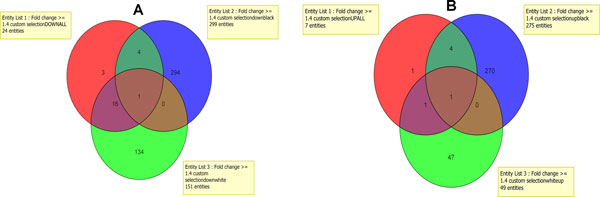
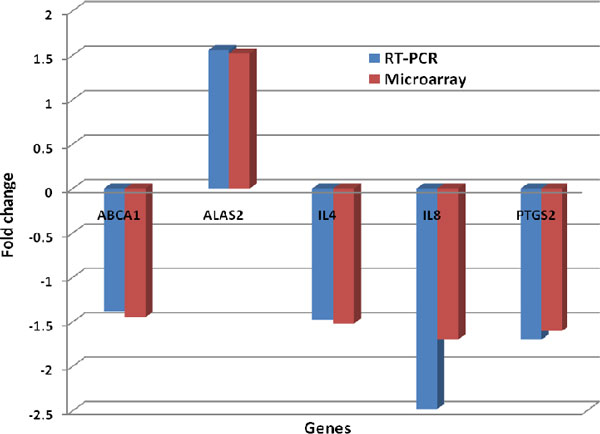
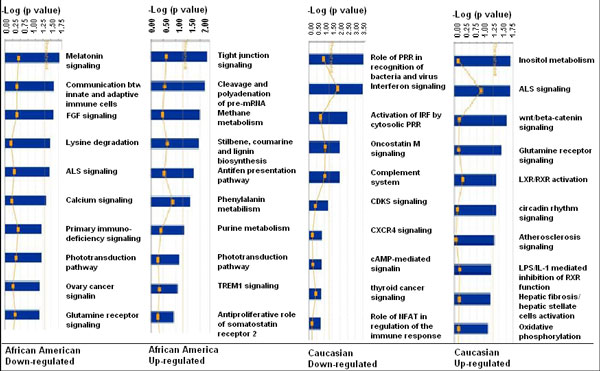
A whole human genome oligomicroarray of peripheral WBCs was performed on 144 samples obtained from 84 patients with T2D (44 AA and 40 CAU) and 60 healthy controls (28 AA and 32 CAU). The results showed that 30 genes had significant difference in expression between patients and controls (a fold change of <-1.4 or >1.4 with a P value <0.05). These known genes were mainly clustered in three functional categories: immune responses, lipid metabolism, and organismal injury/abnormaly. Transcriptomic analysis also showed that 574 genes were differentially expressed in AA diseased versus AA control, compared to 200 genes in CAU subjects. Pathway study revealed that "Communication between innate and adaptive immune cells"/"Primary immunodeficiency signaling" are significantly down-regulated in AA patients and "Interferon signaling"/"Complement System" are significantly down-regulated in CAU patients.
These newly identified genetic markers in WBCs provide valuable information about the pathophysiology of T2D and can be used for diagnosis and pharmaceutical drug design. Our results also found that AA and CAU patients with T2D express genes and pathways differently.
在美国,肥胖症、缺乏身体活动以及代谢紊乱的家族史是 2 型糖尿病(T2D)的风险因素。然而,人们对非裔美国人(AA)和高加索人(CAU)的 T2D 患者血液中的基因表达和转录组谱差异知之甚少,对这两个种族的外周白细胞(WBC)进行微阵列分析将有助于我们了解 T2D 的潜在分子机制,并确定导致差异的遗传生物标志物。
对 144 名 T2D 患者(44 名 AA 和 40 名 CAU)和 60 名健康对照者(28 名 AA 和 32 名 CAU)的外周 WBC 进行了全人类基因组寡微阵列分析。结果显示,30 个基因在患者和对照组之间的表达存在显著差异(倍数变化<-1.4 或>1.4,P 值<0.05)。这些已知的基因主要聚集在三个功能类别中:免疫反应、脂质代谢和机体损伤/异常。转录组分析还显示,与 CAU 患者的 200 个基因相比,AA 患病者中有 574 个基因表达差异。通路研究表明,“固有免疫和适应性免疫细胞之间的通讯”/“原发性免疫缺陷信号”在 AA 患者中显著下调,而“干扰素信号”/“补体系统”在 CAU 患者中显著下调。
WBC 中这些新鉴定的遗传标志物为 T2D 的病理生理学提供了有价值的信息,并可用于诊断和药物设计。我们的结果还发现,患有 T2D 的 AA 和 CAU 患者表达的基因和通路不同。