Ball George E, Acorn John H, Shpeley Danny
Department of Biological Sciences, University of Alberta, Edmonton, Alberta, Canada T6G 2E9.
Zookeys. 2011(147):39-83. doi: 10.3897/zookeys.147.2052. Epub 2011 Nov 16.
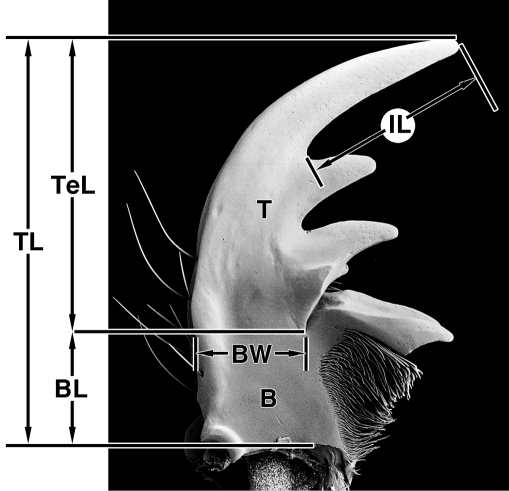
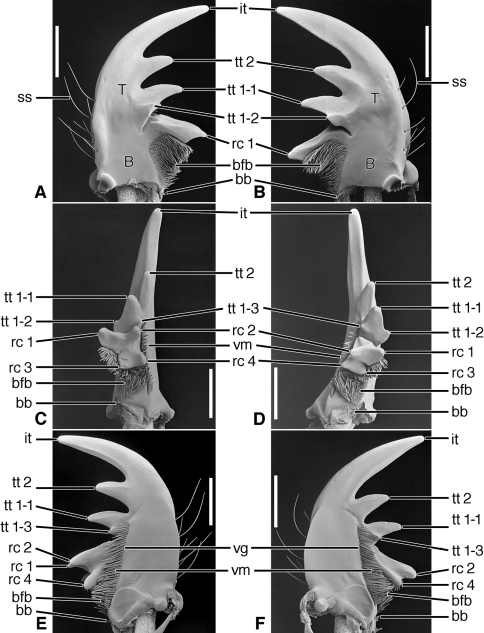
Using for comparison with, and as outgroups for, supertribe Cicindelitae, we describe and illustrate the mandibles and labrum-epipharynx of the basal geadephagans Trachypachus gibbsii LeConte, 1861 (family Trachypachidae), and family Carabidae: Pelophila rudis (LeConte, 1863) (supertribe Nebriitae, tribe Pelophilini) and Ceroglossus chilensis (Eschscholtz, 1829) (supertribe Carabitae, tribe Ceroglossini). The range and pattern of variation in structure of mandibles and labrum-epipharynx within the supertribe Cicindelitae was assessed using scanning-electron (SEM) images of these structures in nine exemplar taxa: Amblycheila baroni (Rivers, 1890), Omus californicus (Eschscholtz, 1829) and Picnochile fallaciosa (Chevrolat, 1854) (representing the Amblycheilini); Manticora tuberculata (DeGeer, 1778) (representing the Manticorini): Tetracha carolina (Linnaeus, 1767) (representing the Megacephalini); Pogonostoma chalybeum (Klug, 1835) (representing the Collyridini); and Therates basalis Dejean, 1826, Oxycheila species, and Cicindela longilabris Say, 1824 (representing the Cicindelini). An evolutionary transformation series was postulated for the mandibles and labrum-epipharynx, based on a reconstructed phylogenetic sequence, which, in turn, was based on morphological and DNAevidence.Principal features of the transformation series for the mandibles included development of a densely setose basal face; wide quadridentate retinaculum; a lengthened incisor tooth; a multidentate terebra (one to five teeth; two-three most frequent), followed by subsequent loss of one or more such teeth; development of a diastema in the occlusal surface; development and subsequent loss of scrobal setae, and reduction and loss of the scrobe. Principal features of the transformation series for the labrum included evolution of form from transverse, sub-rectangular to elongate almost square, to triangular; position and number of setae evolved from dorsal to insertion on the apical margin, the number increased from 8-10 to as many as 36, and decreased to as few as four. The epipharynx broadened evolutionarily, the pedium evolving in form from narrow, triangular and nearly flat, to broad, palatiform, and markedly convex; anterior parapedial setae both increased and decreased in number, and in orientation, from a row parallel to the parapedial ridge to a setal row extended forward at about a right angle to the latter.