Department of Hepatobiliary Surgery, The First Affiliated Hospital of Medical College, Xi'an Jiaotong University, Xi'an, Shaanxi, China.
Curr Pharm Des. 2012;18(17):2404-15. doi: 10.2174/13816128112092404.
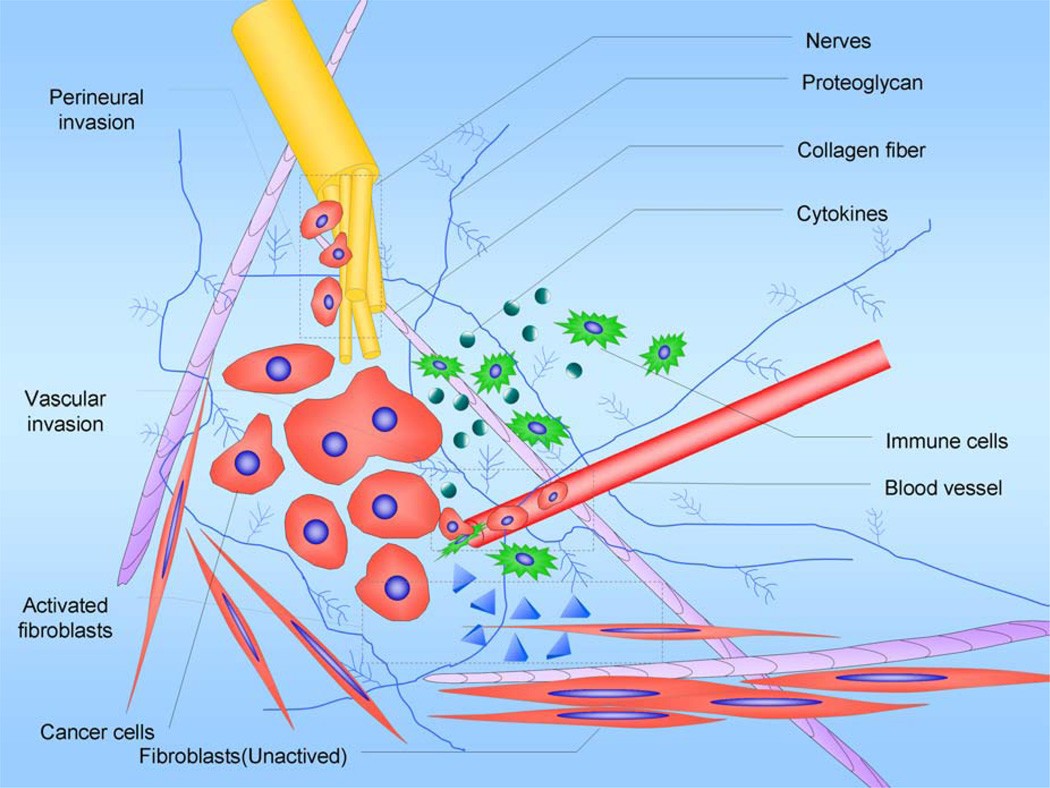
Recent studies have demonstrated that the interaction between the cancer and the stroma, play a key role in the development of pancreatic cancer. The desmoplasia, which consists of fibroblasts, pancreatic stellate cells, lymphatic and vascular endothelial cells, immune cells, pathologic increased nerves, and the extracellular matrix (ECM), creates a complex tumor microenvironment that promotes pancreatic cancer development, invasion, metastasis, and resistance to chemotherapy. Thus, the potential approach for targeting the components of this desmoplastic reaction or the pancreatic tumor microenvironment might represent a novel therapeutic approach to advanced pancreatic carcinoma. Novel therapies that target on the pancreatic tumor microenvironment should become one of the more effective treatments for pancreatic cancer.
最近的研究表明,癌症与基质之间的相互作用在胰腺癌的发展中起着关键作用。由成纤维细胞、胰腺星状细胞、淋巴管和血管内皮细胞、免疫细胞、病理性增加的神经和细胞外基质(ECM)组成的纤维变性,形成了一个促进胰腺癌发展、侵袭、转移和对化疗耐药的复杂肿瘤微环境。因此,针对这种纤维变性反应或胰腺肿瘤微环境成分的潜在治疗方法可能代表了一种治疗晚期胰腺癌的新方法。靶向胰腺肿瘤微环境的新疗法应该成为治疗胰腺癌的更有效方法之一。