Molecular Neurobiology Laboratory, The Salk Institute for Biological Studies, 10010 N. Torrey Pines Rd, La Jolla, CA 92037, USA.
Neural Dev. 2012 Feb 29;7:10. doi: 10.1186/1749-8104-7-10.
Cortical GABAergic interneurons (INs) are generated in the medial ganglionic eminence (MGE) and migrate tangentially into cortex. Because most, if not all, migrating MGE-derived INs express the neuregulin (NRG) receptor, ErbB4, we investigated influences of Nrg1 isoforms and Nrg3 on IN migration through ventral telencephalon (vTel) and within cortex.
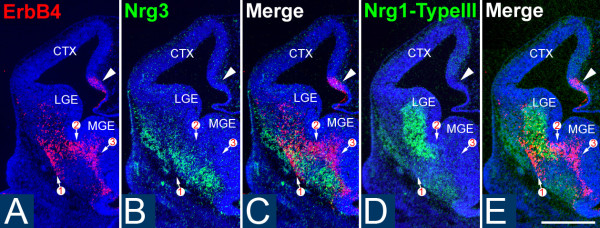
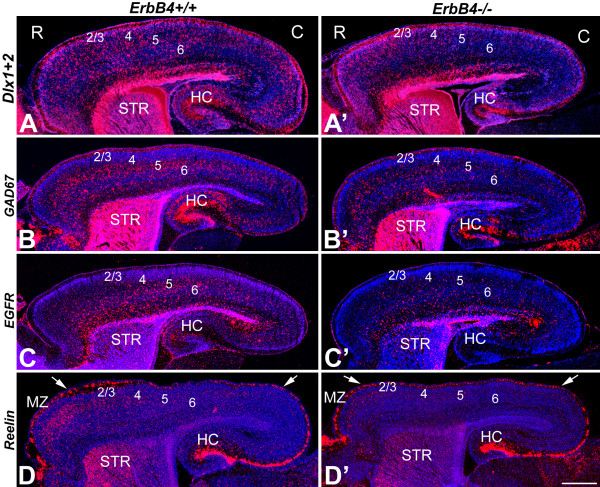
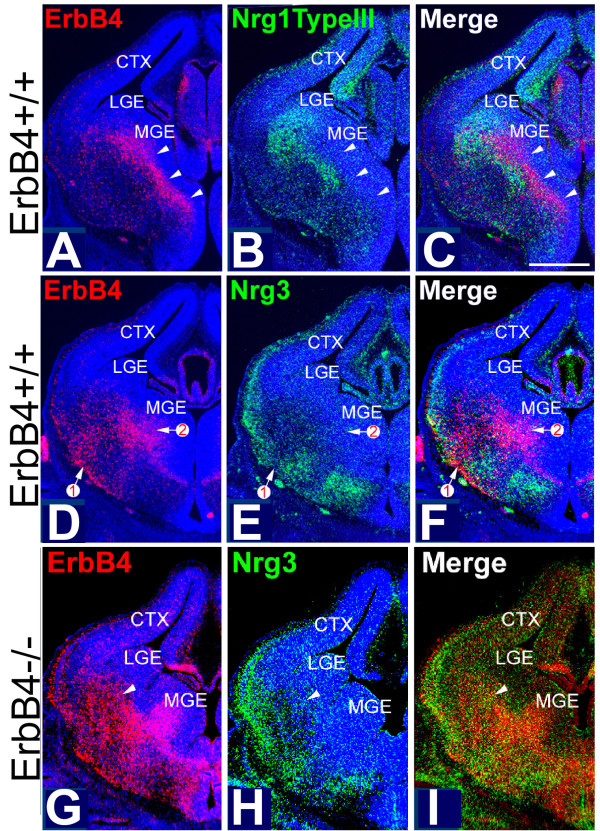
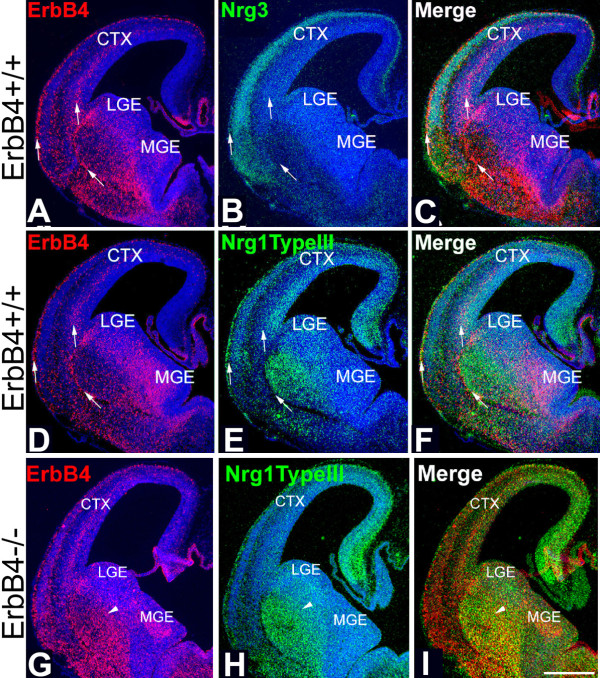
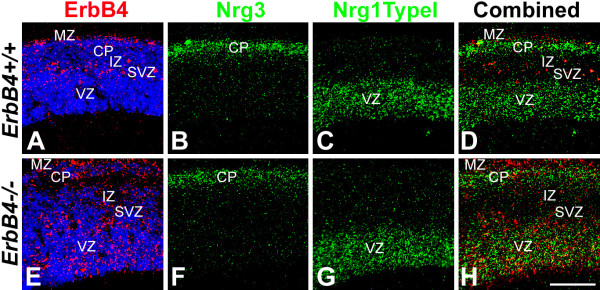
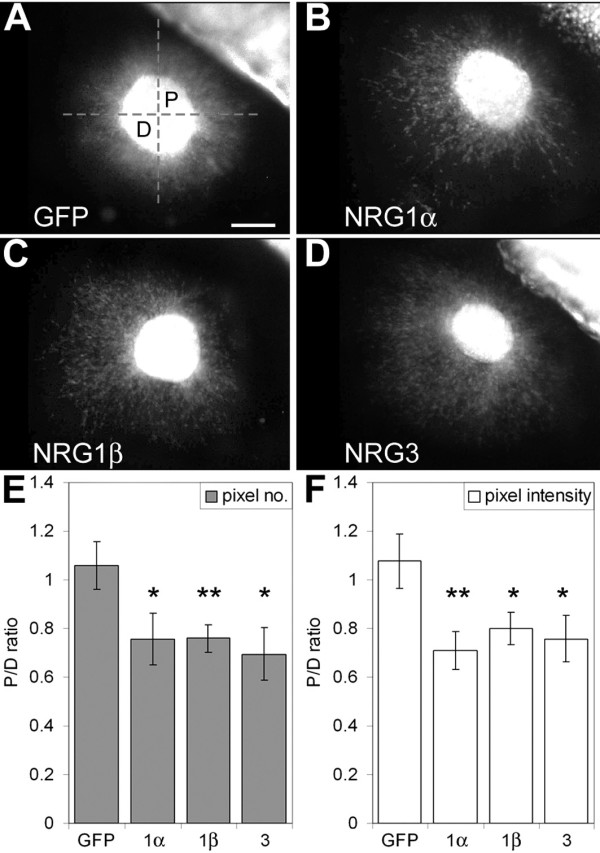
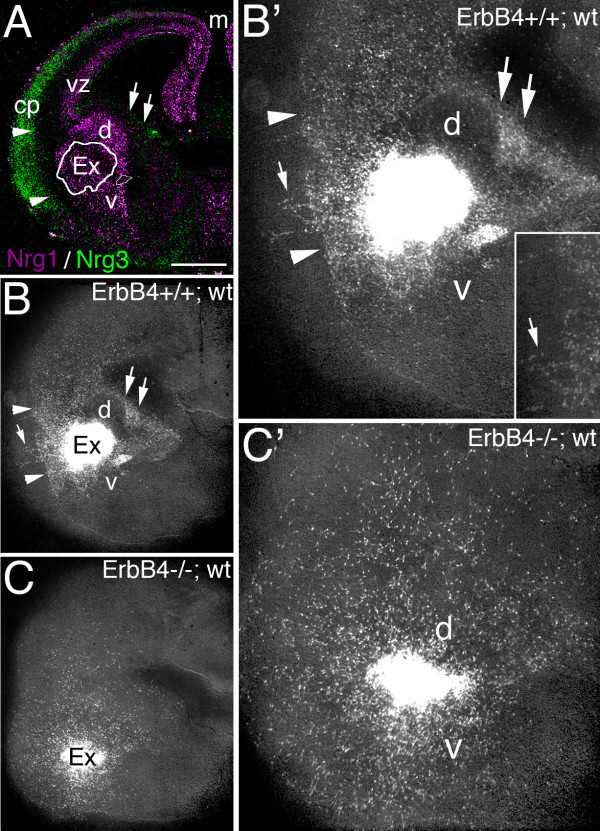
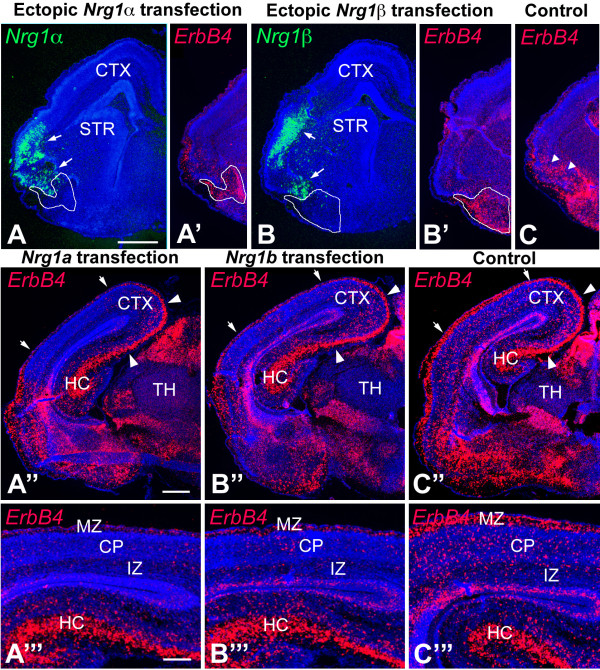
During IN migration, NRG expression domains and distributions of ErbB4-expressing, MGE-derived INs are complementary with minimal overlap, both in vTel and cortex. In wild-type mice, within fields of NRG expression, these INs are focused at positions of low or absent NRG expression. However, in ErbB4-/- HER4(heart) mutant mice in which INs lack ErbB4, these complementary patterns are degraded with considerable overlap evident between IN distribution and NRG expression domains. These findings suggest that NRGs are repellents for migrating ErbB4-expressing INs, a function supported by in vitro and in vivo experiments. First, in collagen co-cultures, MGE-derived cells preferentially migrate away from a source of secreted NRGs. Second, cells migrating from wild-type MGE explants on living forebrain slices from wild-type embryonic mice tend to avoid endogenous NRG expression domains, whereas this avoidance behavior is not exhibited by ErbB4-deficient cells migrating from MGE explants and instead they have a radial pattern with a more uniform distribution. Third, ectopic NRG expression in the IN migration pathway produced by in utero electroporation blocks IN migration and results in cortex distal to the blockade being largely devoid of INs. Finally, fewer INs reach cortex in ErbB4 mutants, indicating that NRG-ErbB4 signaling is required for directing IN migration from the MGE to cortex.
Our results show that NRGs act as repellents for migrating ErbB4-expressing, MGE-derived GABAergic INs and that the patterned expression of NRGs funnels INs as they migrate from the MGE to their cortical destinations.
皮质 GABA 能中间神经元(INs)在正中神经节隆起(MGE)中产生,并经切线迁移进入皮质。由于大多数(如果不是全部)迁移的 MGE 衍生 INs 表达神经调节蛋白(NRG)受体 ErbB4,因此我们研究了 Nrg1 同种型和 Nrg3 对 IN 通过腹侧端脑(vTel)和皮质内迁移的影响。
在 IN 迁移过程中,NRG 表达域和表达 ErbB4 的 MGE 衍生 IN 的分布在 vTel 和皮质中是互补的,且重叠最小。在野生型小鼠中,在 NRG 表达的区域内,这些 IN 集中在 NRG 表达水平低或不存在的位置。然而,在 ErbB4-/-HER4(心脏)突变小鼠中,这些互补模式被破坏,IN 分布和 NRG 表达区域之间明显重叠。这些发现表明,NRGs 是迁移的 ErbB4 表达 IN 的排斥物,这一功能得到了体外和体内实验的支持。首先,在胶原共培养物中,MGE 衍生细胞优先从分泌 NRG 的来源迁移。其次,从野生型 MGE 外植体在野生型胚胎小鼠活体前脑切片上迁移的细胞倾向于避开内源性 NRG 表达区域,而从 MGE 外植体迁移的 ErbB4 缺失细胞则不会表现出这种回避行为,而是具有放射状模式,分布更加均匀。第三,通过体内电穿孔在 IN 迁移途径中异位表达 NRG 会阻止 IN 迁移,并导致阻断后的皮质区域大部分缺乏 INs。最后,ErbB4 突变体中到达皮质的 IN 较少,表明 NRG-ErbB4 信号对于指导 MGE 到皮质的 IN 迁移是必需的。
我们的结果表明,NRGs 作为迁移的 ErbB4 表达的 MGE 衍生 GABA 能 INs 的排斥物,并且 NRGs 的模式表达在 IN 从 MGE 迁移到皮质目的地时引导 INs。