Plant Molecular and Cellular Biology Program and Horticultural Sciences Department, Interdisciplinary Center for Biotechnology Research, 1301 Fifield, PO Box 110690, University of Florida, Gainesville, FL 32611, USA.
J Exp Bot. 2012 May;63(8):3061-70. doi: 10.1093/jxb/ers022. Epub 2012 Feb 29.
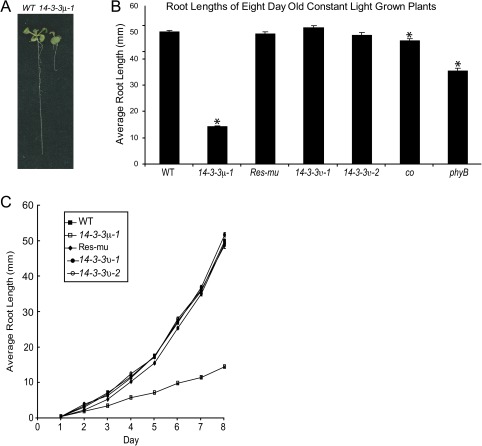
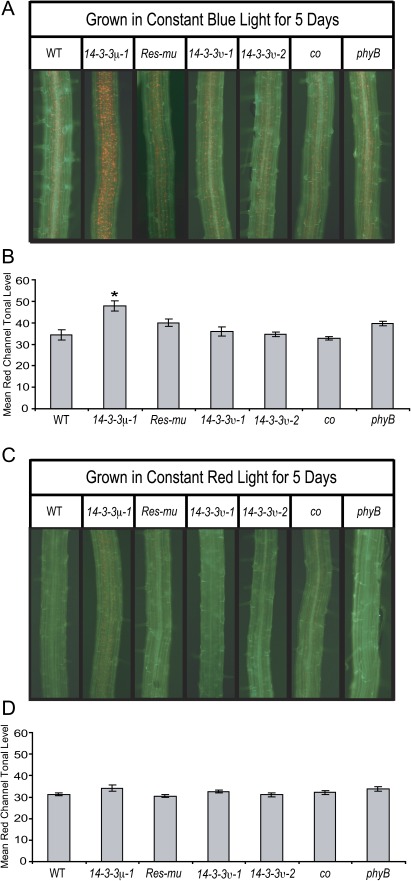
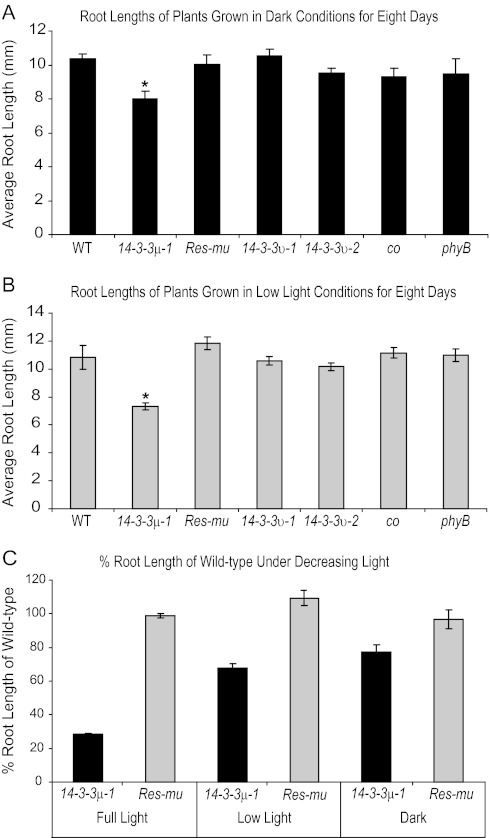
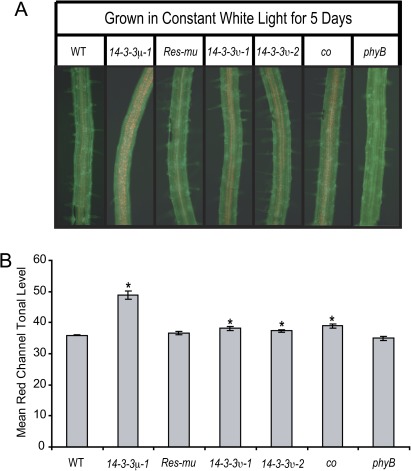
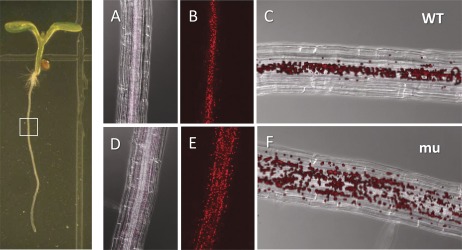
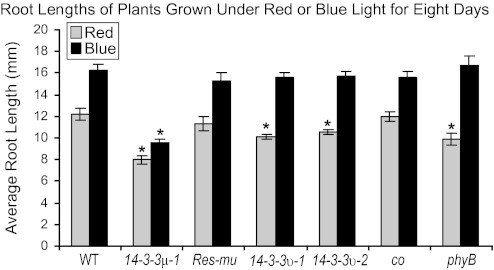
The 14-3-3 proteins specifically bind a number of client proteins to influence important pathways, including flowering timing via the photosensory system. For instance, 14-3-3 proteins influence the photosensory system through interactions with Constans (CO) protein. 14-3-3 associations with the photosensory system were further studied in this investigation using 14-3-3 T-DNA insertion mutants to study root and chloroplast development. The 14-3-3 μ T-DNA insertion mutant, 14-3-3μ-1, had shorter roots than the wild type and the difference in root length could be influenced by light intensity. The 14-3-3 ν T-DNA insertion mutants also had shorter roots, but only when grown under narrow-bandwidth red light. Five-day-old 14-3-3 T-DNA insertion and co mutants all had increased root greening compared with the wild type, which was influenced by light wavelength and intensity. However, beyond 10 d of growth, 14-3-3μ-1 roots did not increase in greening as much as wild-type roots. This study reveals new developmental roles of 14-3-3 proteins in roots and chloroplasts, probably via association with the photosensory system.
14-3-3 蛋白特异性地结合许多客户蛋白,以影响重要途径,包括通过光感受系统开花时间。例如,14-3-3 蛋白通过与 CONSTANS (CO) 蛋白相互作用影响光感受系统。本研究通过使用 14-3-3 T-DNA 插入突变体研究根和叶绿体发育,进一步研究了 14-3-3 蛋白与光感受系统的相互作用。14-3-3μT-DNA 插入突变体 14-3-3μ-1 的根比野生型短,并且根长的差异可以受到光强度的影响。14-3-3νT-DNA 插入突变体的根也较短,但仅在窄带宽红光下生长时才较短。与野生型相比,五天龄的 14-3-3 T-DNA 插入和共突变体的根的绿色化增加,这受到光波长和强度的影响。然而,在生长 10 天以上后,14-3-3μ-1 的根的绿色化增加不如野生型根那么多。本研究揭示了 14-3-3 蛋白在根和叶绿体中发育的新作用,可能通过与光感受系统的关联。