Department of Biology, Section of Cellular and Developmental Biology, University of Copenhagen, The August Krogh Building, Universitetsparken 13, 2100 Copenhagen Ø, Denmark.
J Membr Biol. 2012 Feb;245(2):77-87. doi: 10.1007/s00232-012-9416-8. Epub 2012 Mar 2.
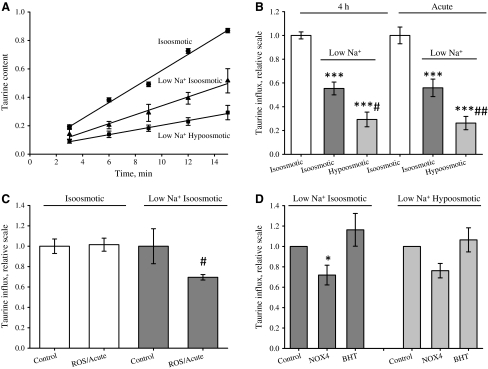
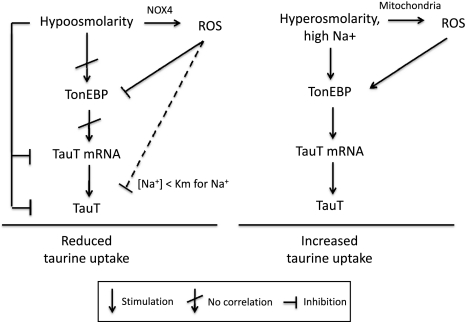
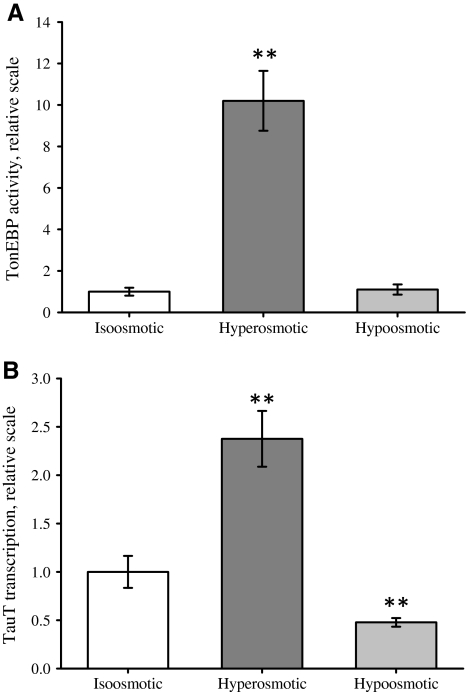
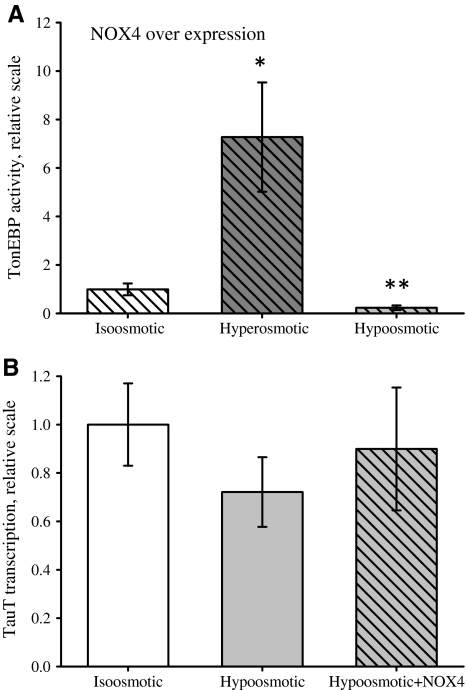
The present work was initiated to investigate regulation of the taurine transporter TauT by reactive oxygen species (ROS) and the tonicity-responsive enhancer binding protein (TonEBP) in NIH3T3 mouse fibroblasts during acute and long-term (4 h) exposure to low-sodium/hypo-osmotic stress. Taurine influx is reduced following reduction in osmolarity, keeping the extracellular Na(+) concentration constant. TonEBP activity is unaltered, whereas TauT transcription as well as TauT activity are significantly reduced under hypo-osmotic conditions. In contrast, TonEBP activity and TauT transcription are significantly increased following hyperosmotic exposure. Swelling-induced ROS production in NIH3T3 fibroblasts is generated by NOX4 and by increasing total ROS, by either exogenous application of H(2)O(2) or overexpressing NOX4, we demonstrate that TonEBP activity and taurine influx are regulated negatively by ROS under hypo-osmotic, low-sodium conditions, whereas the TauT mRNA level is unaffected. Acute exposure to ROS reduces taurine uptake as a result of modulated TauT transport kinetics. Thus, swelling-induced ROS production could account for the reduced taurine uptake under low-sodium/hypo-osmotic conditions by direct modulation of TauT.
本研究旨在探讨 NIH3T3 鼠成纤维细胞在急性(4 小时)和长期(4 小时)低渗/低渗应激下,活性氧(ROS)和张力应答增强结合蛋白(TonEBP)对牛磺酸转运体 TauT 的调节作用。渗透压降低时,牛磺酸内流减少,细胞外 Na+浓度保持不变。TonEBP 活性不变,而在低渗条件下 TauT 转录和 TauT 活性显著降低。相反,高渗暴露后 TonEBP 活性和 TauT 转录显著增加。NIH3T3 成纤维细胞的肿胀诱导 ROS 产生由 NOX4 产生,并通过增加总 ROS,通过外源性应用 H2O2 或过表达 NOX4,我们证明在低渗、低钠条件下,ROS 负调节 TonEBP 活性和牛磺酸内流,而 TauT mRNA 水平不受影响。ROS 的急性暴露会降低牛磺酸的摄取,这是由于 TauT 转运动力学的调节。因此,肿胀诱导的 ROS 产生可能通过直接调节 TauT 来解释低钠/低渗条件下牛磺酸摄取减少的原因。