Department of Biochemistry, School of Medical Sciences, University of Bristol, Bristol, United Kingdom.
PLoS One. 2012;7(2):e32386. doi: 10.1371/journal.pone.0032386. Epub 2012 Feb 22.
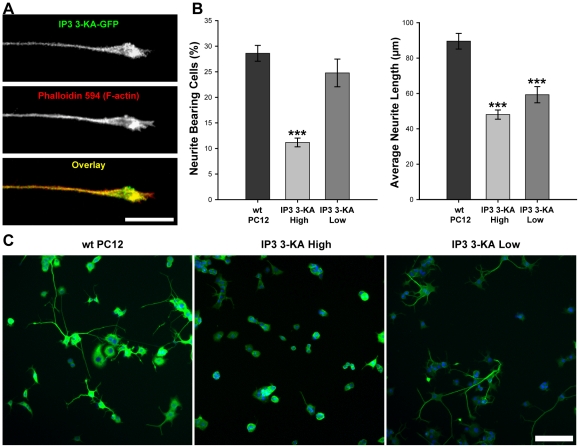
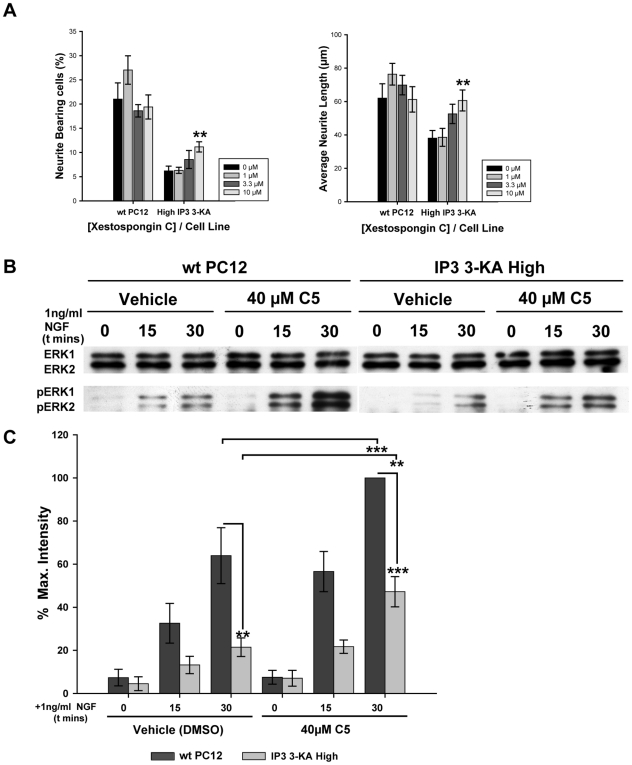
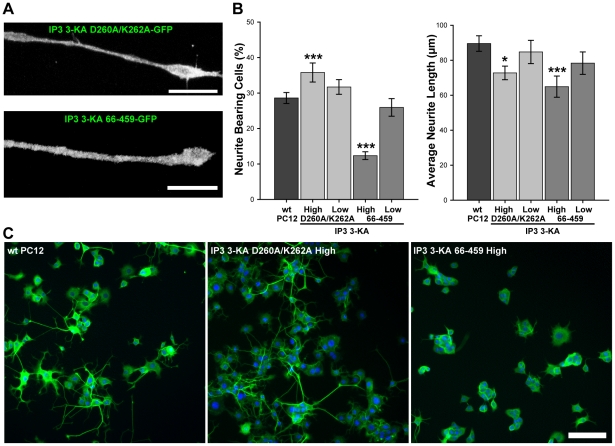
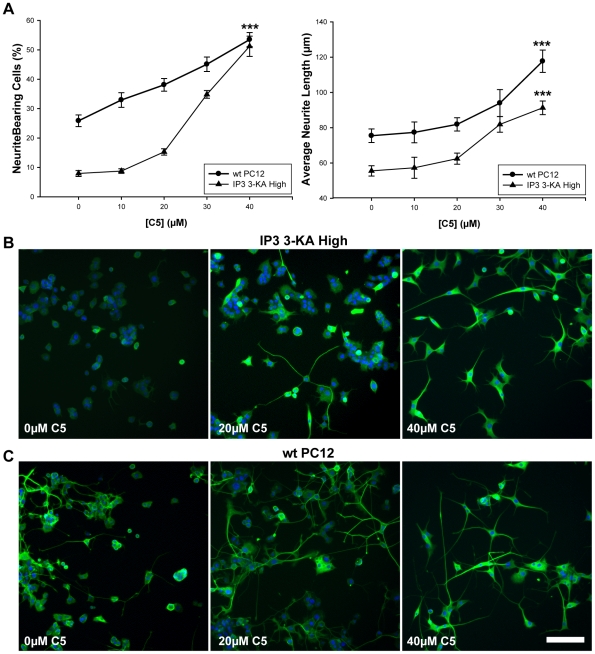
The inositol (1,4,5) trisphosphate 3-kinases comprise a family of enzymes (A, B, and C) that phosphorylate the calcium mobilising molecule inositol (1,4,5) trisphosphate (IP(3)) to generate inositol (1,3,4,5) tetrakisphosphate. This molecule can function as a second messenger, but its roles are not completely understood. The A isoform of inositol (1,4,5) trisphosphate 3-kinase localises to filamentous actin within dendritic spines in the hippocampus and is implicated in the regulation of spine morphology and long term potentiation, however the mechanisms through which it signals in neuronal cells are not completely understood. We have used NGF driven neurite outgrowth from PC12 cells as a platform to examine the impact of signaling via inositol (1,4,5) trisphosphate 3-kinase activity in a neuronal cell. We have found that the catalytic activity of the enzyme opposes neurite outgrowth, whilst pharmacological inhibition of inositol (1,4,5) trisphosphate 3-kinase leads to a significant increase in neurite outgrowth, and we show that the reduction in neurite outgrowth in response to inositol (1,4,5) trisphosphate 3-kinase activity correlates with reduced ERK activity as determined by western blotting using phosphorylation-specific antibodies. Our findings suggest a novel neuronal signaling pathway linking metabolism of IP(3) to signaling via ERK.
肌醇(1,4,5)三磷酸 3-激酶由一组酶(A、B 和 C)组成,它们将钙动员分子肌醇(1,4,5)三磷酸(IP(3))磷酸化生成肌醇(1,3,4,5)四磷酸。这种分子可以作为第二信使发挥作用,但它的作用尚未完全了解。肌醇(1,4,5)三磷酸 3-激酶 A 同工型定位于海马树突棘中的丝状肌动蛋白,与调节棘突形态和长时程增强有关,但其在神经元细胞中的信号传递机制尚未完全了解。我们利用 NGF 驱动的 PC12 细胞的神经突生长作为平台,研究了肌醇(1,4,5)三磷酸 3-激酶活性在神经元细胞中的信号传递的影响。我们发现,该酶的催化活性与神经突生长相反,而肌醇(1,4,5)三磷酸 3-激酶的药理学抑制作用导致神经突生长显著增加,我们表明,肌醇(1,4,5)三磷酸 3-激酶活性导致的神经突生长减少与 ERK 活性降低相关,这是通过使用磷酸化特异性抗体的 Western 印迹来确定的。我们的发现表明,一种将 IP(3)代谢与 ERK 信号传递联系起来的新型神经元信号通路。