Laboratory of Toxicology and Chemistry, National Institute of Environmental Health Sciences, NIH, Research Triangle Park, NC 27709, USA.
Nucleic Acids Res. 2012 Jul;40(12):5477-86. doi: 10.1093/nar/gks180. Epub 2012 Mar 2.
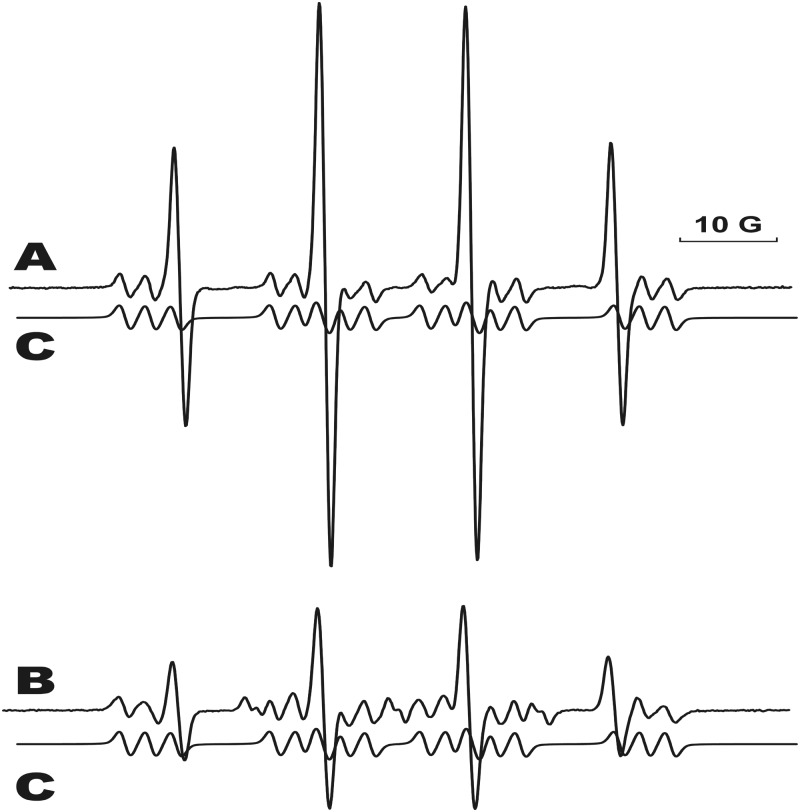
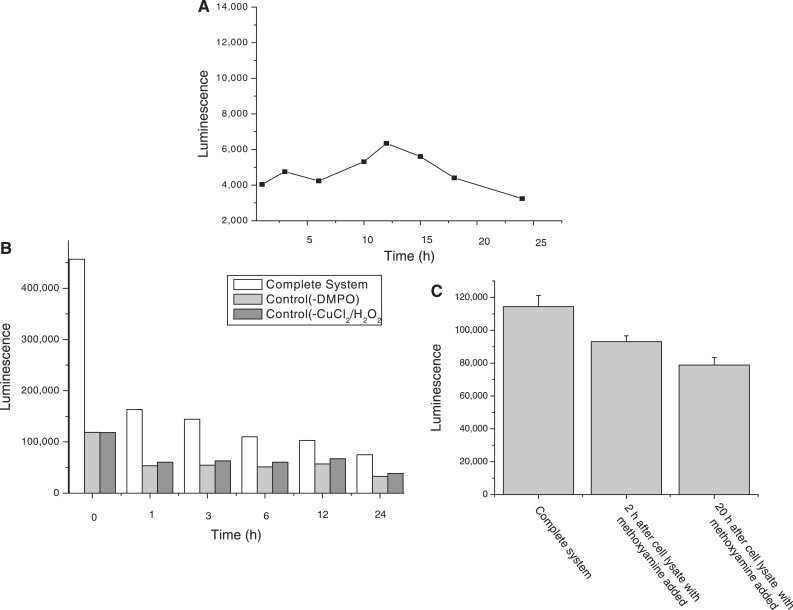
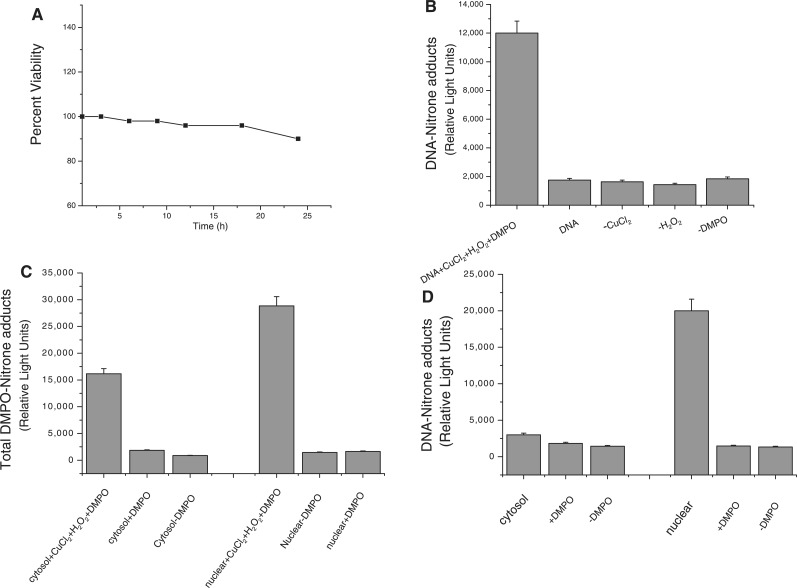
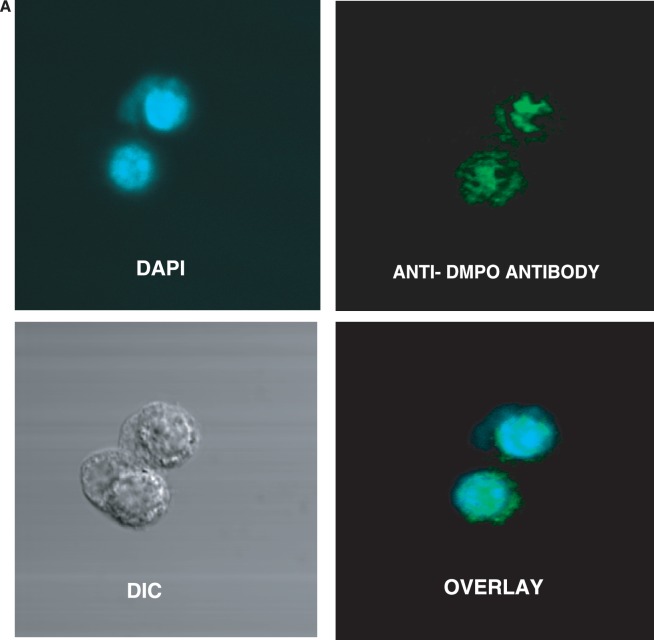
Oxidative stress-related damage to the DNA macromolecule produces lesions that are implicated in various diseases. To understand damage to DNA, it is important to study the free radical reactions causing the damage. Measurement of DNA damage has been a matter of debate as most of the available methods measure the end product of a sequence of events and provide limited information on the initial free radical formation. We report a measurement of free radical damage in DNA induced by a Cu(II)-H(2)O(2) oxidizing system using immuno-spin trapping supplemented with electron paramagnetic resonance. In this investigation, the short-lived radical generated is trapped by the spin trap 5,5-dimethyl-1-pyrroline N-oxide (DMPO) immediately upon formation. The DMPO adduct formed is initially electron paramagnetic resonance active, but is subsequently oxidized to the stable nitrone adduct, which can be detected and visualized by immuno-spin trapping and has the potential to be further characterized by other analytical techniques. The radical was found to be located on the 2'-deoxyadenosine (dAdo) moiety of DNA. The nitrone adduct was repaired on a time scale consistent with DNA repair. In vivo experiments for the purpose of detecting DMPO-DNA nitrone adducts should be conducted over a range of time in order to avoid missing adducts due to the repair processes.
氧化应激相关的 DNA 大分子损伤会产生病变,这些病变与各种疾病有关。为了了解 DNA 的损伤,研究导致损伤的自由基反应非常重要。由于大多数可用的方法都测量一系列事件的最终产物,因此对 DNA 损伤的测量一直存在争议,并且只能提供有关初始自由基形成的有限信息。我们使用免疫自旋捕获技术,结合电子顺磁共振波谱,报告了 Cu(II)-H(2)O(2)氧化体系诱导的 DNA 中自由基损伤的测量结果。在这项研究中,短寿命自由基一形成就被自旋捕获剂 5,5-二甲基-1-吡咯啉 N-氧化物(DMPO)立即捕获。形成的 DMPO 加合物最初具有电子顺磁共振活性,但随后被氧化为稳定的硝酮加合物,该加合物可以通过免疫自旋捕获检测和可视化,并有可能通过其他分析技术进一步表征。该自由基被发现位于 DNA 的 2'-脱氧腺苷(dAdo)部分。硝酮加合物在与 DNA 修复一致的时间尺度上进行修复。为了避免因修复过程而错过加合物,体内实验检测 DMPO-DNA 硝酮加合物应该在一段时间内进行。