Andersson Neil, Paredes-Solís Sergio, Milne Deborah, Omer Khalid, Marokoane Nobantu, Laetsang Ditiro, Cockcroft Anne
Universidad Autónoma de Guerrero, Centro de Investigación de Enfermedades Tropicales, Acapulco, Mexico.
BMJ Open. 2012 Mar 2;2(2):e000754. doi: 10.1136/bmjopen-2011-000754. Print 2012.
To study prevalence at two time points and risk factors for experience of forced or coerced sex among school-going youth in 10 southern African countries.
Cross-sectional surveys, by facilitated self-administered questionnaire, of in-school youth in 2003 and 2007.
Schools serving representative communities in eight countries (Botswana, Lesotho, Malawi, Mozambique, Namibia, Swaziland, Zambia and Zimbabwe) in 2003 and with Tanzania and South Africa added in 2007.
Students aged 11-16 years present in the school classes.
Experience of forced or coerced sex, perpetration of forced sex.
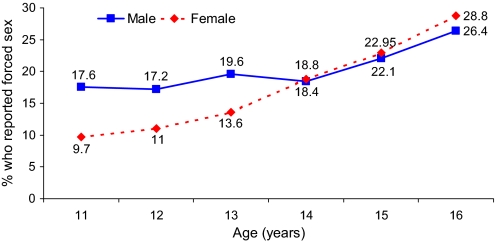
In 2007, 19.6% (4432/25 840) of female students and 21.1% (4080/21 613) of male students aged 11-16 years reported they had experienced forced or coerced sex. Rates among 16-year-olds were 28.8% in females and 25.4% in males. Comparing the same schools in eight countries, in an analysis age standardised on the 2007 Botswana male sample, there was no significant decrease between 2003 and 2007 among females in any country and inconsistent changes among males. In multilevel analysis using generalised linear mixed model, individual-level risk factors for forced sex among female students were age over 13 years and insufficient food in the household; school-level factors were a lower proportion of students knowing about child rights and higher proportions experiencing or perpetrating forced sex; and community-level factors were a higher proportion of adults in favour of transactional sex and a higher rate of intimate partner violence. Male risk factors were similar. Some 4.7% of female students and 11.7% of male students reported they had perpetrated forced sex. Experience of forced sex was strongly associated with perpetration and other risk factors for perpetration were similar to those for victimisation.
Forced or coerced sex remained common among female and male youth in 2007. Experience of sexual abuse in childhood is recognised to increase the risk of HIV infection. The association the authors found between forced sex and school-level factors suggests preventive interventions in schools could help to tackle the HIV epidemic in southern Africa.
研究10个南部非洲国家在校青年在两个时间点的强迫或胁迫性行为发生率及风险因素。
2003年和2007年通过简易自填问卷对在校青年进行横断面调查。
2003年在8个国家(博茨瓦纳、莱索托、马拉维、莫桑比克、纳米比亚、斯威士兰、赞比亚和津巴布韦)具有代表性社区的学校开展调查,2007年增加了坦桑尼亚和南非。
在校班级中年龄在11至16岁的学生。
强迫或胁迫性行为经历、强迫性行为实施情况。
2007年,11至16岁的女学生中有19.6%(4432/25840)、男学生中有21.1%(4080/21613)报告称他们经历过强迫或胁迫性行为。16岁学生中的发生率,女性为28.8%,男性为25.4%。在对8个国家相同学校进行比较时,以2007年博茨瓦纳男性样本为标准进行年龄标准化分析,2003年至2007年期间,任何国家的女性发生率均无显著下降,男性的变化则不一致。在使用广义线性混合模型的多水平分析中,女学生强迫性行为的个体层面风险因素为年龄超过13岁以及家庭食物不足;学校层面因素为了解儿童权利的学生比例较低以及经历或实施强迫性行为的比例较高;社区层面因素为支持交易性性行为的成年人比例较高以及亲密伴侣暴力发生率较高。男性的风险因素与之相似。约4.7%的女学生和11.7%的男学生报告称他们实施过强迫性行为。强迫性行为经历与实施行为密切相关,实施行为的其他风险因素与受害风险因素相似。
2007年,强迫或胁迫性行为在青年男女中仍然很常见。童年期性虐待经历被认为会增加感染艾滋病毒的风险。作者发现的强迫性行为与学校层面因素之间的关联表明,在学校开展预防性干预措施可能有助于应对南部非洲的艾滋病毒疫情。