Pharmaceutical Department, University of Parma, Parma, Italy.
PLoS One. 2012;7(2):e32397. doi: 10.1371/journal.pone.0032397. Epub 2012 Feb 28.
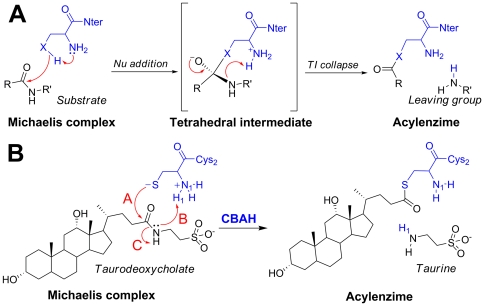
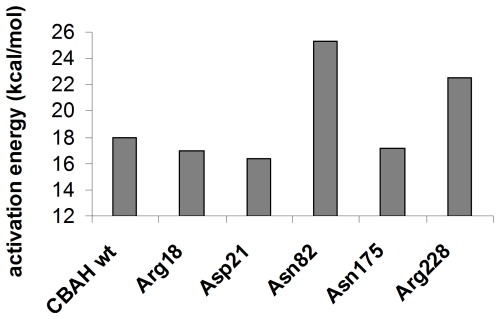
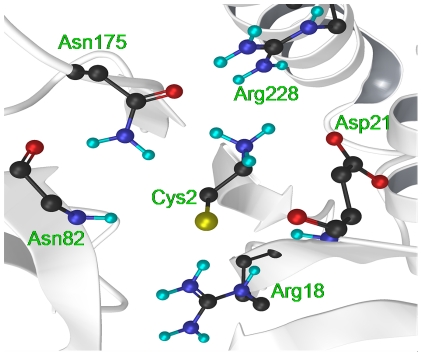
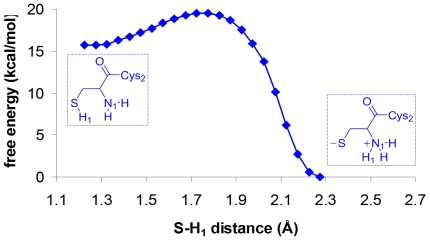
The N-terminal nucleophile (Ntn) hydrolases are a superfamily of enzymes specialized in the hydrolytic cleavage of amide bonds. Even though several members of this family are emerging as innovative drug targets for cancer, inflammation, and pain, the processes through which they catalyze amide hydrolysis remains poorly understood. In particular, the catalytic reactions of cysteine Ntn-hydrolases have never been investigated from a mechanistic point of view. In the present study, we used free energy simulations in the quantum mechanics/molecular mechanics framework to determine the reaction mechanism of amide hydrolysis catalyzed by the prototypical cysteine Ntn-hydrolase, conjugated bile acid hydrolase (CBAH). The computational analyses, which were confirmed in water and using different CBAH mutants, revealed the existence of a chair-like transition state, which might be one of the specific features of the catalytic cycle of Ntn-hydrolases. Our results offer new insights on Ntn-mediated hydrolysis and suggest possible strategies for the creation of therapeutically useful inhibitors.
N-末端亲核试剂(Ntn)水解酶是一类专门催化酰胺键水解的酶超家族。尽管该家族的几个成员作为癌症、炎症和疼痛的创新药物靶点而崭露头角,但它们催化酰胺水解的过程仍知之甚少。特别是,半胱氨酸 Ntn-水解酶的催化反应从未从机械观点进行过研究。在本研究中,我们使用量子力学/分子力学框架中的自由能模拟来确定典型半胱氨酸 Ntn-水解酶结合胆酸水解酶(CBAH)催化的酰胺水解反应机制。通过在水中和使用不同 CBAH 突变体进行的计算分析,揭示了椅式过渡态的存在,这可能是 Ntn-水解酶催化循环的特征之一。我们的结果提供了关于 Ntn 介导的水解的新见解,并为创建治疗上有用的抑制剂提供了可能的策略。