Department of Neuroanatomy, Medical School Homburg/Saar, Institute for Anatomy and Cell Biology, Saarland University Saarland, Germany.
Front Mol Neurosci. 2012 Feb 29;5:26. doi: 10.3389/fnmol.2012.00026. eCollection 2012.
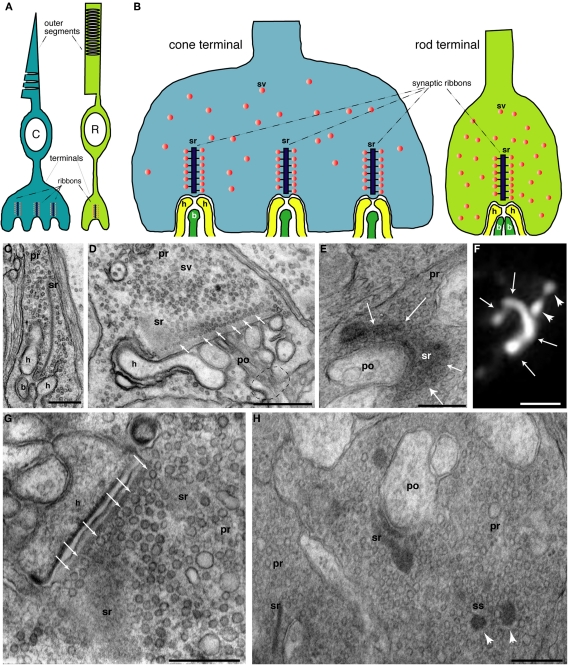
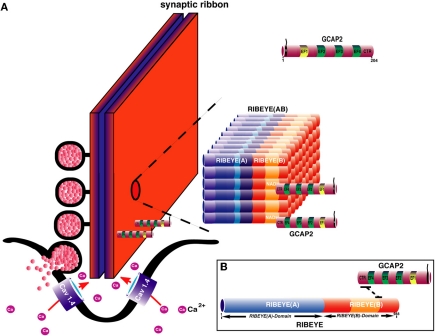
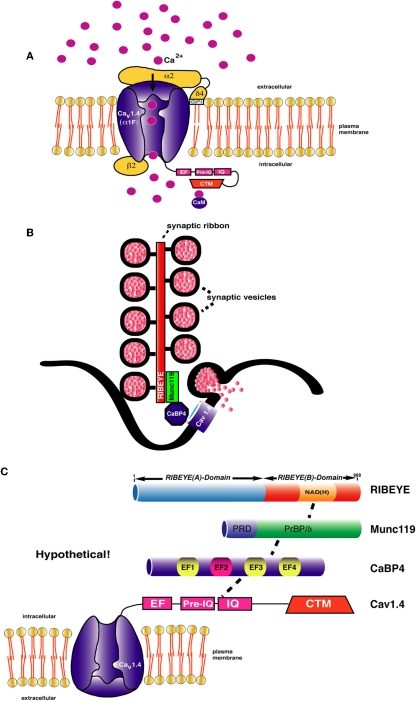
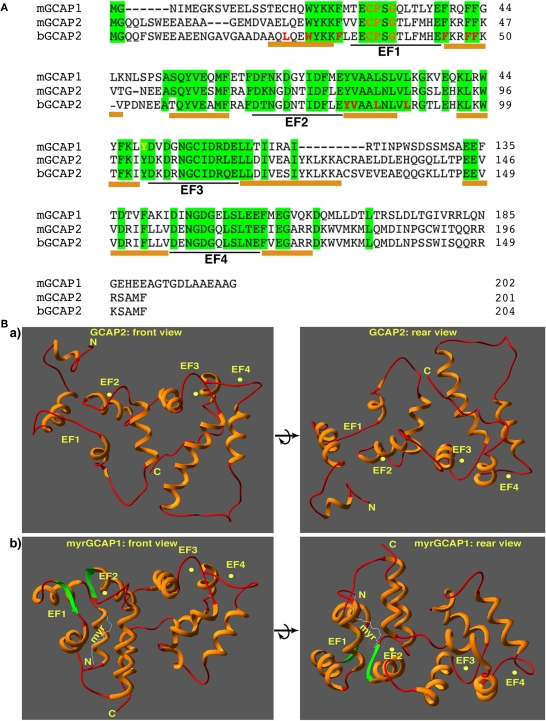
Photoreceptors, the light-sensitive receptor neurons of the retina, receive and transmit a plethora of visual informations from the surrounding world. Photoreceptors capture light and convert this energy into electrical signals that are conveyed to the inner retina. For synaptic communication with the inner retina, photoreceptors make large active zones that are marked by synaptic ribbons. These unique synapses support continuous vesicle exocytosis that is modulated by light-induced, graded changes of membrane potential. Synaptic transmission can be adjusted in an activity-dependent manner, and at the synaptic ribbons, Ca(2+)- and cGMP-dependent processes appear to play a central role. EF-hand-containing proteins mediate many of these Ca(2+)- and cGMP-dependent functions. Since continuous signaling of photoreceptors appears to be prone to malfunction, disturbances of Ca(2+)- and cGMP-mediated signaling in photoreceptors can lead to visual defects, retinal degeneration (rd), and even blindness. This review summarizes aspects of signal transmission at the photoreceptor presynaptic terminals that involve EF-hand-containing Ca(2+)-binding proteins.
光感受器是视网膜中对光敏感的受体神经元,它接收并传递来自周围世界的大量视觉信息。光感受器捕捉光线,并将这种能量转化为电信号,传递到视网膜内部。为了与视网膜内部进行突触通讯,光感受器形成了由突触带标记的大型活性区。这些独特的突触支持由光诱导的膜电位分级变化调制的连续囊泡胞吐作用。突触传递可以以活动依赖性的方式进行调节,而在突触带上,Ca(2+)和 cGMP 依赖性过程似乎起着核心作用。EF 手结构域蛋白介导了许多这些 Ca(2+)和 cGMP 依赖性的功能。由于光感受器的持续信号似乎容易出现故障,因此光感受器中 Ca(2+)和 cGMP 介导的信号紊乱可导致视觉缺陷、视网膜变性 (rd),甚至失明。本综述总结了涉及 EF 手结构域 Ca(2+)结合蛋白的光感受器突触前末梢信号转导的各个方面。