Department of Plant Developmental Genetics, Institute of Biophysics, Academy of Sciences of the Czech Republic, v.v.i., Brno, Czech Republic.
PLoS One. 2012;7(2):e31898. doi: 10.1371/journal.pone.0031898. Epub 2012 Feb 29.
Genome size evolution is a complex process influenced by polyploidization, satellite DNA accumulation, and expansion of retroelements. How this process could be affected by different reproductive strategies is still poorly understood.
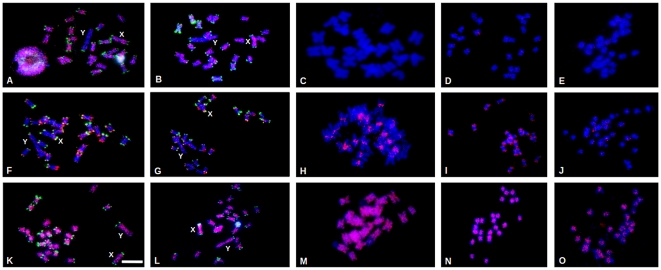
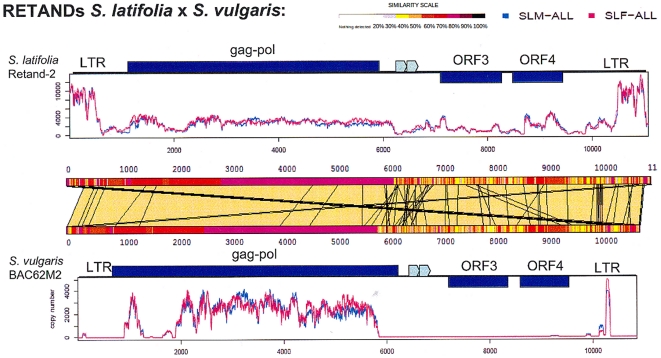
METHODOLOGY/PRINCIPAL FINDINGS: We analyzed differences in the number and distribution of major repetitive DNA elements in two closely related species, Silene latifolia and S. vulgaris. Both species are diploid and possess the same chromosome number (2n = 24), but differ in their genome size and mode of reproduction. The dioecious S. latifolia (1C = 2.70 pg DNA) possesses sex chromosomes and its genome is 2.5× larger than that of the gynodioecious S. vulgaris (1C = 1.13 pg DNA), which does not possess sex chromosomes. We discovered that the genome of S. latifolia is larger mainly due to the expansion of Ogre retrotransposons. Surprisingly, the centromeric STAR-C and TR1 tandem repeats were found to be more abundant in S. vulgaris, the species with the smaller genome. We further examined the distribution of major repetitive sequences in related species in the Caryophyllaceae family. The results of FISH (fluorescence in situ hybridization) on mitotic chromosomes with the Retand element indicate that large rearrangements occurred during the evolution of the Caryophyllaceae family.
CONCLUSIONS/SIGNIFICANCE: Our data demonstrate that the evolution of genome size in the genus Silene is accompanied by the expansion of different repetitive elements with specific patterns in the dioecious species possessing the sex chromosomes.
基因组大小的进化是一个复杂的过程,受到多倍体化、卫星 DNA 积累和反转录转座子扩张的影响。不同繁殖策略如何影响这个过程仍知之甚少。
方法/主要发现:我们分析了两个密切相关的物种,长柱剪秋罗(Silene latifolia)和普通剪秋罗(S. vulgaris)中主要重复 DNA 元件的数量和分布的差异。这两个物种都是二倍体,具有相同的染色体数(2n=24),但基因组大小和繁殖方式不同。雌雄异株的长柱剪秋罗(1C=2.70pgDNA)具有性染色体,其基因组比没有性染色体的雌雄同株的普通剪秋罗(1C=1.13pgDNA)大 2.5 倍。我们发现,长柱剪秋罗的基因组较大主要是由于 Ogre 反转录转座子的扩张。令人惊讶的是,在基因组较小的普通剪秋罗中,发现着丝粒 STAR-C 和 TR1 串联重复序列更为丰富。我们进一步研究了石竹科家族中相关物种的主要重复序列的分布。用 Retand 元件进行有丝分裂染色体的 FISH(荧光原位杂交)的结果表明,在石竹科家族的进化过程中发生了大规模的重排。
结论/意义:我们的数据表明,长柱剪秋罗属的基因组大小的进化伴随着不同重复元件的扩张,在具有性染色体的雌雄异株物种中具有特定的模式。