Psychiatric Centre Copenhagen, Rigshospitalet, University Hospital of Copenhagen, Copenhagen, Denmark.
PLoS One. 2012;7(2):e31980. doi: 10.1371/journal.pone.0031980. Epub 2012 Feb 29.
The serotonergic neurotransmitter system is closely linked to depression and personality traits. It is not known if selective serotonin reuptake inhibitors (SSRI) have an effect on neuroticism that is independent of their effect on depression. Healthy individuals with a genetic liability for depression represent a group of particular interest when investigating if intervention with SSRIs affects personality. The present trial is the first to test the hypothesis that escitalopram may reduce neuroticism in healthy first-degree relatives of patients with major depressive disorder (MD).
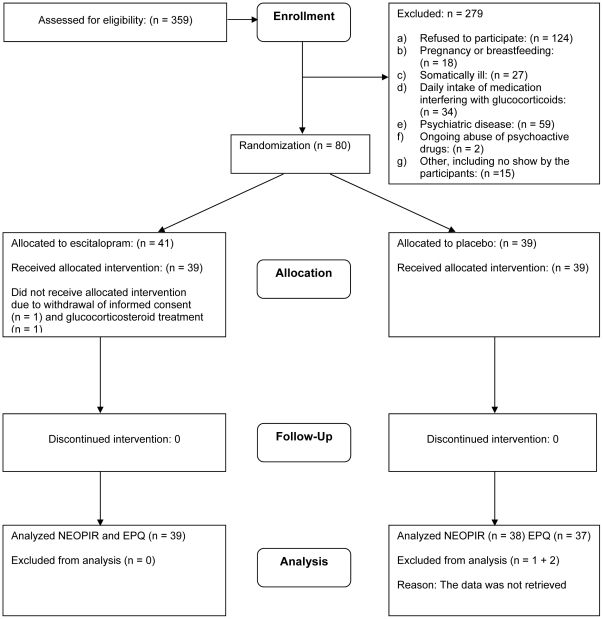
The trial used a randomized, blinded, placebo-controlled parallel-group design. We examined the effect of four weeks escitalopram 10 mg daily versus matching placebo on personality in 80 people who had a biological parent or sibling with a history of MD. The outcome measure on personality traits was change in self-reported neuroticism scores on the Revised Neuroticism-Extroversion-Openness-Personality Inventory (NEO-PI-R) and the Eysenck Personality Inventory (EPQ) from entry until end of four weeks of intervention.
When compared with placebo, escitalopram did not significantly affect self-reported NEO-PI-R and EPQ neuroticism and extroversion, EPQ psychoticism, NEO-PI-R openness, or NEO-PI-R conscientiousness (p all above 0.05). However, escitalopram increased NEO-PI-R agreeableness scores significantly compared with placebo (mean; SD) (2.38; 8.09) versus (-1.32; 7.94), p = 0.046), but not following correction for multiplicity. A trend was shown for increased conscientiousness (p = 0.07). There was no significant effect on subclinical depressive symptoms (p = 0.6).
In healthy first-degree relatives of patients with MD, there is no effect of escitalopram on neuroticism, but it is possible that escitalopram may increase the personality traits of agreeableness and conscientiousness.
Clinicaltrials.gov NCT00386841.
血清素能神经递质系统与抑郁和人格特质密切相关。目前尚不清楚选择性 5-羟色胺再摄取抑制剂(SSRIs)是否对神经质有影响,而这种影响与它们对抑郁的影响无关。对于那些有抑郁遗传倾向的健康个体来说,当研究 SSRIs 干预是否会影响人格时,他们是一个特别有趣的群体。本试验首次测试了假设,即艾司西酞普兰可能会降低重度抑郁症(MD)患者一级亲属的神经质。
该试验采用随机、双盲、安慰剂对照平行组设计。我们检查了在 80 名有 MD 病史的生物学父母或兄弟姐妹的健康个体中,每天服用艾司西酞普兰 10 毫克 4 周与匹配安慰剂对人格的影响。人格特质的结果测量是在 4 周干预开始到结束时,自我报告的神经质评分的变化,使用修订后的神经质-外向性-开放性-人格量表(NEO-PI-R)和艾森克人格问卷(EPQ)进行评估。
与安慰剂相比,艾司西酞普兰对自我报告的 NEO-PI-R 和 EPQ 神经质和外向性、EPQ 精神病质、NEO-PI-R 开放性或 NEO-PI-R 尽责性均无显著影响(p 均大于 0.05)。然而,与安慰剂相比,艾司西酞普兰显著增加了 NEO-PI-R 的宜人性评分(均值;标准差)(2.38;8.09)与(-1.32;7.94),p=0.046),但未进行多重校正。尽责性呈增加趋势(p=0.07)。对亚临床抑郁症状无显著影响(p=0.6)。
在 MD 患者的一级亲属中,艾司西酞普兰对神经质没有影响,但它可能会增加宜人性和尽责性的人格特质。
Clinicaltrials.gov NCT00386841。