Department of Neurology, University of Michigan Medical School, Ann Arbor, Michigan, United States of America.
PLoS One. 2012;7(2):e32245. doi: 10.1371/journal.pone.0032245. Epub 2012 Feb 29.
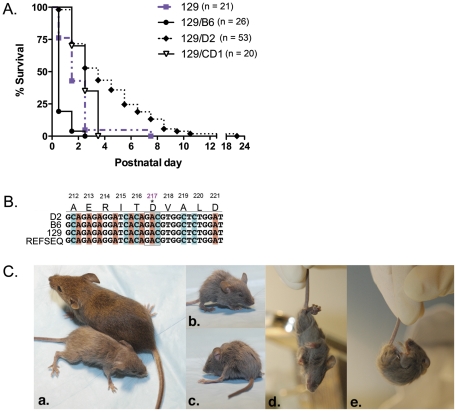
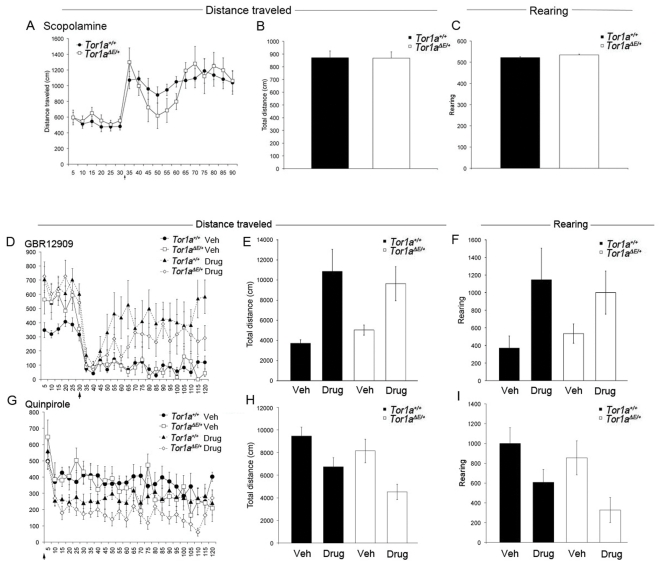
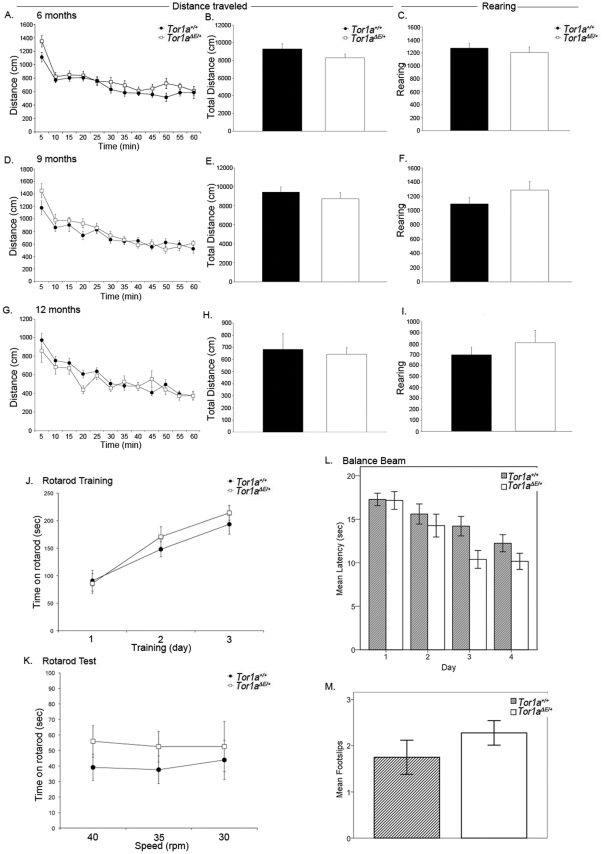
DYT1 dystonia is a debilitating neurological disease characterized by involuntary twisting movements. The disease is caused by an in-frame deletion (GAG, "ΔE") mutation in the TOR1A gene that encodes the torsinA protein. Intriguingly, only 30% of mutation carriers exhibit motor symptoms despite the fact that functional brain imaging studies show abnormal brain metabolism in all carriers. Because genetic modifiers may be a determinant of this reduced penetrance, we examined the genetic contribution of three different inbred strains of mice on the DYT1 mutation in animals that are homozygous (Tor1a(ΔE/ΔE)) or heterozygous (Tor1a(ΔE/+); disease state) for the disease-causing ΔE mutation. We find that the DBA/2J, C57BL/6J, and CD1-ICR contribution of genes significantly alter lifespan in Tor1a(ΔE/ΔE) mice, which die during the first few days of life on the 129S6/SvEvTac (129) background. The C57BL/6J (B6) strain significantly decreases life expectancy of Tor1a(ΔE/ΔE) animals but, like 129S6/SvEvTac Tor1a(ΔE/+) mice, congenic C57BL/6J Tor1a(ΔE/+) mice do not exhibit any motor abnormalities. In contrast, the DBA/2J (D2) strain significantly increases life expectancy. This effect was not present in congenic DBA/2J Tor1a(ΔE/ΔE) mice, indicating that the extended lifespan of F2 129/D2 mice was due to a combination of homozygous and heterozygous allelic effects. Our observations suggest that genetic modifiers may alter the penetrance of the ΔE mutation, and that mapping these modifiers may provide fresh insight into the torsinA molecular pathway.
DYT1 型肌张力障碍是一种使人衰弱的神经系统疾病,其特征是不自主的扭曲运动。该疾病是由 TOR1A 基因中的框内缺失(GAG,“ΔE”)突变引起的,该基因编码 torsinA 蛋白。有趣的是,尽管功能脑成像研究显示所有携带者的大脑代谢异常,但只有 30%的突变携带者表现出运动症状。由于遗传修饰因子可能是这种低外显率的决定因素,因此我们研究了三种不同近交系小鼠对 DYT1 突变的遗传贡献,这些小鼠是该疾病致病 ΔE 突变的纯合子(Tor1a(ΔE/ΔE))或杂合子(Tor1a(ΔE/+);疾病状态)。我们发现,DBA/2J、C57BL/6J 和 CD1-ICR 对基因的贡献显著改变了 Tor1a(ΔE/ΔE)小鼠的寿命,这些小鼠在 129S6/SvEvTac(129)背景下的生命的最初几天内死亡。C57BL/6J(B6)品系显著降低了 Tor1a(ΔE/ΔE)动物的预期寿命,但与 129S6/SvEvTac Tor1a(ΔE/+)小鼠一样,同基因 C57BL/6J Tor1a(ΔE/+)小鼠没有表现出任何运动异常。相比之下,DBA/2J(D2)品系显著增加了预期寿命。这种效应在同基因 DBA/2J Tor1a(ΔE/ΔE)小鼠中不存在,表明 F2 129/D2 小鼠的延长寿命是由于纯合和杂合等位基因效应的组合。我们的观察结果表明,遗传修饰因子可能改变 ΔE 突变的外显率,并且对这些修饰因子的定位可能为 torsinA 分子途径提供新的见解。