Atherosclerosis and Metabolism Unit, Department of Cardiovascular Sciences, KU Leuven, Leuven, Belgium.
PLoS One. 2012;7(2):e32794. doi: 10.1371/journal.pone.0032794. Epub 2012 Feb 29.
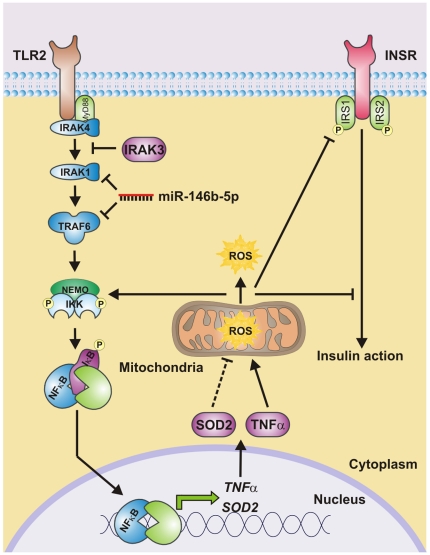
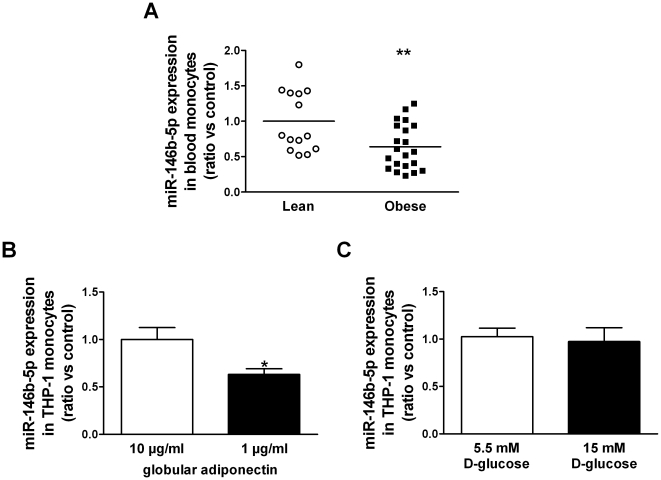
Low adiponectin, a well-recognized antidiabetic adipokine, has been associated with obesity-related inflammation, oxidative stress and insulin resistance. Globular adiponectin is an important regulator of the interleukin-1 receptor-associated kinase (IRAK)/NFκB pathway in monocytes of obese subjects. It protects against inflammation and oxidative stress by inducing IRAK3. microRNA (miR)-146b-5p inhibits NFκB-mediated inflammation by targeted repression of IRAK1 and TNF receptor-associated factor-6 (TRAF6). Therefore, we measured the expression of miR-146b-5p in monocytes of obese subjects. Because it was low we determined the involvement of this miR in the anti-inflammatory, antioxidative and insulin signaling action of globular adiponectin.
miR-146b-5p expression in monocytes of obese subjects was determined by qRT-PCR. The effect of miR-146b-5p silencing on molecular markers of inflammation, oxidative stress and insulin signaling and the association with globular adiponectin was assessed in human THP-1 monocytes.
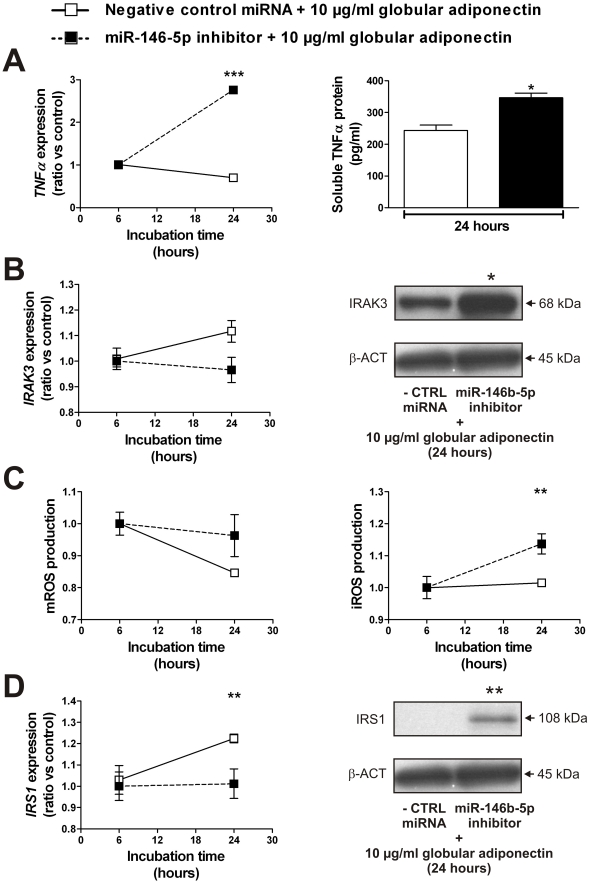
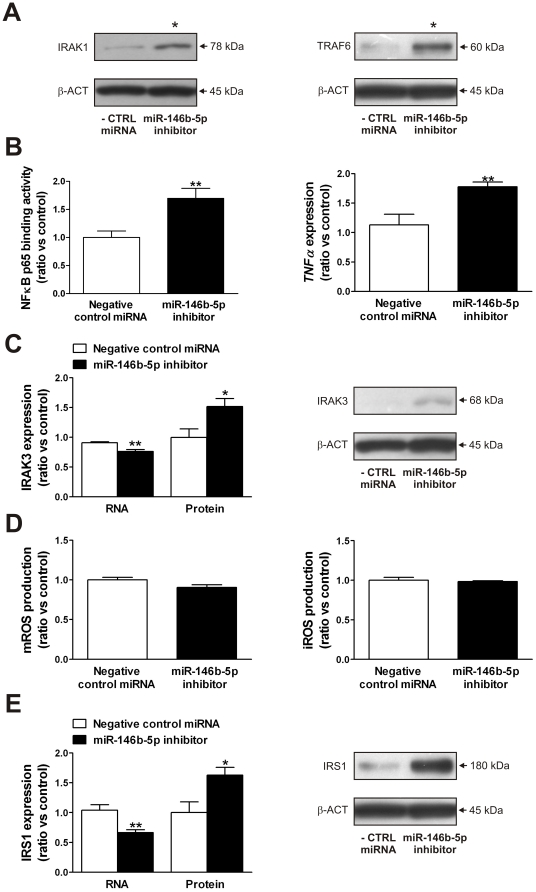
miR-146b-5p was downregulated in monocytes of obese persons. Low globular adiponectin decreased miR-146b-5p and IRAK3 in THP-1 monocytes, associated with increased mitochondrial reactive oxygen species (ROS). Intracellular ROS and insulin receptor substrate-1 (IRS1) protein were unchanged. Silencing of miR-146b-5p with an antisense inhibitor resulted in increased expression of IRAK1 and TRAF6 leading to more NFκB p65 DNA binding activity and TNFα. As a response IRAK3 and IRS1 protein increased. Mitochondrial and intracellular ROS production did not increase despite more inflammation. In addition, exposure of miR-146b-5p-depleted THP-1 monocytes to high levels of globular adiponectin resulted in an increased production of TNFα and intracellular ROS. Still, they did not lose their potential to increase IRAK3 and IRS1 protein and to decrease mitochondrial ROS.
miR-146b-5p, decreased in monocytes during obesity, is a major mediator of the anti-inflammatory action of globular adiponectin. It appears not to be involved in insulin signaling possibly by protective response of IRAK3 and lack of mitochondrial ROS production.
脂联素是一种公认的抗糖尿病脂肪因子,与肥胖相关的炎症、氧化应激和胰岛素抵抗有关。球状脂联素是肥胖患者单核细胞中白细胞介素-1 受体相关激酶(IRAK)/NFκB 途径的重要调节剂。它通过诱导 IRAK3 来保护免受炎症和氧化应激。microRNA(miR)-146b-5p 通过靶向抑制 IRAK1 和 TNF 受体相关因子-6(TRAF6)来抑制 NFκB 介导的炎症。因此,我们测量了肥胖患者单核细胞中 miR-146b-5p 的表达。由于其水平较低,我们确定了该 miR 在球状脂联素的抗炎、抗氧化和胰岛素信号作用中的参与。
通过 qRT-PCR 测定肥胖患者单核细胞中 miR-146b-5p 的表达。在人 THP-1 单核细胞中,评估 miR-146b-5p 沉默对炎症、氧化应激和胰岛素信号分子标志物的影响及其与球状脂联素的关联。
肥胖者单核细胞中 miR-146b-5p 下调。低水平的球状脂联素降低了 THP-1 单核细胞中的 miR-146b-5p 和 IRAK3,与增加的线粒体活性氧(ROS)相关。细胞内 ROS 和胰岛素受体底物-1(IRS1)蛋白不变。用反义抑制剂沉默 miR-146b-5p 导致 IRAK1 和 TRAF6 的表达增加,从而导致更多的 NFκB p65 DNA 结合活性和 TNFα。作为反应,IRAK3 和 IRS1 蛋白增加。尽管炎症增加,但线粒体和细胞内 ROS 产生没有增加。此外,用高浓度的球状脂联素处理 miR-146b-5p 耗尽的 THP-1 单核细胞会导致 TNFα 和细胞内 ROS 的产生增加。尽管如此,它们并没有失去增加 IRAK3 和 IRS1 蛋白和减少线粒体 ROS 的能力。
肥胖期间单核细胞中减少的 miR-146b-5p 是球状脂联素抗炎作用的主要介导物。它似乎不参与胰岛素信号转导,可能是由于 IRAK3 的保护反应和缺乏线粒体 ROS 产生。