Department of Medicine, Columbia University, 630 West 168th St, New York, NY 10032, USA.
Circ Res. 2010 Jan 8;106(1):58-67. doi: 10.1161/CIRCRESAHA.109.208488.
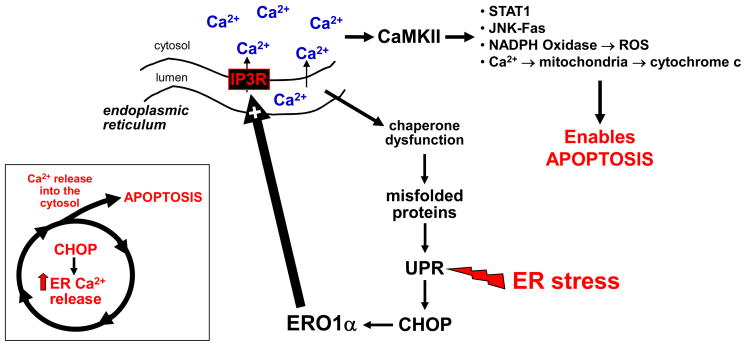
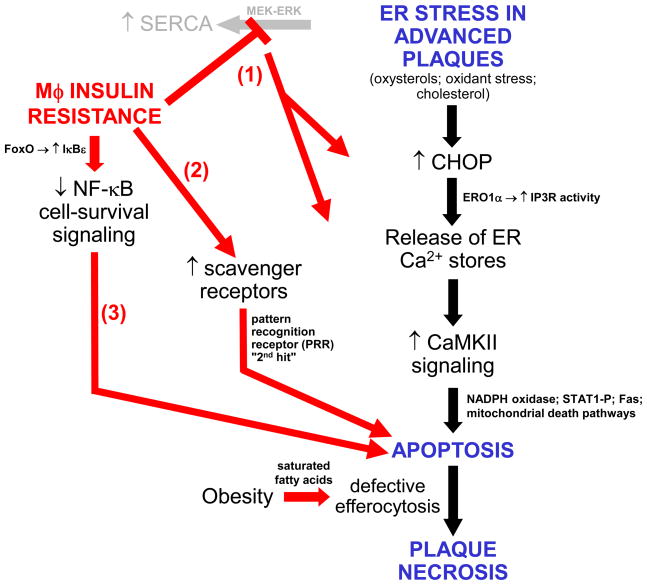
Atherothrombotic vascular disease is the major cause of death and disability in obese and diabetic subjects with insulin resistance. Although increased systemic risk factors in the setting of insulin resistance contribute to this problem, it is likely exacerbated by direct effects of insulin resistance on the arterial wall cells that participate in atherosclerosis. A critical process in the progression of subclinical atherosclerotic lesions to clinically relevant lesions is necrotic breakdown of plaques. Plaque necrosis, which is particularly prominent in the lesions of diabetics, is caused by the combination of macrophage apoptosis and defective phagocytic clearance, or efferocytosis, of the apoptotic macrophages. One cause of macrophage apoptosis in advanced plaques is activation of a proapoptotic branch of the unfolded protein response, which is an endoplasmic reticulum stress pathway. Macrophages have a functional insulin receptor signaling pathway, and downregulation of this pathway in the setting insulin resistance enhances unfolded protein response-induced apoptosis. Moreover, other aspects of the obesity/insulin-resistance syndrome may adversely affect efferocytosis. These processes may therefore provide an important mechanistic link among insulin resistance, plaque necrosis, and atherothrombotic vascular disease and suggest novel therapeutic approaches to this expanding health problem.
动脉粥样硬化性血管疾病是肥胖和糖尿病伴胰岛素抵抗患者死亡和残疾的主要原因。尽管胰岛素抵抗情况下全身性危险因素的增加导致了这一问题,但胰岛素抵抗对参与动脉粥样硬化的动脉壁细胞的直接影响可能使其恶化。亚临床动脉粥样硬化病变向临床相关病变进展的一个关键过程是斑块的坏死性破裂。斑块坏死在糖尿病患者的病变中尤为突出,是由巨噬细胞凋亡和吞噬细胞清除(或吞噬作用)缺陷的组合引起的。晚期斑块中巨噬细胞凋亡的一个原因是未折叠蛋白反应( unfolded protein response,UPR)的促凋亡分支的激活,这是内质网应激途径。巨噬细胞具有功能性胰岛素受体信号通路,而在胰岛素抵抗的情况下,该通路的下调会增强未折叠蛋白反应诱导的细胞凋亡。此外,肥胖/胰岛素抵抗综合征的其他方面可能会对吞噬作用产生不利影响。因此,这些过程可能为胰岛素抵抗、斑块坏死和动脉粥样硬化性血管疾病之间提供了一个重要的机制联系,并为这一不断扩大的健康问题提供了新的治疗方法。