Department of Brain and Cognitive Sciences, Massachusetts Institute of Technology, Cambridge, Massachusetts, United States of America.
PLoS One. 2012;7(2):e32816. doi: 10.1371/journal.pone.0032816. Epub 2012 Feb 29.
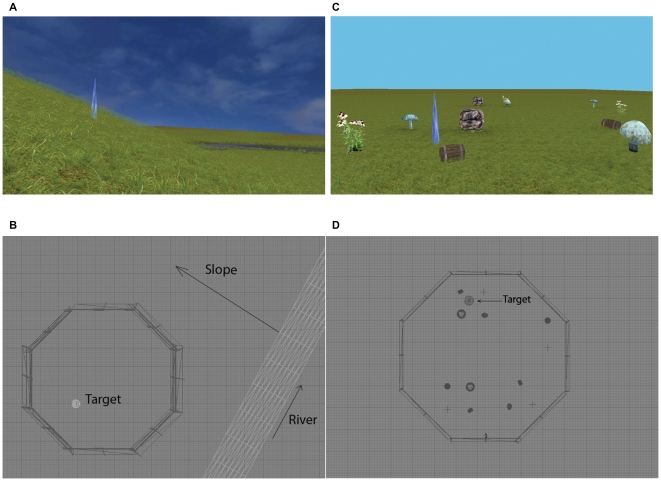
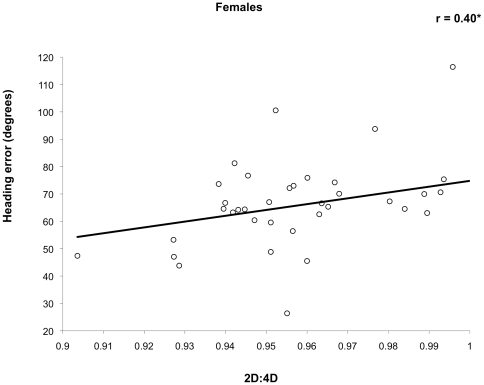
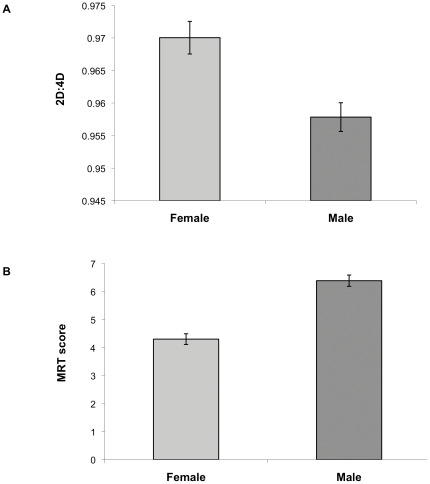
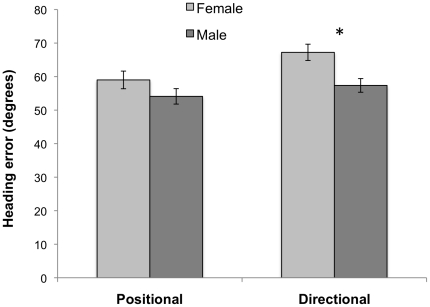
The relative length of the second-to-fourth digits (2D:4D) has been linked with prenatal androgen in humans. The 2D:4D is sexually dimorphic, with lower values in males than females, and appears to correlate with diverse measures of behavior. However, the relationship between digit ratio and cognition, and spatial cognition in particular, has produced mixed results. In the present study, we hypothesized that spatial tasks separating cue conditions that either favored female or male strategies would examine this structure-function correlation with greater precision. Previous work suggests that males are better in the use of directional cues than females. In the present study, participants learned a target location in a virtual landscape environment, in conditions that contained either all directional (i.e., distant or compass bearing) cues, or all positional (i.e., local, small objects) cues. After a short delay, participants navigated back to the target location from a novel starting location. Males had higher accuracy in initial search direction than females in environments with all directional cues. Lower digit ratio was correlated with higher accuracy of initial search direction in females in environments with all directional cues. Mental rotation scores did not correlate with digit ratio in either males or females. These results demonstrate for the first time that a sex difference in the use of directional cues, i.e., the sense of direction, is associated with more male-like digit ratio.
第二到第四指的相对长度(2D:4D)与人类产前雄激素有关。2D:4D 存在性别二态性,男性的数值低于女性,并且似乎与多种行为测量相关。然而,手指比率与认知,特别是空间认知之间的关系产生了混杂的结果。在本研究中,我们假设分离出有利于女性或男性策略的线索条件的空间任务将更精确地检验这种结构-功能相关性。先前的工作表明,男性在使用方向线索方面优于女性。在本研究中,参与者在虚拟景观环境中学习目标位置,条件包含所有方向(即远距离或罗盘方位)线索或所有位置(即本地、小物体)线索。短暂延迟后,参与者从一个新的起始位置导航回到目标位置。在所有方向线索的环境中,男性在初始搜索方向上的准确性高于女性。在所有方向线索的环境中,女性的初始搜索方向的准确性与较低的手指比率相关。男性或女性的心理旋转分数与手指比率均无关。这些结果首次表明,方向线索使用中的性别差异,即方向感,与更男性化的手指比率相关。