Biodiversity and Macroecology Group, Department of Animal and Plant Sciences, University of Sheffield, Sheffield, United Kingdom.
PLoS One. 2012;7(3):e31463. doi: 10.1371/journal.pone.0031463. Epub 2012 Mar 2.
The Fynbos (FB) and Succulent Karoo biomes (SKB) have high regional plant diversity despite relatively low productivity. Local diversity in the region varies but is moderate. For insects, previous work suggests that strict phytophages, but not other taxa, may have high regional richness. However, what has yet to be investigated is whether the local insect species richness of FB and SKB is unusual for a region of this productivity level at this latitude, and whether regional richness is also high. Here we determine whether this is the case for ants.
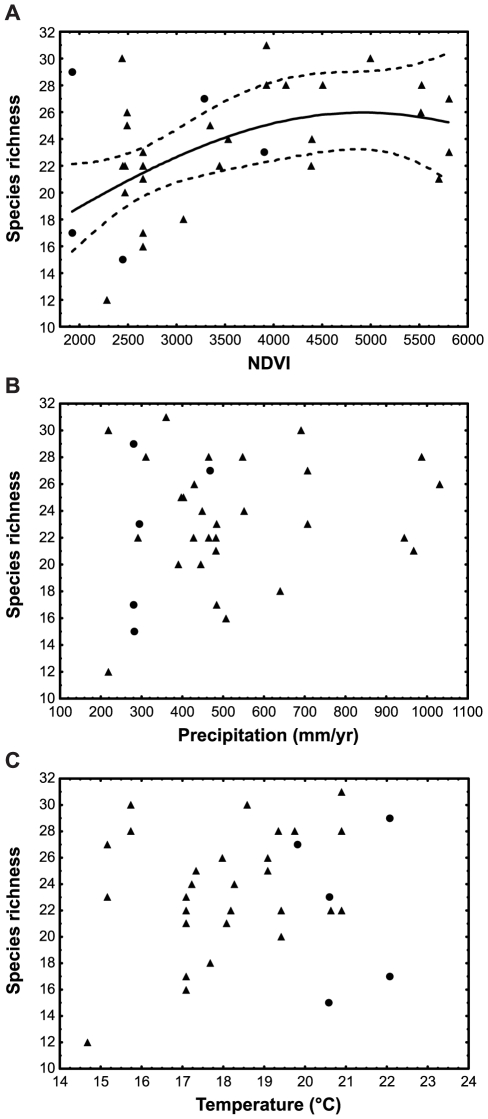
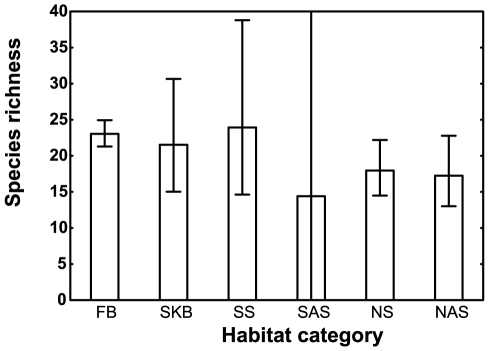
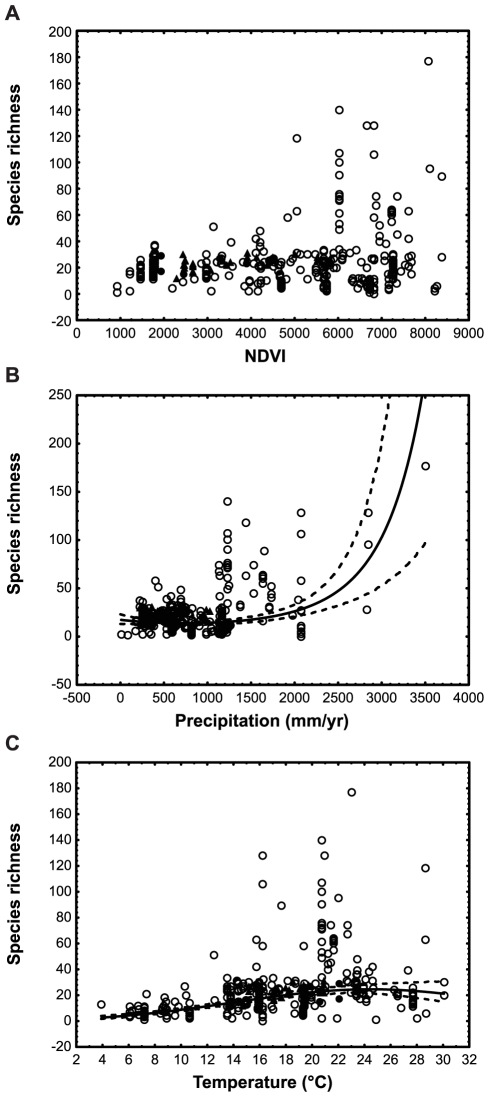
METHODOLOGY/PRINCIPAL FINDINGS: We use species richness data from pitfall traps in the FB and SKB in the Western Cape Province, South Africa and a global dataset of local ant richness extracted from the literature. We then relate the globally derived values of local richness to two energy-related predictors--productive energy (NDVI) and temperature, and to precipitation, and compare the data from the FB and SKB with these relationships. We further compare our local richness estimates with that of similar habitats worldwide, and regional ant richness with estimates derived from other regions. The local ant species richness of the FB and SKB falls within the general global pattern relating ant richness to energy, and is similar to that in comparable habitats elsewhere. At a regional scale, the richness of ants across all of our sites is not exceptional by comparison with other regional estimates from across the globe.
CONCLUSIONS/SIGNIFICANCE: Local richness of ants in the FB and SKB is not exceptional by global standards. Initial analyses suggest that regional diversity is also not exceptional for the group. It seems unlikely that the mechanisms which have contributed to the development of extraordinarily high regional plant diversity in these biomes have had a strong influence on the ants.
尽管 Fynbos(FB)和多汁 Karoo 生物群系(SKB)的生产力相对较低,但它们具有很高的区域植物多样性。该地区的局部多样性各不相同,但处于中等水平。对于昆虫,先前的工作表明,严格的植食性昆虫(而非其他分类群)可能具有较高的区域丰富度。但是,尚未研究的是,FB 和 SKB 的当地昆虫物种丰富度对于该生产力水平和该纬度地区是否异常,以及区域丰富度是否也很高。在这里,我们确定蚂蚁是否就是这种情况。
方法/主要发现:我们使用了来自南非西开普省 FB 和 SKB 的陷阱诱捕法获得的物种丰富度数据,以及从文献中提取的全球局部蚂蚁丰富度数据集。然后,我们将全球衍生的局部丰富度值与两个与能量有关的预测因子(NDVI 和温度)以及降水相关联,并将 FB 和 SKB 的数据与这些关系进行比较。我们还将我们的局部丰富度估计值与全球类似栖息地的数据进行比较,并将区域蚂蚁丰富度与从其他地区得出的估计值进行比较。FB 和 SKB 的当地蚂蚁物种丰富度符合与能量相关的全球模式,与其他地方类似栖息地的丰富度相似。在区域尺度上,与全球其他地区的估计值相比,我们所有地点的蚂蚁丰富度都没有异常。
结论/意义:FB 和 SKB 蚂蚁的局部丰富度在全球标准下并不罕见。初步分析表明,该组的区域多样性也不罕见。似乎没有证据表明,导致这些生物群系中出现极高区域植物多样性的机制对蚂蚁产生了强烈影响。