Organismic and Evolutionary Biology, University of Massachusetts Amherst, Amherst, Massachusetts, USA.
PLoS One. 2013 Jul 12;8(7):e67973. doi: 10.1371/journal.pone.0067973. Print 2013.
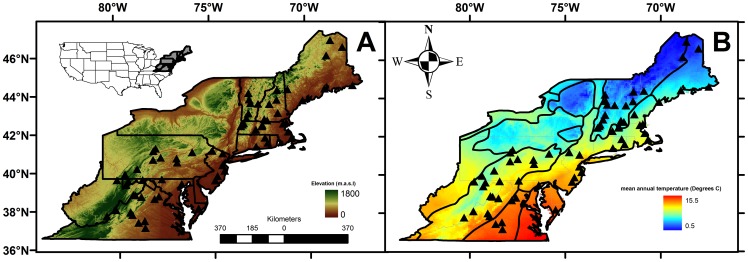
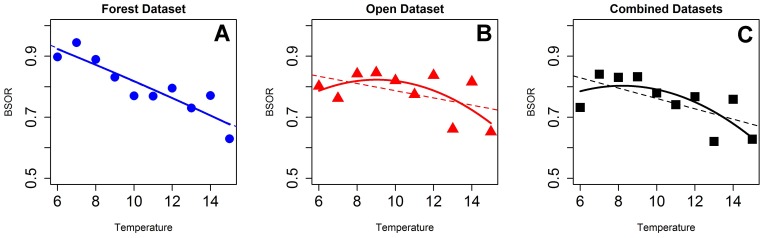
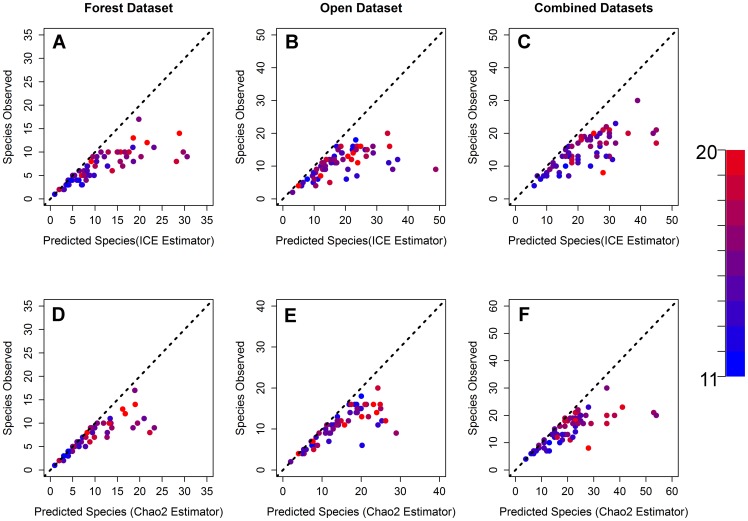
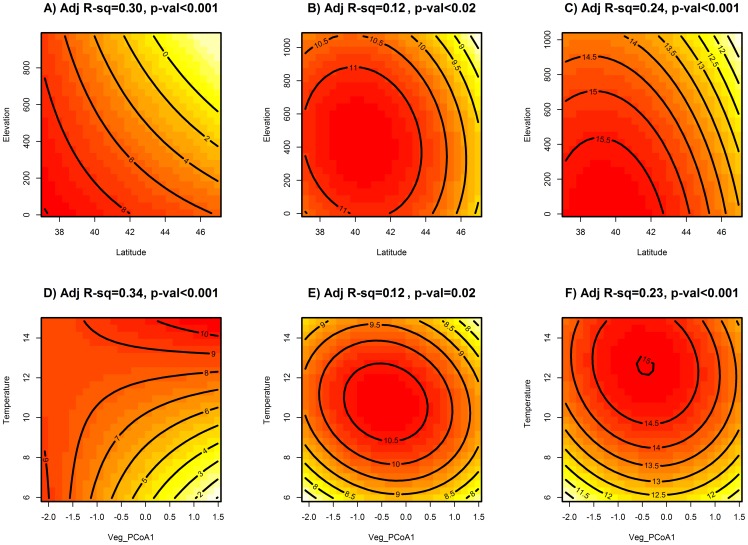
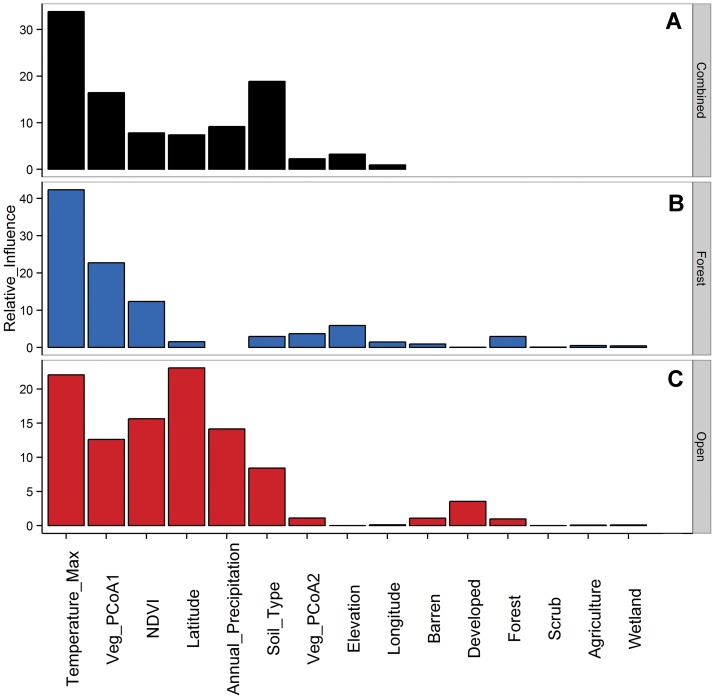
Studies of species diversity patterns across regional environmental gradients seldom consider the impact of habitat type on within-site (alpha) and between-site (beta) diversity. This study is designed to identify the influence of habitat type across geographic and environmental space, on local patterns of species richness and regional turnover patterns of ant diversity in the northeastern United States. Specifically, I aim to 1) compare local species richness in paired open and forested transects and identify the environmental variables that best correlate with richness; and 2) document patterns of beta diversity throughout the region in both open and forested habitat. I systematically sampled ants at 67 sites from May to August 2010, spanning 10 degrees of latitude, and 1000 meters of elevation. Patterns of alpha and beta diversity across the region and along environmental gradients differed between forested and open habitats. Local species richness was higher in the low elevation and warmest sites and was always higher in open habitat than in forest habitat transects. Richness decreased as temperature decreased or elevation increased. Forested transects show strong patterns of decreasing dissimilarity in species composition between sites along the temperature gradient but open habitat transects did not. Maximum temperature of the warmest month better predicted species richness than either latitude or elevation. I find that using environmental variables as key predictors of richness yields more biologically relevant results, and produces simpler macroecological models than commonly used models which use only latitude and elevation as predictors of richness and diversity patterns. This study contributes to the understanding of mechanisms that structure the communities of important terrestrial arthropods which are likely to be influenced by climatic change.
研究物种多样性模式在区域环境梯度上的分布很少考虑生境类型对站点内(α)和站点间(β)多样性的影响。本研究旨在确定生境类型在地理和环境空间上的分布对美国东北部本地物种丰富度格局和蚂蚁多样性区域周转率格局的影响。具体而言,我旨在:1)比较配对的开阔和森林样带内的本地物种丰富度,并确定与丰富度最相关的环境变量;2)记录开阔和森林生境整个区域的β多样性模式。我于 2010 年 5 月至 8 月在 67 个地点系统地采样了蚂蚁,跨越 10 度纬度和 1000 米海拔。整个区域和沿环境梯度的 α和β多样性模式在森林和开阔生境之间存在差异。低海拔和最温暖的地点的本地物种丰富度较高,且开阔生境中的物种丰富度总是高于森林生境中的样带。随着温度降低或海拔升高,丰富度降低。森林样带显示出沿温度梯度站点间物种组成相似性逐渐降低的强烈模式,但开阔生境样带则没有。最温暖月份的最高温度比纬度或海拔更能预测物种丰富度。我发现,使用环境变量作为丰富度的关键预测因子,可以产生更具生物学意义的结果,并产生比常用模型更简单的宏观生态模型,这些模型仅使用纬度和海拔作为丰富度和多样性模式的预测因子。本研究有助于理解可能受气候变化影响的重要陆地节肢动物群落结构的机制。