Department of Oncology, Shanghai Medical College, Fudan University, Shanghai, People's Republic of China.
PLoS One. 2012;7(3):e32474. doi: 10.1371/journal.pone.0032474. Epub 2012 Mar 2.
Capecitabine is effective and indicated for the salvage treatment of metastatic breast cancer. Therefore, it is essential to evaluate the efficacy of capecitabine in the adjuvant setting. There have been two large randomized studies to determine whether patients with high-risk early breast cancer benefit from the addition of capecitabine to standard chemotherapy, but they have yielded inconsistent results. We first undertook a meta-analysis to evaluate the efficacy of the addition of capecitabine over standard treatment.
PubMed, EBSCO, Web of Science, conference proceedings and key trials were searched from 1998 to 2011. The hazard ratio (HR) was used to evaluate the efficacy of a taxane-anthracycline regimen and a taxane-anthracycline-capecitabine regimen in early breast cancer. All of the data from each study use either fixed-effects or random-effects by Stata.
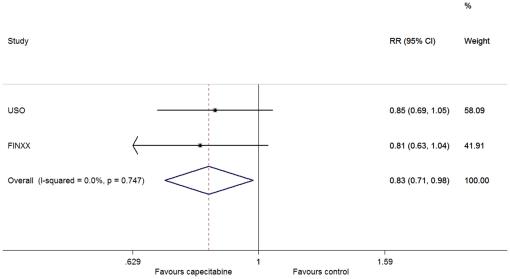
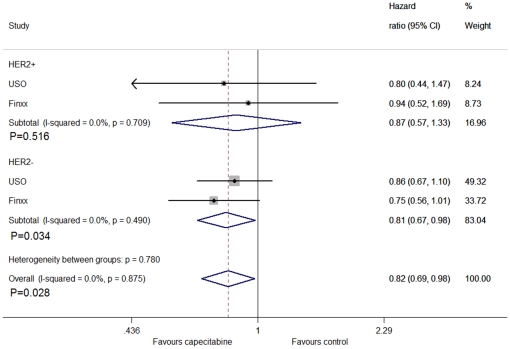
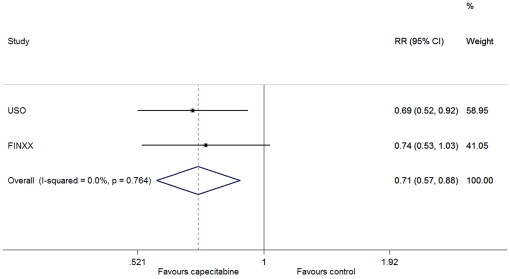
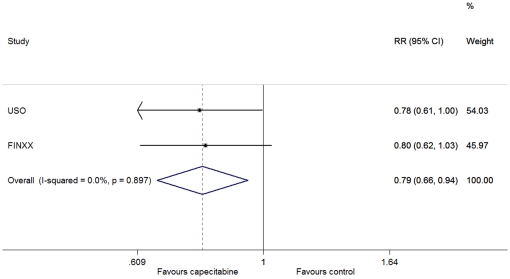
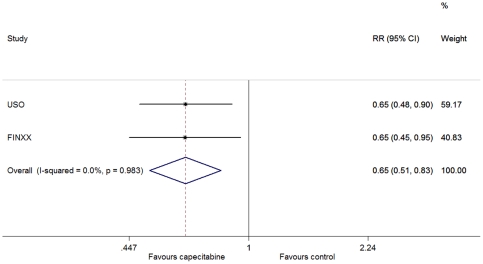
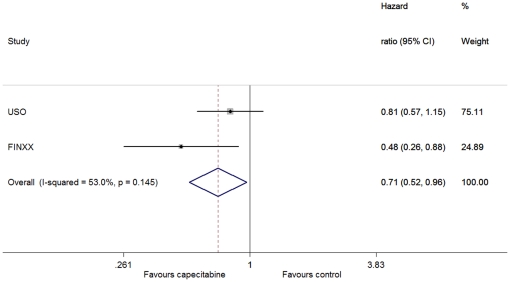
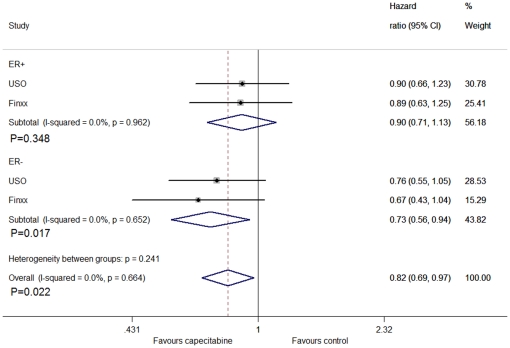
We found significant improvement in the additional capecitabine arm versus control in disease-free survival (DFS) (HR = 0.83, 95% CI: 0.71-0.98, P = 0.027), overall survival (OS) (HR = 0.71, 95% CI: 0.57-0.88, P = 0.002), distant recurrence (HR = 0.79, 95% CI: 0.66-0.94, P = 0.008) and the death from breast cancer only (HR = 0.65, 95% CI: 0.51-0.83, P = 0.001). Meanwhile, the subgroup analysis revealed that capecitabine improved the DFS in triple negative (HR = 0.71, 95% CI: 0.53-0.96, P = 0.028), hormone receptor negative (HR = 0.73, CI: 0.56-0.94, P = 0.017) and HER2 negative (HR = 0.81, CI: 0.67-0.98, P = 0.034) patients.
Due to the synergistic effect of taxane and capecitabine, taxane-anthracycline-capecitabine regimen may effectively improve the efficacy in the adjuvant setting and may be a novel generation of adjuvant chemotherapy regimen. The results of the current meta-analysis support this hypothesis and indicate that taxane-based regimen with capecitabine may be an effective, convenient, and well tolerated regimen in patients with early breast cancer.
卡培他滨在转移性乳腺癌的挽救治疗中是有效的,并且有明确的疗效。因此,评估卡培他滨在辅助治疗中的疗效至关重要。已经有两项大型随机研究来确定高危早期乳腺癌患者是否从卡培他滨联合标准化疗中获益,但它们的结果并不一致。我们首先进行了一项荟萃分析,以评估卡培他滨联合标准治疗的疗效。
从 1998 年到 2011 年,我们在 PubMed、EBSCO、Web of Science、会议记录和关键试验中进行了搜索。使用风险比(HR)评估了紫杉烷-蒽环类药物方案和紫杉烷-蒽环类药物-卡培他滨方案在早期乳腺癌中的疗效。每个研究的数据均使用 Stata 中的固定效应或随机效应进行分析。
我们发现卡培他滨联合治疗组在无病生存(DFS)(HR=0.83,95%CI:0.71-0.98,P=0.027)、总生存(OS)(HR=0.71,95%CI:0.57-0.88,P=0.002)、远处复发(HR=0.79,95%CI:0.66-0.94,P=0.008)和仅乳腺癌死亡(HR=0.65,95%CI:0.51-0.83,P=0.001)方面均显著优于对照组。同时,亚组分析显示卡培他滨改善了三阴性(HR=0.71,95%CI:0.53-0.96,P=0.028)、激素受体阴性(HR=0.73,CI:0.56-0.94,P=0.017)和 HER2 阴性(HR=0.81,CI:0.67-0.98,P=0.034)患者的 DFS。
由于紫杉烷和卡培他滨具有协同作用,紫杉烷-蒽环类药物-卡培他滨方案可能在辅助治疗中有效提高疗效,可能成为新一代辅助化疗方案。目前荟萃分析的结果支持这一假设,并表明卡培他滨联合紫杉烷类药物可能是一种有效、方便、耐受性良好的早期乳腺癌治疗方案。