Cancer Research Institute, Xiangya School of Medicine, Central South University, Changsha, China.
PLoS One. 2012;7(3):e32624. doi: 10.1371/journal.pone.0032624. Epub 2012 Mar 1.
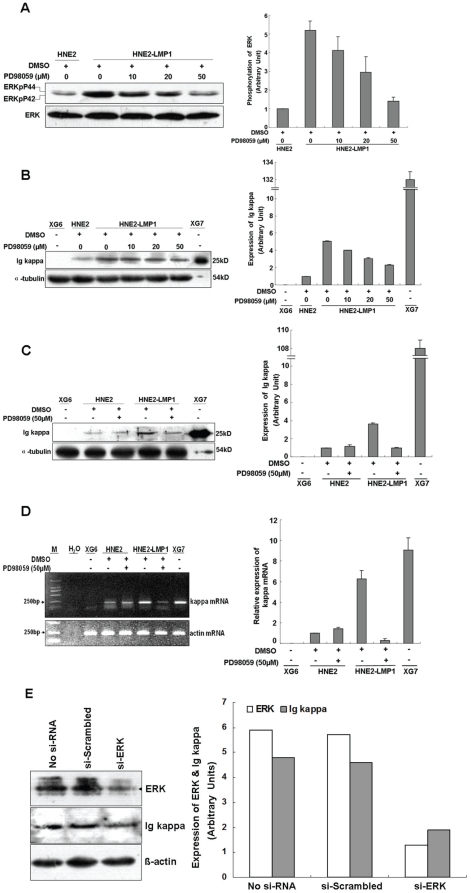
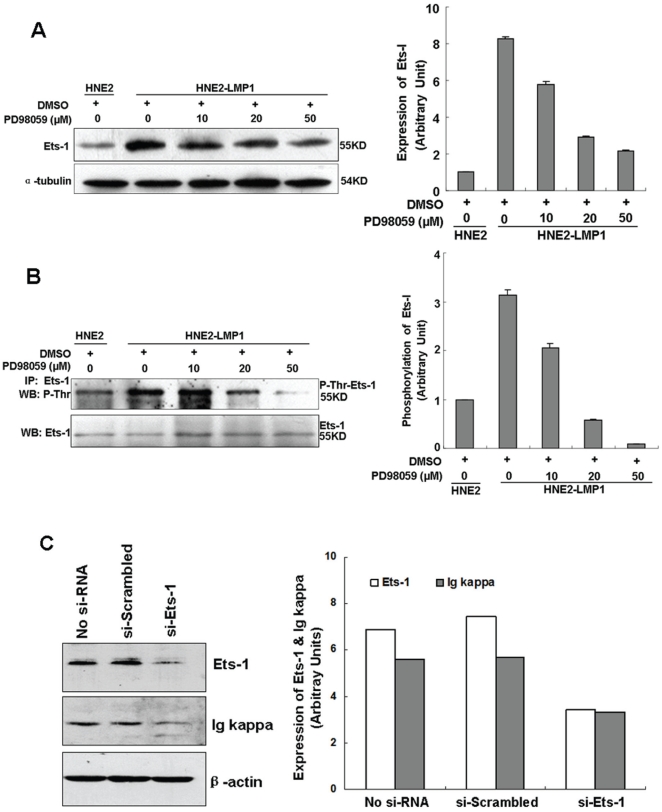
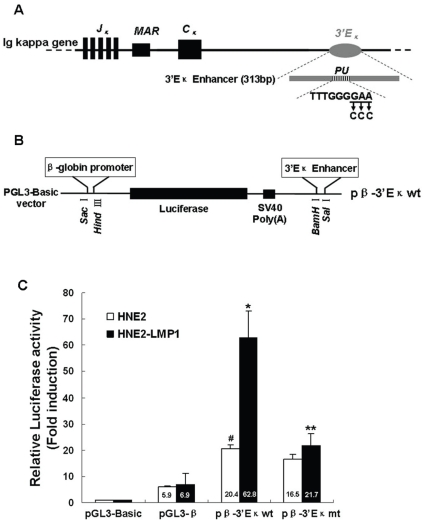
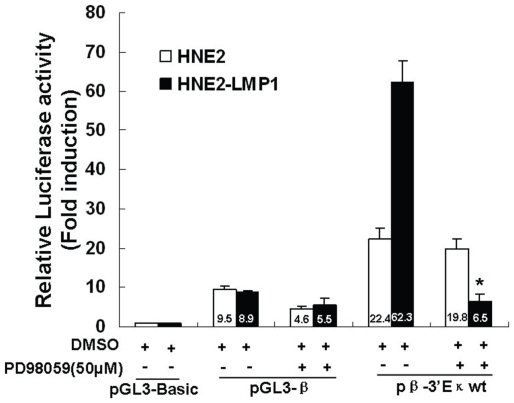
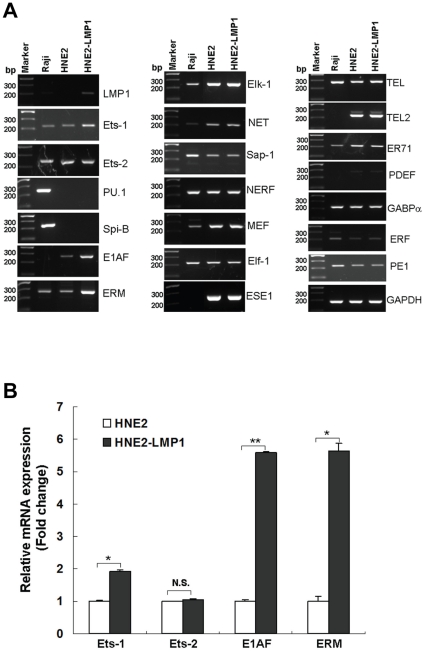
Accumulating evidence indicates that epithelial cancer cells, including nasopharyngeal carcinoma (NPC) cells, express immunoglobulins (Igs). We previously found that the expression of the kappa light chain protein in NPC cells can be upregulated by the EBV-encoded latent membrane protein 1 (LMP1). In the present study, we used NPC cell lines as models and found that LMP1-augmented kappa production corresponds with elevations in ERKs phosphorylation. PD98059 attenuates LMP1-induced ERKs phosphorylation resulting in decreased expression of the kappa light chain. ERK-specific small interfering RNA blunts LMP1-induced kappa light chain gene expression. Luciferase reporter assays demonstrate that immunoglobulin κ 3' enhancer (3'E(κ)) is active in Igκ-expressing NPC cells and LMP1 upregulates the activity of 3'E(κ) in NPC cells. Moreover, mutation analysis of the PU binding site in 3'E(κ) and inhibition of the MEK/ERKs pathway by PD98059 indicate that the PU site is functional and LMP1-enhanced 3'E(κ) activity is partly regulated by this site. PD98059 treatment also leads to a concentration-dependent inhibition of LMP1-induced Ets-1 expression and phosphorylation, which corresponds with a dose-dependent attenuation of LMP1-induced ERK phosphorylation and kappa light chain expression. Suppression of endogenous Ets-1 by small interfering RNA is accompanied by a decrease of Ig kappa light chain expression. Gel shift assays using nuclear extracts of NPC cells indicate that the transcription factor Ets-1 is recruited by LMP1 to the PU motif within 3'E(κ)in vitro. ChIP assays further demonstrate Ets-1 binding to the PU motif of 3'E(κ) in cells. These results suggest that LMP1 upregulates 3'E(κ) activity and kappa gene expression by activating the Ets-1 transcription factor through the ERKs signaling pathway. Our studies provide evidence for a novel regulatory mechanism of kappa expression, by which virus-encoded proteins activate the kappa 3' enhancer through activating transcription factors in non-B epithelial cancer cells.
越来越多的证据表明,上皮癌细胞,包括鼻咽癌(NPC)细胞,表达免疫球蛋白(Igs)。我们之前发现 EBV 编码的潜伏膜蛋白 1(LMP1)可上调 NPC 细胞中κ轻链蛋白的表达。在本研究中,我们以 NPC 细胞系为模型,发现 LMP1 增强κ产生与 ERKs 磷酸化的升高相对应。PD98059 减弱 LMP1 诱导的 ERKs 磷酸化,导致κ轻链表达减少。ERK 特异性小干扰 RNA 削弱 LMP1 诱导的κ轻链基因表达。荧光素酶报告基因分析表明,免疫球蛋白κ 3'增强子(3'E(κ))在表达 Igκ 的 NPC 细胞中具有活性,并且 LMP1 上调 NPC 细胞中 3'E(κ)的活性。此外,对 3'E(κ)中的 PU 结合位点进行突变分析和用 PD98059 抑制 MEK/ERKs 通路表明,PU 位点是功能性的,并且 LMP1 增强的 3'E(κ)活性部分受该位点调节。PD98059 处理还导致 LMP1 诱导的 Ets-1 表达和磷酸化的浓度依赖性抑制,这与 LMP1 诱导的 ERK 磷酸化和κ轻链表达的剂量依赖性衰减相对应。通过小干扰 RNA 抑制内源性 Ets-1 会导致 Igκ 轻链表达减少。使用 NPC 细胞核提取物进行凝胶迁移分析表明,转录因子 Ets-1 在体外被 LMP1 募集到 3'E(κ)中的 PU 基序。ChIP 测定进一步证明了 Ets-1 与细胞中 3'E(κ)的 PU 基序的结合。这些结果表明,LMP1 通过激活 ERKs 信号通路,通过激活转录因子 Ets-1 来上调 3'E(κ)活性和κ基因表达。我们的研究为病毒编码的蛋白通过在非 B 上皮癌细胞中激活转录因子来激活κ 3'增强子提供了一种新的κ表达调控机制。