Johns Hopkins Preparedness and Emergency Response Research Center, 615 North Wolfe Street, Room E7537, Baltimore, MD 21205, USA.
BMC Public Health. 2012 Mar 7;12:164. doi: 10.1186/1471-2458-12-164.
The all-hazards willingness to respond (WTR) of local public health personnel is critical to emergency preparedness. This study applied a threat-and efficacy-centered framework to characterize these workers' scenario and jurisdictional response willingness patterns toward a range of naturally-occurring and terrorism-related emergency scenarios.
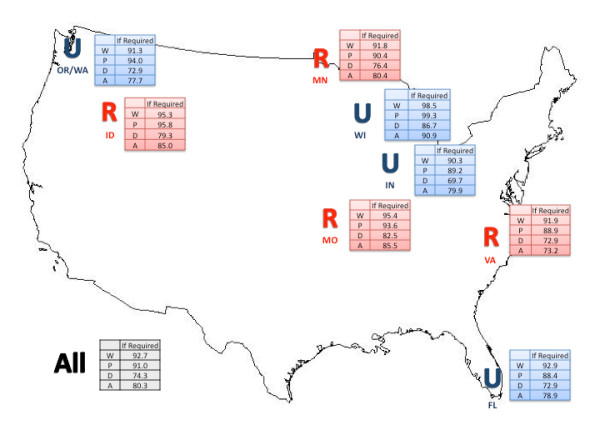
Eight geographically diverse local health department (LHD) clusters (four urban and four rural) across the U.S. were recruited and administered an online survey about response willingness and related attitudes/beliefs toward four different public health emergency scenarios between April 2009 and June 2010 (66% response rate). Responses were dichotomized and analyzed using generalized linear multilevel mixed model analyses that also account for within-cluster and within-LHD correlations.
Comparisons of rural to urban LHD workers showed statistically significant odds ratios (ORs) for WTR context across scenarios ranging from 1.5 to 2.4. When employees over 40 years old were compared to their younger counterparts, the ORs of WTR ranged from 1.27 to 1.58, and when females were compared to males, the ORs of WTR ranged from 0.57 to 0.61. Across the eight clusters, the percentage of workers indicating they would be unwilling to respond regardless of severity ranged from 14-28% for a weather event; 9-27% for pandemic influenza; 30-56% for a radiological 'dirty' bomb event; and 22-48% for an inhalational anthrax bioterrorism event. Efficacy was consistently identified as an important independent predictor of WTR.
Response willingness deficits in the local public health workforce pose a threat to all-hazards response capacity and health security. Local public health agencies and their stakeholders may incorporate key findings, including identified scenario-based willingness gaps and the importance of efficacy, as targets of preparedness curriculum development efforts and policies for enhancing response willingness. Reasons for an increased willingness in rural cohorts compared to urban cohorts should be further investigated in order to understand and develop methods for improving their overall response.
地方公共卫生人员应对各种灾害的意愿(WTR)对于应急准备至关重要。本研究应用以威胁和效能为中心的框架,描述了这些工作人员对一系列自然发生和与恐怖主义相关的紧急情况的情景和管辖范围响应意愿模式。
2009 年 4 月至 2010 年 6 月期间,美国 8 个地理上不同的地方卫生部门(LHD)集群(4 个城市和 4 个农村)被招募并在线调查了他们对 4 种不同公共卫生紧急情况的响应意愿和相关态度/信念。对反应意愿进行二分法分析,并使用广义线性多层混合模型分析进行分析,该分析还考虑了聚类内和 LHD 内的相关性。
与城市 LHD 工作人员相比,农村 LHD 工作人员在不同情景下的 WTR 背景下的比较显示出统计学上显著的优势比(OR),范围从 1.5 到 2.4。当比较 40 岁以上的员工与他们年轻的同事时,WTR 的 OR 范围从 1.27 到 1.58,当比较女性与男性时,WTR 的 OR 范围从 0.57 到 0.61。在这 8 个集群中,无论严重程度如何,表明不愿意响应的工作人员比例从天气事件的 14-28%;大流行性流感的 9-27%;放射性“肮脏”炸弹事件的 30-56%;吸入性炭疽生物恐怖主义事件的 22-48%。效能始终被确定为 WTR 的重要独立预测因素。
地方公共卫生劳动力的响应意愿不足对全灾害应对能力和健康安全构成威胁。地方公共卫生机构及其利益相关者可以将关键发现纳入应急准备课程开发工作和增强响应意愿的政策中,包括确定基于情景的意愿差距和效能的重要性。应该进一步调查与城市队列相比农村队列中增加的意愿的原因,以便了解和开发提高其整体响应的方法。