Department of Radiation Oncology, Indiana University School of Medicine, 535 Barnhill Dr. RT-041, Indianapolis, IN 46202, USA.
J Appl Clin Med Phys. 2012 Mar 8;13(2):3631. doi: 10.1120/jacmp.v13i2.3631.
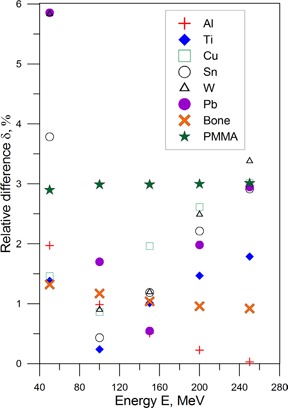
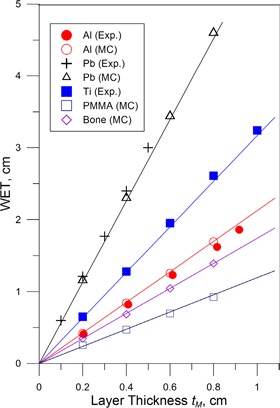
The purpose of this study was to devise a simple semi-empirical model to estimate the range shift in clinical practices with high-Z inhomogeneity in proton beam. A semi-empirical model utilizing the logarithmic dependence on Z in stopping power from Bohr's classical approach has been developed to calculate the range shift due to the presence of inhomogeneity. Range shift from metallic plates of atomic number Z of various thicknesses were measured in water using a parallel plate ionization chamber and calculated with the FLUKA Monte Carlo code. The proton range shifts for bone and polymethyl methacrylate (PMMA) were estimated using the semi-empirical model and compared with Monte Carlo calculation. The semi-empirical equation to determine range shift and water equivalent thickness is presented. The model predicts a shift of the therapeutic range to within 2.5% accuracy for initial proton energies of 50 to 250 MeV and atomic numbers from 3.3 (effective Z for water) to 82. This equation is independent of beam energy, and thus provides range shift from high-Z materials without the knowledge of proton energy. The proposed method of calculating the therapeutic range shift accurately requires only knowledge of the effective or actual atomic number of the inhomogeneity and the thickness of the inhomogeneity along the beam direction. The model generalizes the range shift calculation for any material based on its effective atomic number, and permits reliable prediction of the range shift for material combinations where no data is currently available. The proposed model can be readily implemented in routine clinical practice for proton range shift estimation and quality assurance on the treatment planning.
本研究旨在设计一种简单的半经验模型,以估计质子束中具有高 Z 不均匀性的临床实践中的射程偏移。利用波尔经典方法中对阻止能力的对数依赖于 Z,开发了一种半经验模型来计算由于不均匀性存在而导致的射程偏移。使用平行板电离室在水中测量了具有各种厚度的原子序数 Z 的金属板的射程偏移,并使用 FLUKA 蒙特卡罗代码进行了计算。使用半经验模型估计了骨和聚甲基丙烯酸甲酯(PMMA)的质子射程偏移,并与蒙特卡罗计算进行了比较。提出了一种确定射程偏移和水等效厚度的半经验方程。该模型预测初始质子能量为 50 至 250 MeV 且原子数从 3.3(水的有效 Z)至 82 时,治疗范围的偏移将在 2.5%的精度范围内。该方程与束能无关,因此无需质子能量知识即可提供来自高 Z 材料的射程偏移。该方法准确计算治疗范围偏移仅需要不均匀性的有效或实际原子数以及沿束方向的不均匀性的厚度的知识。该模型基于其有效原子数概括了任何材料的射程偏移计算,并允许对尚无数据的材料组合进行可靠的射程偏移预测。该模型可在质子射程偏移估计和治疗计划的质量保证的常规临床实践中轻松实现。