Division of Cardiology, Department of Internal Medicine, Kangdong Sacred Heart Hospital, Hallym University College of Medicine, Seoul, Korea.
Korean J Intern Med. 2012 Mar;27(1):53-9. doi: 10.3904/kjim.2012.27.1.53. Epub 2012 Feb 28.
BACKGROUND/AIMS: Right ventricular dysfunction (RVD) is associated with poor prognosis in patients with acute pulmonary embolism (APE). Echocardiography and computed tomography (CT)-angiography may be difficult to perform in a serial follow up, unlike electrocardiography (ECG). Many ECG findings specific for APE have been reported, and many studies have found that negative T-waves (NTW) in precordial leads are most frequently observed in patients with APE. We analyzed serial changes in precordial NTW to detect RVD and predict the recovery of RVD in patients with APE.
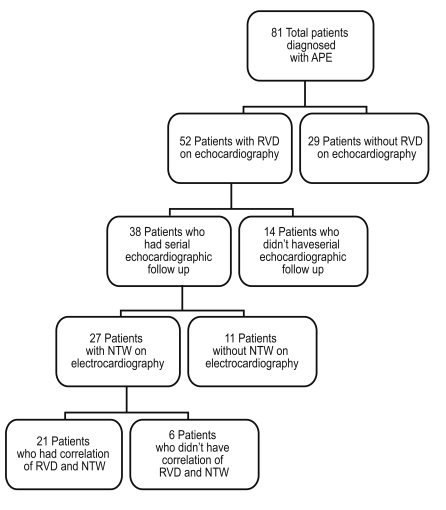
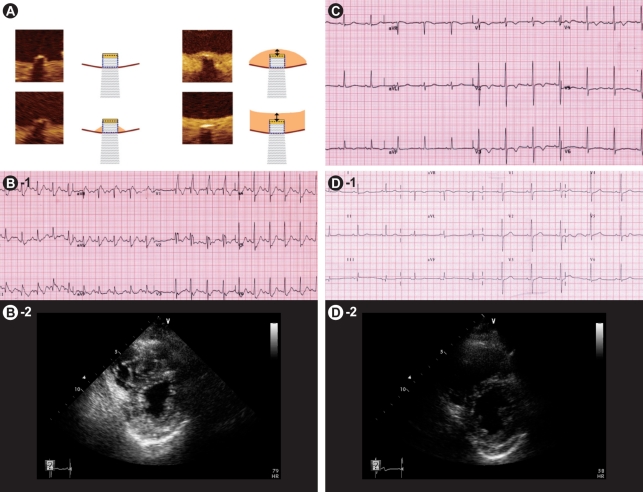
We examined 81 consecutive patients diagnosed with APE using CT-angiography or echocardiography. ECG, transthoracic echocardiography, and laboratory tests were performed within 24 hours of admission, and daily ECG follow-up was performed. Precordial NTWs were defined by the new development of pointed and symmetrical inverted T-waves in at least three leads. Recovery of NTW was defined as flattening or upright inverted T-waves in more than two leads.
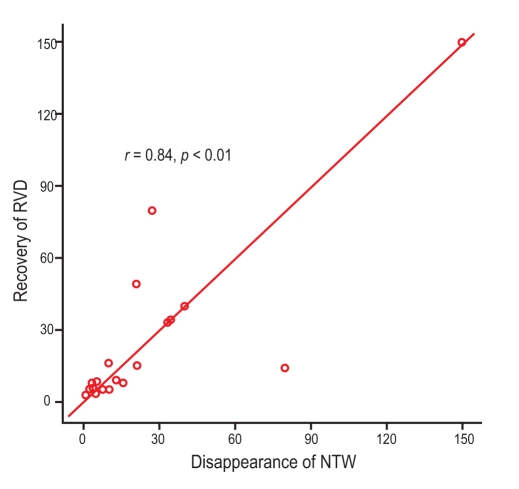
Of the 81 patients with APE, 52 (64%) had RVD according to echocardiography. Among the patients with RVD, 33 (63%) showed precordial NTW. The multivariate logistic regression analysis revealed that NTW was the strongest independent predictor for RVD (odds ratio, 22.8; 95% confidence interval, 2.4 to 221.4; p = 0.007). Time to normalization of NTW was associated with improvement of RVD on echocardiography (r = 0.84, p < 0.01).
Precordial NTW was a reliable finding to identify RVD in patients with APE. Improvements in RVD can be predicted by normalizing precordial NTW.
背景/目的:右心室功能障碍(RVD)与急性肺栓塞(APE)患者的预后不良相关。与心电图(ECG)不同,超声心动图和计算机断层扫描(CT)-血管造影可能难以进行连续随访。已经报道了许多针对 APE 的特定心电图发现,许多研究发现,前导 NTW 在 APE 患者中最常观察到。我们分析了前导 NTW 的连续变化,以检测 RVD 并预测 APE 患者 RVD 的恢复情况。
我们检查了 81 例连续的经 CT-血管造影或超声心动图诊断为 APE 的患者。入院后 24 小时内进行了心电图、经胸超声心动图和实验室检查,并进行了每日心电图随访。前导 NTW 通过至少三个导联中新出现的尖锐对称倒置 T 波来定义。NTW 的恢复定义为两个以上导联中的 T 波变平或直立倒置。
在 81 例 APE 患者中,根据超声心动图,有 52 例(64%)存在 RVD。在 RVD 患者中,33 例(63%)出现前导 NTW。多变量逻辑回归分析显示,NTW 是 RVD 的最强独立预测因子(优势比,22.8;95%置信区间,2.4 至 221.4;p = 0.007)。NTW 正常化的时间与超声心动图上 RVD 的改善相关(r = 0.84,p < 0.01)。
前导 NTW 是识别 APE 患者 RVD 的可靠发现。通过使前导 NTW 正常化,可以预测 RVD 的改善。