Sato Hiroki, Yoneda Misako, Honda Tomoyuki, Kai Chieko
Laboratory Animal Research Center, Institute of Medical Science, The University of Tokyo Tokyo, Japan.
Front Microbiol. 2012 Mar 1;3:75. doi: 10.3389/fmicb.2012.00075. eCollection 2012.
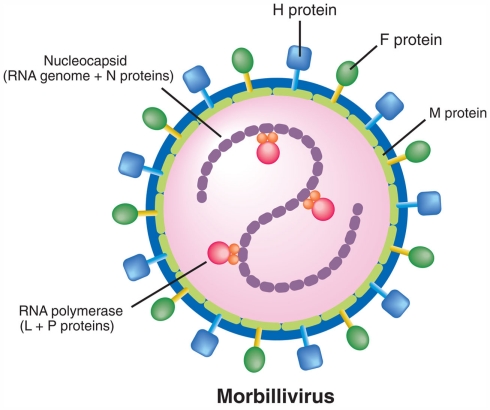
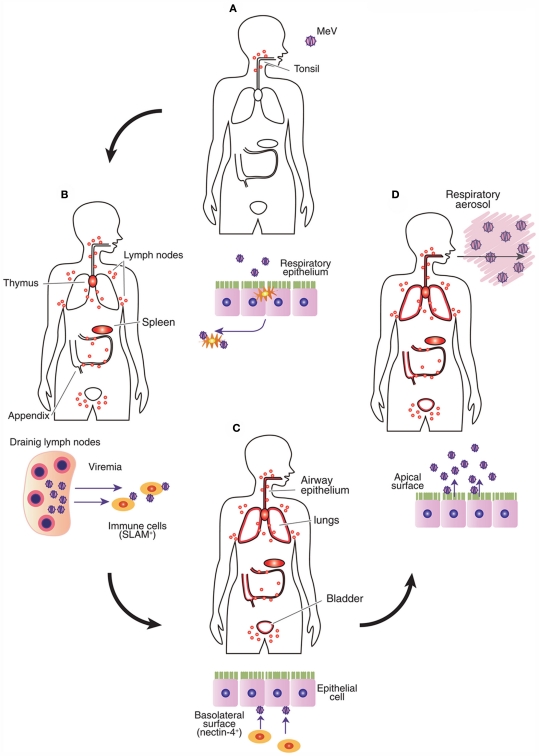
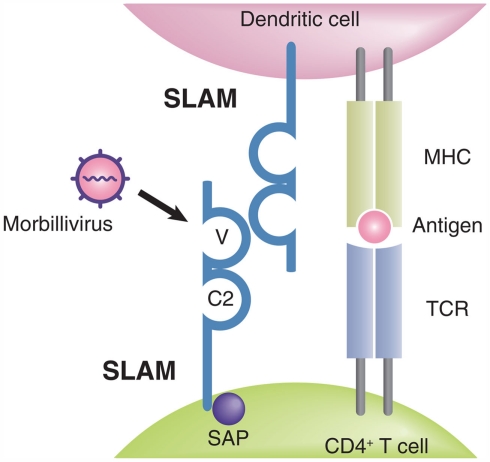
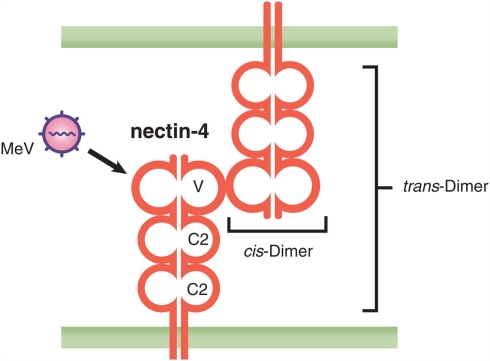
Morbilliviruses, which include measles virus (MeV), canine distemper virus, and rinderpest virus, are among the most important pathogens in their respective hosts and cause severe syndromes. Morbilliviruses are enveloped viruses with two envelope proteins, one of which is hemagglutinin (H) protein, which plays a role in binding to cellular receptors. During morbillivirus infection, the virus initially targets lymphoid cells and replicates efficiently in the lymph nodes. The principal cellular receptor for morbillivirus is signaling lymphocyte activation molecule (SLAM, also called CD150), which is exclusively expressed on immune cells. This feature reflects the strong lymphoid cell tropism and viral spread in the infected body. Morbillivirus infection, however, affects various tissues in the body, including the lung, kidney, gastrointestinal tract, vascular endothelium, and brain. Thus, other receptors for morbilliviruses in addition to SLAM might exist. Recently, nectin-4 has been identified as a novel epithelial cell receptor for MeV. The expression of nectin-4 is localized to polarized epithelial cells, and this localization supports the notion of cell tropism since MeV also grows well in the epithelial cells of the respiratory tract. Although two major receptors for lymphoid and epithelial cells in natural infection have been identified, morbillivirus can still infect many other types of cells with low infectivity, suggesting the existence of inefficient but ubiquitously expressed receptors. We have identified other molecules that are implicated in morbillivirus infection of SLAM-negative cells by alternative mechanisms. These findings indicate that morbillivirus utilizes multiple pathways for establishment of infection. These studies will advance our understanding of morbillivirus tropism and pathogenesis.
麻疹病毒属病毒,包括麻疹病毒(MeV)、犬瘟热病毒和牛瘟病毒,是其各自宿主中最重要的病原体之一,并会引发严重病症。麻疹病毒属病毒是包膜病毒,有两种包膜蛋白,其中之一是血凝素(H)蛋白,它在与细胞受体结合中发挥作用。在麻疹病毒属病毒感染期间,该病毒最初靶向淋巴细胞并在淋巴结中高效复制。麻疹病毒属病毒的主要细胞受体是信号淋巴细胞激活分子(SLAM,也称为CD150),它仅在免疫细胞上表达。这一特征反映了其在感染机体中对淋巴细胞的强烈嗜性和病毒传播。然而,麻疹病毒属病毒感染会影响身体的各种组织,包括肺、肾、胃肠道、血管内皮和脑。因此,除了SLAM之外,可能还存在麻疹病毒属病毒的其他受体。最近,nectin-4已被确定为MeV的一种新型上皮细胞受体。nectin-4的表达定位于极化上皮细胞,这种定位支持了细胞嗜性的概念,因为MeV在呼吸道上皮细胞中也能良好生长。尽管在自然感染中已确定了淋巴细胞和上皮细胞的两种主要受体,但麻疹病毒属病毒仍能以低感染性感染许多其他类型的细胞,这表明存在低效但广泛表达的受体。我们已经通过替代机制鉴定出了其他与SLAM阴性细胞的麻疹病毒属病毒感染有关的分子。这些发现表明,麻疹病毒属病毒利用多种途径来建立感染。这些研究将推动我们对麻疹病毒属病毒嗜性和发病机制的理解。