Department of Infectious Diseases, Aarhus University Hospital, Skejby, Denmark.
PLoS One. 2012;7(3):e32538. doi: 10.1371/journal.pone.0032538. Epub 2012 Mar 5.
Early identification of persons with undiagnosed HIV infection is an important health care issue. We examined associations between diseases diagnosed in hospitals and risk of subsequent HIV diagnosis.
In this population-based case control study, cases were persons with incident HIV infection diagnosed in Denmark between 1 January 1995 and 1 June 2008. Risk-set sampling was used to identify 19 age- and gender-matched population controls for each HIV case, using the HIV diagnosis date as the index date for both cases and controls. Prior hospital diagnoses obtained from Danish medical databases were first categorized into 22 major disease categories (excluding AIDS-defining diseases except tuberculosis) and then subdivided into 161 subcategories, allowing us to examine specific diseases as potential HIV indicators by conditional logistic regression.
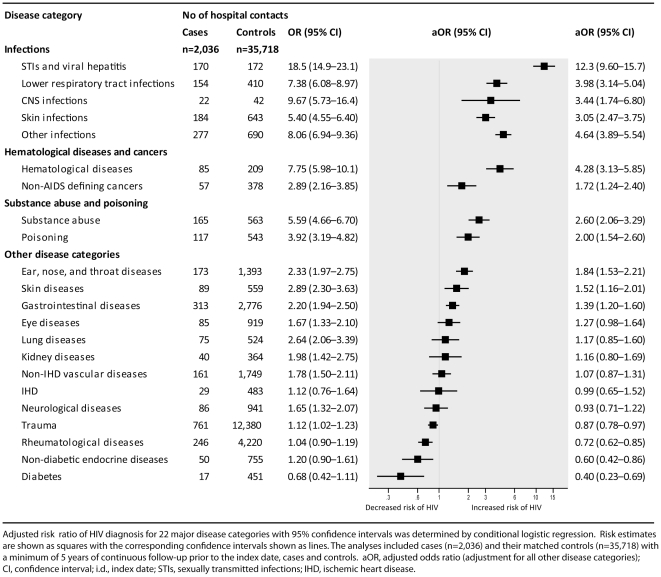
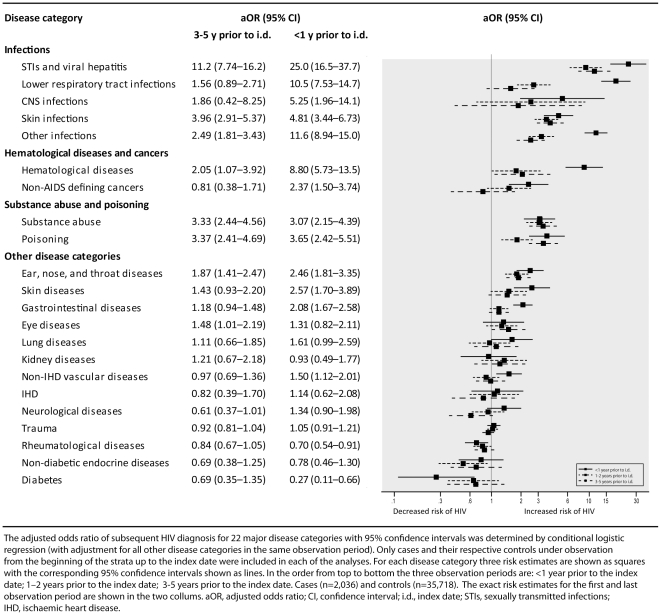
The study included 2,036 HIV cases and 35,718 controls. Persons with the following disease categories had a high risk of HIV diagnosis during the subsequent 5-year period: sexually transmitted infections and viral hepatitis (adjusted odds ratio [aOR] = 12.3, 95% CI: 9.60-15.7), hematological diseases (aOR = 4.28, 3.13-5.85), lower respiratory tract infections (aOR = 3.98, 3.14-5.04)), CNS infections (aOR = 3.44, 1.74-6.80), skin infections (aOR = 3.05, 2.47-3.75), other infections (aOR = 4.64, 3.89-5.54), and substance abuse (aOR = 2.60, 2.06-3.29). Several specific diseases were associated with aORs >20 including syphilis, hepatitis A, non "A" viral hepatitis, herpes zoster, candida infection, endocarditis, thrombocytopenia, and opioid abuse.
Targeted testing for HIV in patients diagnosed with diseases associated with HIV may lead to earlier treatment and thereby reduced morbidity, mortality and HIV transmission.
早期发现未被诊断的 HIV 感染者是一个重要的医疗保健问题。本研究旨在探讨医院诊断的疾病与随后 HIV 诊断之间的关联。
本基于人群的病例对照研究中,病例为 1995 年 1 月 1 日至 2008 年 6 月 1 日期间在丹麦新诊断 HIV 感染的患者。采用风险集抽样法,以 HIV 诊断日期为病例和对照的索引日期,为每位 HIV 病例匹配了 19 名年龄和性别匹配的人群对照。通过丹麦医学数据库获取的先前医院诊断结果首先分为 22 个主要疾病类别(不包括艾滋病定义疾病,结核病除外),然后细分为 161 个亚类别,使我们能够通过条件逻辑回归来检查特定疾病是否为潜在的 HIV 指标。
本研究共纳入 2036 例 HIV 病例和 35718 名对照。在随后的 5 年期间,以下疾病类别的患者 HIV 诊断风险较高:性传播感染和病毒性肝炎(调整后的优势比 [aOR] = 12.3,95%CI:9.60-15.7)、血液系统疾病(aOR = 4.28,3.13-5.85)、下呼吸道感染(aOR = 3.98,3.14-5.04))、中枢神经系统感染(aOR = 3.44,1.74-6.80)、皮肤感染(aOR = 3.05,2.47-3.75)、其他感染(aOR = 4.64,3.89-5.54)和药物滥用(aOR = 2.60,2.06-3.29)。一些特定疾病与 aOR >20 相关,包括梅毒、甲型肝炎、非“甲”型病毒性肝炎、带状疱疹、假丝酵母菌感染、心内膜炎、血小板减少症和阿片类药物滥用。
对诊断为与 HIV 相关疾病的患者进行 HIV 靶向检测可能会导致更早的治疗,从而降低发病率、死亡率和 HIV 传播。