American Schools of Public Health, U.S. Centers for Disease Control and Prevention, Pretoria, South Africa.
BMC Public Health. 2012 Mar 9;12:173. doi: 10.1186/1471-2458-12-173.
South Africa has an estimated 1.5 million persons in need of antiretroviral therapy (ART). In 2004, the South African government began collaborating with the United States President's Emergency Plan for AIDS Relief (PEPFAR) to increase access to ART. We determined how PEPFAR treatment support changed from 2005-2009.
In order to describe the change in number and type of PEPFAR-supported ART facilities, we analyzed routinely collected program-monitoring data from 2005-2009. The collected data included the number, type and province of facilities as well as the number of patients receiving ART at each facility.
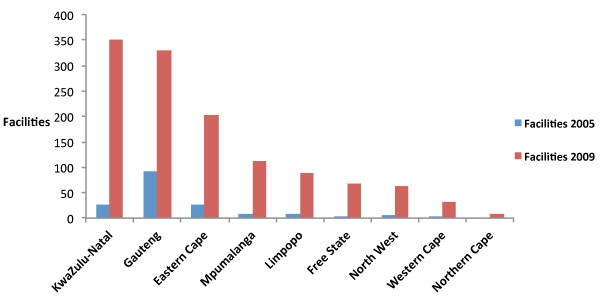
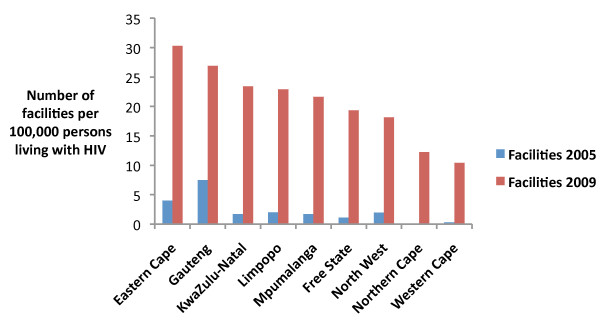
The number of PEPFAR-supported facilities providing ART increased from 184 facilities in 2005 to 1,469 facilities in 2009. From 2005-2009 the number of PEPFAR-supported government facilities increased 10.1 fold from 54 to 546 while the number of PEPFAR-supported NGO facilities (including general practitioner and NGO facilities) increased 6.2 fold from 114 to 708. In 2009 the total number of persons treated at PEPFAR-supported NGO facilities was 43,577 versus 501,089 persons at PEPFAR-supported government facilities. Overall, the median number of patients receiving ART per site increased from 81 in 2005 to 136 in 2009.
To mitigate the gap between those needing and those receiving ART, more facilities were supported. The proportion of government facilities supported and the median number of persons treated at these facilities increased. This shift could potentially be sustainable as government sites reach more individuals and receive government funding. These results demonstrate that PEPFAR was able to support a massive scale-up of ART services in a short period of time.
南非约有 150 万人需要接受抗逆转录病毒治疗(ART)。2004 年,南非政府开始与美国总统艾滋病紧急救援计划(PEPFAR)合作,以增加获得 ART 的机会。我们确定了 PEPFAR 治疗支持在 2005-2009 年间的变化情况。
为了描述 PEPFAR 支持的 ART 设施数量和类型的变化,我们分析了 2005-2009 年常规收集的项目监测数据。收集的数据包括设施的数量、类型和省份,以及每个设施接受 ART 的患者数量。
提供 ART 的 PEPFAR 支持设施数量从 2005 年的 184 个增加到 2009 年的 1469 个。2005-2009 年,PEPFAR 支持的政府设施数量增加了 10.1 倍,从 54 个增加到 546 个,而 PEPFAR 支持的非政府组织设施(包括全科医生和非政府组织设施)数量增加了 6.2 倍,从 114 个增加到 708 个。2009 年,在 PEPFAR 支持的非政府组织设施接受治疗的总人数为 43577 人,而在 PEPFAR 支持的政府设施接受治疗的人数为 501089 人。总体而言,每个站点接受 ART 的患者中位数从 2005 年的 81 人增加到 2009 年的 136 人。
为了缩小需要接受 ART 治疗的人和实际接受治疗的人之间的差距,支持了更多的设施。支持的政府设施的比例和这些设施治疗的人数中位数都有所增加。随着政府站点覆盖更多的人群并获得政府资金,这种转变可能是可持续的。这些结果表明,PEPFAR 能够在短时间内支持大规模扩大 ART 服务。