Department of Pharmaceutics and Pharmaceutical Chemistry, The University of Utah, 421 Wakara way, Suite 318, Salt Lake City, UT 84108, USA.
J Control Release. 2012 Jun 28;160(3):440-50. doi: 10.1016/j.jconrel.2012.02.024. Epub 2012 Mar 3.
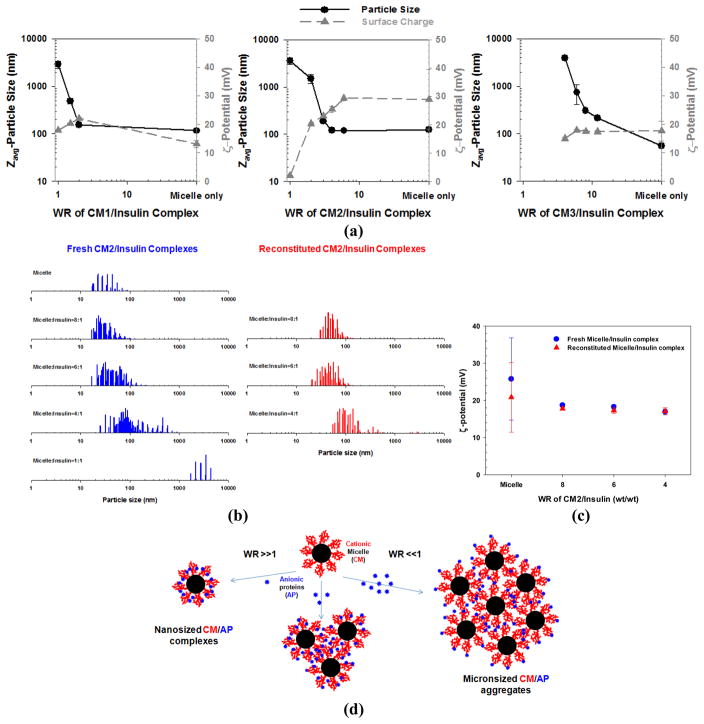
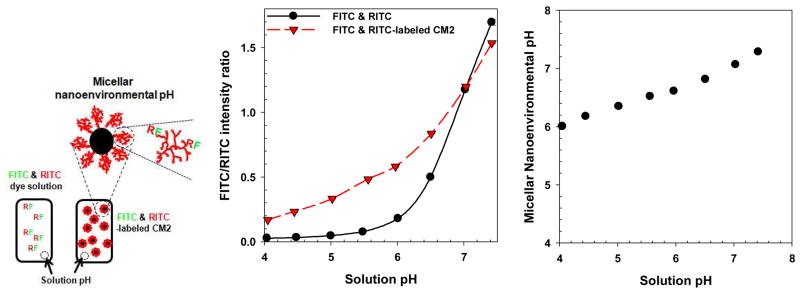
Poly(lactide-co-glycolide) (PLGA) has most often been employed for the controlled release of protein formulations because of its safety profile with non-toxic degradation products. Nevertheless, such formulations have been plagued by a local acidic microenvironment and protein-polymer interactions, which result in chemical and physical denaturation of loaded proteins and often unfavorable release profiles. This study investigated the pH change of inner PLGA microsphere (MS) using charged (PLGA)(n)-b-branched polyethyleneimine (bPEI) micelles. The designed micelles can be transformed into either micelle or reverse micelle (RM) depending on the solvent and RM can form microspheres. In addition, (PLGA)(n)-b-bPEI can be modified into (PLGA)(n)-b-(carboxylated bPEI) via carboxylation of the primary amines. Cationic micelle (CM) or anionic micelle (AM) was complexed with counter-charged proteins leading to nanosized particles (approximately 100nm). In the micelle/protein complexes, the micelles mostly maintained their proton buffering capacity, and consequently, prevented or delayed the typical decrease in pH caused by degradation of PLGA in aqueous solution. Reconstitutable micelle/protein complexes allowed for increased and fine-tuned protein loading (~20wt.% when using CM1 (CM prepared from PLGA(36kDa)-b-bPEI(25kDa))/insulin complexes) in PLGA MS. In CM2 (CM prepared from (PLGA(36kDa))(2)-b-bPEI(25kDa))/insulin (4 of weight ratio (WR) of micelle to protein; WR4)-loaded PLGA MS, CM2 strongly prevented the micellar nanoenvironmental pH (pH 6.6 within 5days and then approximately pH 8.5) to be acidified in PLGA MS for 9weeks, unlike CM2-free PLGA MS. In conclusion, our findings propose that the proton buffering capacity and protein loading in PLGA MS can be tuned by controlling the complexation ratios of micelles and proteins, polymeric architectures of (PLGA)(n)-b-bPEI copolymers and WR of micelle/protein complexes and PLGA (or RM).
聚(丙交酯-乙交酯)(PLGA)由于其毒性降解产物而具有安全特性,因此最常用于蛋白质制剂的控制释放。然而,此类制剂一直受到局部酸性微环境和蛋白质-聚合物相互作用的困扰,这导致负载蛋白质发生化学和物理变性,并且经常出现不理想的释放曲线。本研究使用带电荷的(PLGA)(n)-b-支化聚乙烯亚胺(bPEI)胶束研究了内 PLGA 微球(MS)的 pH 值变化。设计的胶束可以根据溶剂转换为胶束或反胶束(RM),并且 RM 可以形成微球。此外,(PLGA)(n)-b-bPEI 可以通过伯胺的羧化修饰成(PLGA)(n)-b-(羧基化 bPEI)。阳离子胶束(CM)或阴离子胶束(AM)与带相反电荷的蛋白质复合形成纳米颗粒(约 100nm)。在胶束/蛋白质复合物中,胶束大多保持其质子缓冲能力,从而防止或延迟了 PLGA 在水溶液中降解导致的典型 pH 值下降。可重构胶束/蛋白质复合物允许增加和精细调整蛋白质负载量(当使用 CM1(由 PLGA(36kDa)-b-bPEI(25kDa)制成的 CM)/胰岛素复合物时,约为 20wt.%)PLGA MS 中。在 CM2(由(PLGA(36kDa))(2)-b-bPEI(25kDa)制成的 CM)/胰岛素(4 重量比(WR)的胶束与蛋白质;WR4)-负载的 PLGA MS 中,CM2 强烈防止 CM2 自由的 PLGA MS 中在 9 周内微球纳米环境 pH 值(5 天内 pH 6.6,然后约 pH 8.5)酸化,与 CM2 自由的 PLGA MS 不同。总之,我们的研究结果表明,可以通过控制胶束和蛋白质的络合比、(PLGA)(n)-b-bPEI 共聚物的聚合结构以及胶束/蛋白质复合物和 PLGA(或 RM)的 WR 来调节 PLGA MS 中的质子缓冲能力和蛋白质负载量。