Pérez-De La Cruz Verónica, Carrillo-Mora Paul, Santamaría Abel
Laboratorio de Aminoácidos Excitadores, Instituto Nacional de Neurología y Neurocirugía, Mexico City, Mexico 14269.
Int J Tryptophan Res. 2012;5:1-8. doi: 10.4137/IJTR.S8158. Epub 2012 Feb 23.
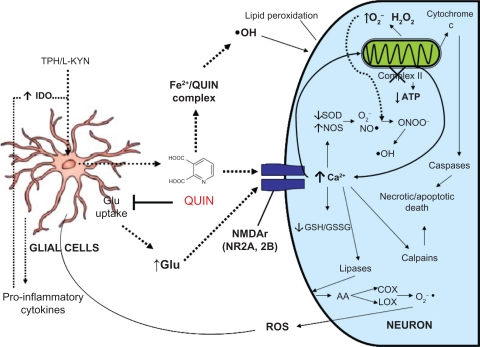
Quinolinic acid (QUIN), an endogenous metabolite of the kynurenine pathway, is involved in several neurological disorders, including Huntington's disease, Alzheimer's disease, schizophrenia, HIV associated dementia (HAD) etc. QUIN toxicity involves several mechanisms which trigger various metabolic pathways and transcription factors. The primary mechanism exerted by this excitotoxin in the central nervous system (CNS) has been largely related with the overactivation of N-methyl-D-aspartate receptors and increased cytosolic Ca(2+) concentrations, followed by mitochondrial dysfunction, cytochrome c release, ATP exhaustion, free radical formation and oxidative damage. As a result, this toxic pattern is responsible for selective loss of middle size striatal spiny GABAergic neurons and motor alterations in lesioned animals. This toxin has recently gained attention in biomedical research as, in addition to its proven excitotoxic profile, a considerable amount of evidence suggests that oxidative stress and energetic disturbances are major constituents of its toxic pattern in the CNS. Hence, this profile has changed our perception of how QUIN-related disorders combine different toxic mechanisms resulting in brain damage. This review will focus on the description and integration of recent evidence supporting old and suggesting new mechanisms to explain QUIN toxicity.
喹啉酸(QUIN)是犬尿氨酸途径的内源性代谢产物,与多种神经疾病有关,包括亨廷顿舞蹈症、阿尔茨海默病、精神分裂症、HIV相关痴呆(HAD)等。QUIN毒性涉及多种机制,这些机制会触发各种代谢途径和转录因子。这种兴奋性毒素在中枢神经系统(CNS)中发挥作用的主要机制很大程度上与N-甲基-D-天冬氨酸受体的过度激活以及胞质Ca(2+)浓度升高有关,随后会出现线粒体功能障碍、细胞色素c释放、ATP耗竭、自由基形成和氧化损伤。因此,这种毒性模式导致受损动物中中等大小的纹状体棘状GABA能神经元选择性丧失和运动改变。这种毒素最近在生物医学研究中受到关注,因为除了已证实的兴奋性毒性特征外,大量证据表明氧化应激和能量紊乱是其在中枢神经系统中毒性模式的主要组成部分。因此,这种特征改变了我们对与QUIN相关的疾病如何结合不同的毒性机制导致脑损伤的认识。本综述将重点描述和整合最近的证据,这些证据支持旧的并提出新的机制来解释QUIN毒性。