Department of Rheumatology, C1-R, Leiden University Medical Center, PO Box 9600, NL-2300 RC Leiden, The Netherlands.
Arthritis Res Ther. 2012 Mar 12;14(2):R57. doi: 10.1186/ar3770.
B-cell depletion has become a common treatment strategy in anti-TNF-refractory rheumatoid arthritis (RA). Although the exact mechanism of how B-cell depletion leads to clinical amelioration in RA remains to be elucidated, repetitive treatment with B-cell-depleting agents leading to long-term B-cell depletion has been reported to be beneficial. The latter has led to the hypothesis that the beneficial effects of B-cell depletion might act through their influence on pathogenic autoreactive plasma cells.
In this study, we investigated the effects of a fixed retreatment regimen with anti-CD20 mAbs on the humoral (auto)immune system in a cohort of therapy-refractory RA patients.
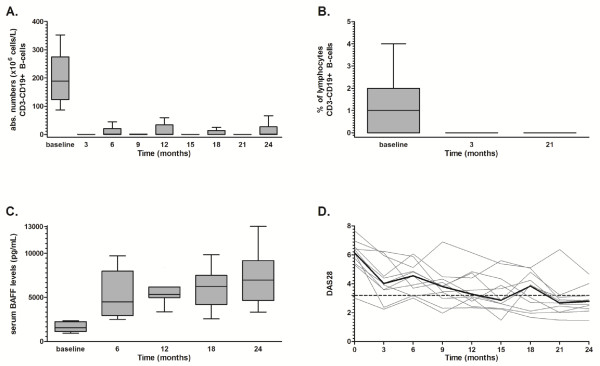
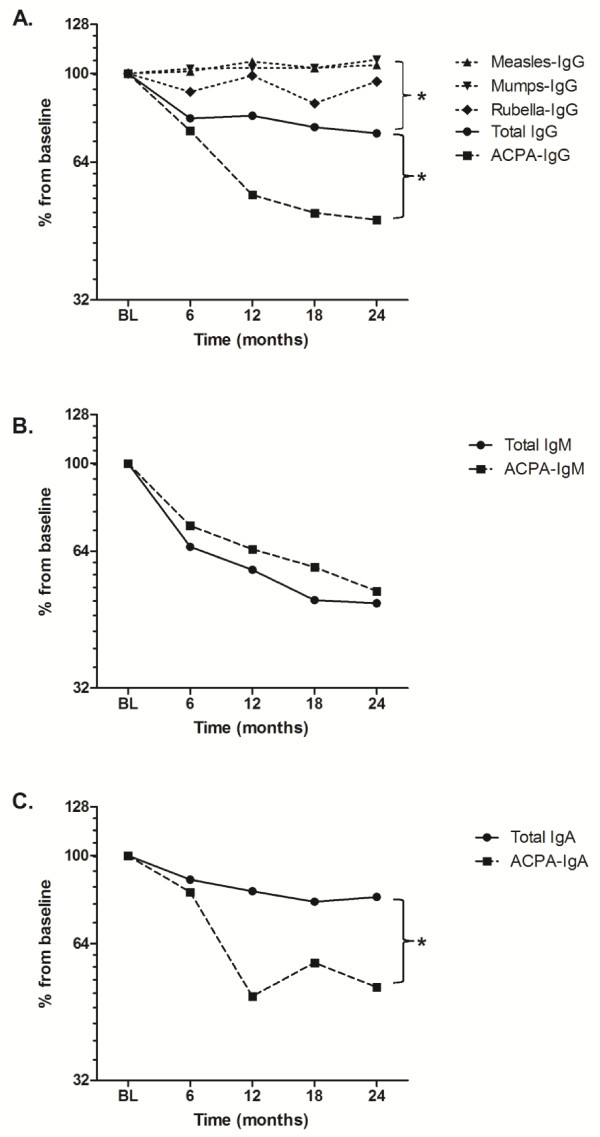
Fixed retreatment led to long-term B-cell depletion in peripheral blood, bone marrow and, to a lesser extent, synovium. Also, pathologic autoantibody secretion (that is, anticitrullinated peptide antibodies (ACPAs)) was more profoundly affected by long-term depletion than by physiological protective antibody secretion (that is, against measles, mumps and rubella). This was further illustrated by a significantly shorter estimated life span of ACPA-IgG secretion compared to total IgG secretion as well as protective antibody secretion.
By studying plasma cell function during an extensive 2-year period of B-cell depletion, autoantibody secretion was significantly shorter-lived than physiologically protective antibody secretion. This suggests that the longevity of autoreactive plasma cells is different from protective long-lived plasma cells and might indicate a therapeutic window for therapies that target plasma cells.
B 细胞耗竭已成为抗 TNF 难治性类风湿关节炎(RA)的常用治疗策略。尽管 B 细胞耗竭如何导致 RA 临床改善的确切机制仍有待阐明,但重复使用 B 细胞耗竭剂导致长期 B 细胞耗竭已被报道是有益的。后者导致了这样一种假设,即 B 细胞耗竭的有益效果可能通过其对致病性自身反应性浆细胞的影响而发挥作用。
在这项研究中,我们调查了在一组治疗抵抗的 RA 患者中,使用抗 CD20 mAbs 进行固定重复治疗对体液(自身)免疫系统的影响。
固定重复治疗导致外周血、骨髓和(在较小程度上)滑膜中的 B 细胞长期耗竭。此外,病理性自身抗体分泌(即抗瓜氨酸化肽抗体(ACPAs))比生理性保护性抗体分泌(即针对麻疹、腮腺炎和风疹的抗体)受长期耗竭的影响更大。这进一步说明了与总 IgG 分泌相比,ACPA-IgG 分泌的估计寿命显著缩短,以及保护性抗体分泌。
通过在广泛的 2 年 B 细胞耗竭期间研究浆细胞功能,自身抗体分泌的寿命明显短于生理性保护性抗体分泌。这表明自身反应性浆细胞的寿命与保护性长寿浆细胞不同,并且可能表明针对浆细胞的治疗的治疗窗口。