Capone Ricardo, Jang Hyunbum, Kotler Samuel A, Connelly Laura, Teran Arce Fernando, Ramachandran Srinivasan, Kagan Bruce L, Nussinov Ruth, Lal Ratnesh
J Chem Theory Comput. 2012 Mar 13;8(3):1143-1152. doi: 10.1021/ct200885r. Epub 2012 Feb 3.
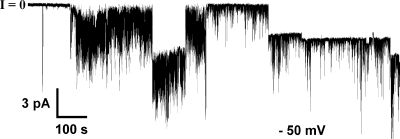
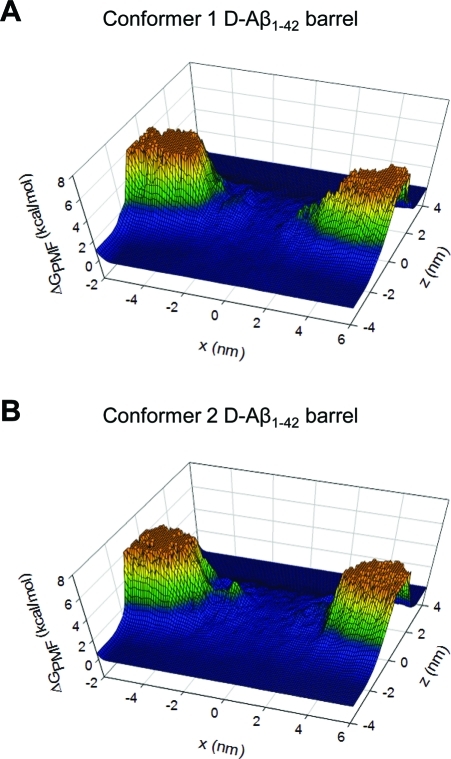
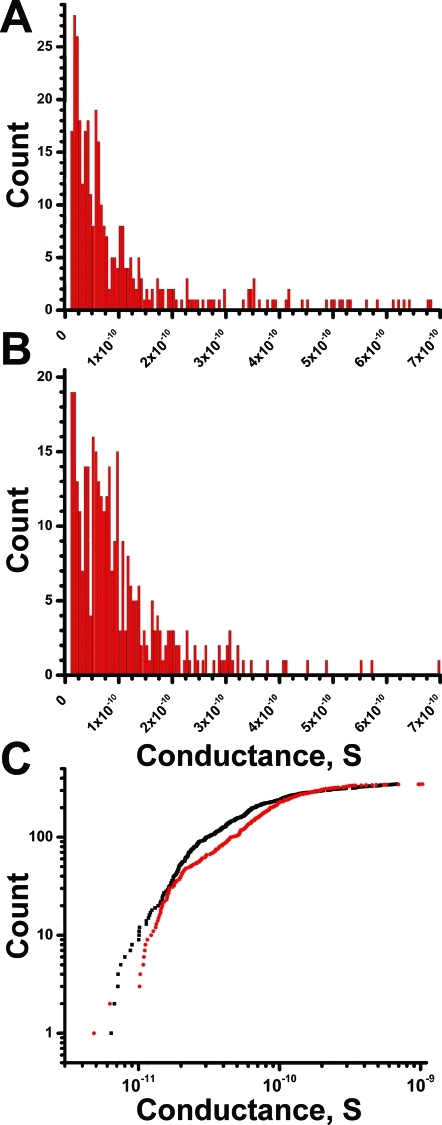
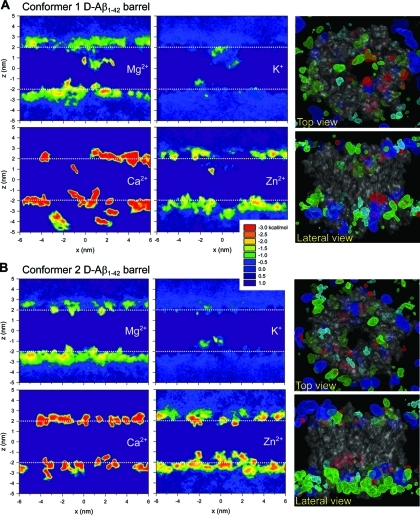
Alzheimer's disease (AD) is the most common type of senile dementia in aging populations. Amyloid β (Aβ)-mediated dysregulation of ionic homeostasis is the prevailing underlying mechanism leading to synaptic degeneration and neuronal death. Aβ-dependent ionic dysregulation most likely occurs either directly via unregulated ionic transport through the membrane or indirectly via Aβ binding to cell membrane receptors and subsequent opening of existing ion channels or transporters. Receptor binding is expected to involve a high degree of stereospecificity. Here, we investigated whether an Aβ peptide enantiomer, whose entire sequence consists of d-amino acids, can form ion-conducting channels; these channels can directly mediate Aβ effects even in the absence of receptor-peptide interactions. Using complementary approaches of planar lipid bilayer (PLB) electrophysiological recordings and molecular dynamics (MD) simulations, we show that the d-Aβ isomer exhibits ion conductance behavior in the bilayer indistinguishable from that described earlier for the l-Aβ isomer. The d isomer forms channel-like pores with heterogeneous ionic conductance similar to the l-Aβ isomer channels, and the d-isomer channel conductance is blocked by Zn(2+), a known blocker of l-Aβ isomer channels. MD simulations further verify formation of β-barrel-like Aβ channels with d- and l-isomers, illustrating that both d- and l-Aβ barrels can conduct cations. The calculated values of the single-channel conductance are approximately in the range of the experimental values. These findings are in agreement with amyloids forming Ca(2+) leaking, unregulated channels in AD, and suggest that Aβ toxicity is mediated through a receptor-independent, nonstereoselective mechanism.
阿尔茨海默病(AD)是老年人群中最常见的一种老年性痴呆。淀粉样β蛋白(Aβ)介导的离子稳态失调是导致突触退化和神经元死亡的主要潜在机制。Aβ依赖性离子失调很可能直接通过膜上不受调控的离子转运发生,或者间接通过Aβ与细胞膜受体结合以及随后现有离子通道或转运体的开放发生。预计受体结合涉及高度的立体特异性。在此,我们研究了一种其整个序列由d - 氨基酸组成的Aβ肽对映体是否能形成离子传导通道;即使在没有受体 - 肽相互作用的情况下,这些通道也能直接介导Aβ的作用。使用平面脂质双层(PLB)电生理记录和分子动力学(MD)模拟的互补方法,我们表明d - Aβ异构体在双层中表现出与先前描述的l - Aβ异构体无法区分的离子传导行为。d异构体形成具有异质离子传导的通道样孔,类似于l - Aβ异构体通道,并且d异构体通道传导被Zn(2+)阻断,Zn(2+)是已知的l - Aβ异构体通道阻断剂。MD模拟进一步验证了d - 和l - 异构体的β桶状Aβ通道的形成,表明d - 和l - Aβ桶状结构都可以传导阳离子。单通道传导率的计算值大致在实验值范围内。这些发现与淀粉样蛋白在AD中形成Ca(2+)泄漏、不受调控的通道一致,并表明Aβ毒性是通过一种不依赖受体的、非立体选择性机制介导的。