Epilepsy Society MRI Unit, Epilepsy Society, Chalfont St Peter, Buckinghamshire, UK.
Epilepsia. 2012 Apr;53(4):639-50. doi: 10.1111/j.1528-1167.2012.03433.x. Epub 2012 Mar 16.
Anterior temporal lobe resection (ATLR) controls seizures in up to 70% of patients with intractable temporal lobe epilepsy (TLE) but, in the language dominant hemisphere, may impair language function, particularly naming. Functional reorganization can occur within the ipsilateral and contralateral hemispheres. We investigated reorganization of language in left-hemisphere-dominant patients before and after ATLR; whether preoperative functional magnetic resonance imaging (fMRI) predicts postoperative naming decline; and efficiency of postoperative language networks.
We studied 44 patients with TLE due to unilateral hippocampal sclerosis (24 left) on a 3T GE-MRI scanner. All subjects performed language fMRI and neuropsychological testing preoperatively and again 4 months after left or right ATLR.
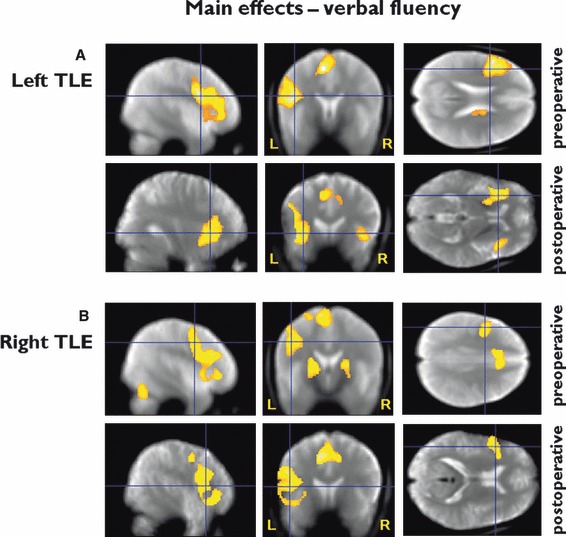
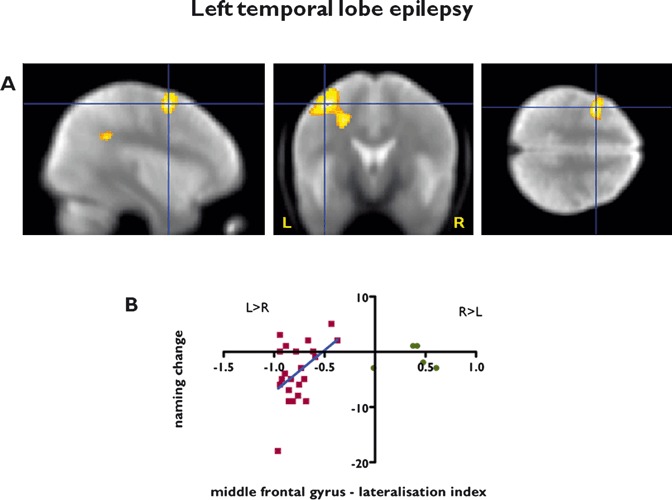
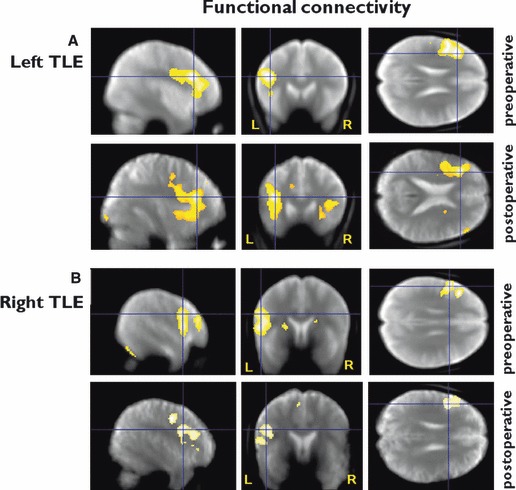
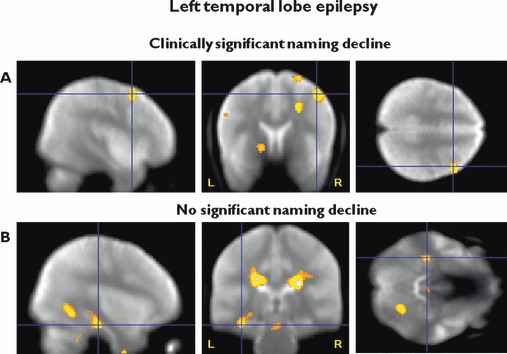
Postoperatively, individuals with left TLE had greater bilateral middle/inferior frontal fMRI activation and stronger functional connectivity from the left inferior/middle frontal gyri to the contralateral frontal lobe than preoperatively, and this was not observed in individuals with right TLE. Preoperatively, in left and right TLE, better naming correlated with greater preoperative left hippocampal and left frontal activation for verbal fluency (VF). In left TLE, stronger preoperative left middle frontal activation for VF was predictive of greater decline in naming after ATLR. Postoperatively, in left TLE with clinically significant naming decline, greater right middle frontal VF activation correlated with better postoperative naming. In patients without postoperative naming decline, better naming correlated with greater activation in the remaining left posterior hippocampus. In right TLE, naming ability correlated with left hippocampal and left and right frontal VF activation postoperatively.
In left TLE, early postoperative reorganization to the contralateral frontal lobe suggests multiple systems support language function. Postoperatively, ipsilateral recruitment involving the posterior hippocampal remnant is important for maintaining language, and reorganization to the contralateral hemisphere is less effective. Preoperative left middle frontal activation for VF was predictive of naming decline in left TLE after ATLR.
前颞叶切除术(ATLR)可使 70%的耐药性颞叶癫痫(TLE)患者的癫痫发作得到控制,但在语言优势半球中,可能会损害语言功能,特别是命名功能。功能重组可能发生在同侧和对侧半球。我们研究了左半球优势患者在 ATLR 前后的语言重组情况;术前功能磁共振成像(fMRI)是否能预测术后命名能力下降;以及术后语言网络的效率。
我们在 3T GE-MRI 扫描仪上研究了 44 例单侧海马硬化(24 例左侧)所致 TLE 患者。所有患者均在术前和左或右 ATLR 后 4 个月进行语言 fMRI 和神经心理学测试。
术后,左 TLE 患者双侧中下额回 fMRI 激活增强,左中下额回与对侧额叶的功能连接增强,而右 TLE 患者则无此现象。术前,左、右 TLE 患者的命名能力与术前左海马和左额叶言语流畅性(VF)的激活呈正相关。在左 TLE 中,术前左额中回 VF 激活越强,术后 ATLR 后命名能力下降越大。术后,左 TLE 患者出现明显命名能力下降时,右侧额中回 VF 激活越强,术后命名能力越好。在无术后命名能力下降的患者中,命名能力与剩余左侧后海马的激活呈正相关。在右 TLE 中,术后命名能力与左海马和左、右额叶 VF 激活相关。
在左 TLE 中,术后早期对侧额叶的重组提示有多种系统支持语言功能。术后,涉及后海马残余物的同侧募集对于维持语言功能很重要,而对侧半球的重组效果较差。术前左额中回 VF 激活预测左 TLE 患者 ATLR 后命名能力下降。